
Real Sociedad's Tactical Paradox in 3-4 Defeat to Valencia
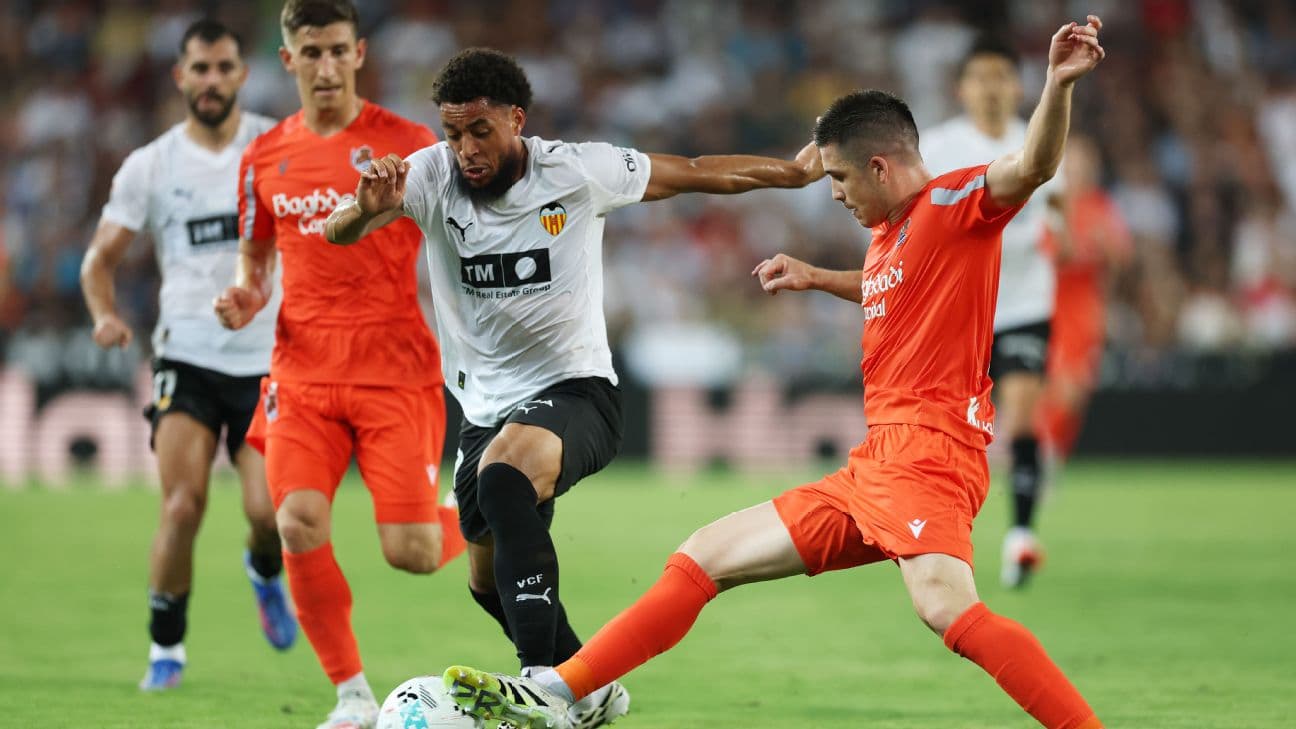
Real Sociedad’s 3-4 home defeat to Valencia at Reale Arena unfolded as a tactical paradox: territorial control and structural initiative from the hosts, but superior efficiency and late-game management from the visitors. Across 90 minutes, Pellegrino Matarazzo’s 4-2-3-1 generated more possession (55%), more passes (491 vs 412) and a clearer territorial footprint, yet Carlos Corberan’s 4-4-2 exploited key transition moments and late structural tweaks to tilt a volatile match their way.
I. Scoring Sequence and Disciplinary Log
Scoring sequence and disciplinary log were central to the tactical story. Real Sociedad struck first on 3', when left-back Aihen Munoz advanced aggressively from the back four to finish, assisted by right-back Aritz Elustondo. This early full-back-to-full-back connection underlined Matarazzo’s intent to attack with width from deep. Valencia hit back quickly on 8': Javi Guerra, operating as a second forward from the 4-4-2, converted after a pass from Diego Lopez, a typical pattern of a midfielder breaking the line to feed a mobile attacker arriving between Sociedad’s centre-backs and pivots.
On 22', Hugo Duro completed Valencia’s early turnaround, finishing a move assisted by Eray Cömert. The centre-back’s involvement as provider hinted at Valencia’s willingness to bypass midfield and use direct balls into the front line, with Duro pinning the defence. At 25', Arsen Zakharyan received a Yellow Card for “Foul”, an early sign of Sociedad’s difficulty controlling Valencia’s transition runs between the lines.
Matarazzo reacted with a triple substitution on 57': Luka Sucic (IN) came on for Brais Mendez (OUT), Mikel Oyarzabal (IN) came on for Arsen Zakharyan (OUT), and Santi Gomez (IN) came on for Aihen Munoz (OUT). These changes recalibrated the attacking structure, adding a more natural wide threat and a creative central presence. The impact was immediate. On 60', an Own Goal by Cristhian Tarrega brought Real Sociedad level; the pressure generated by Sociedad’s renewed width and crossing forced a defensive mistake. Three minutes later, on 63', Oscar Oskarsson finished a move assisted by Mikel Oyarzabal, capitalising on Valencia’s disorganisation after the equaliser and underlining the value of Oyarzabal’s introduction between the lines.
The match’s disciplinary and numerical balance shifted on 70', when Eray Cömert received a Red Card for “Professional foul last man”. This forced Corberan to reconstruct his defensive line and defensive block under numerical inferiority. Valencia responded with a substitution wave focused on fresh legs and compactness: at 73', Umar Sadiq (IN) came on for Hugo Duro (OUT) and T. Rendall (IN) came on for Filip Ugrinic (OUT), adding aerial presence up front and defensive reliability at the back. At 74', Pepelu (IN) came on for Diego Lopez (OUT) and Largie Ramazani (IN) came on for Luis Rioja (OUT), shifting the midfield profile towards more control and counter-potential.
Real Sociedad continued to adjust: at 79', Goncalo Guedes (IN) came on for Oscar Oskarsson (OUT), adding direct pace against a tiring, ten-man Valencia back line. On 83', Andre Almeida (IN) came on for Unai Nunez (OUT), and on 84' Jon Aramburu (IN) came on for Aritz Elustondo (OUT), further reshaping both sides’ back lines for the closing phase.
The hosts’ late-game defensive discipline collapsed under transition pressure. Three more Yellow Cards, all for “Foul”, reflected their reactive defending against Valencia’s late counters: Beñat Turrientes on 86', Jon Martin on 88', and Igor Zubeldia also on 88'. With the score at 3-2 to Real Sociedad after their second-half surge, Valencia’s structural resilience and transition quality produced a dramatic turnaround. On 89', Guido Rodriguez scored, assisted by Andre Almeida, a move born from a quick progression through midfield despite being a man down. Then on 90', Javi Guerra struck again, assisted by T. Rendall, sealing a 3-4 away win that punished Sociedad’s high-risk approach and late-game disorganisation.
II. Tactical Analysis
Tactically, Real Sociedad’s 4-2-3-1 was built on controlled possession and full-back aggression. Their 55% ball possession, 491 passes, and 410 accurate passes (84%) show a side comfortable circulating from the back, with Munoz and Elustondo stepping high and the double pivot of Beñat Turrientes and Carlos Soler tasked with both initiation and rest-defence. Seven of their eight shots came from inside the box, indicating that the structure did succeed in creating high-value zones, even if the final xG of 1.14 suggests the chances were not consistently elite.
The downside was defensive exposure. With both full-backs advancing and the attacking midfield trio pushing high, Real Sociedad’s rest-defence often reduced to the centre-backs plus one pivot, vulnerable to Valencia’s direct passes and second balls. This was visible on Valencia’s early goals and again in the closing minutes, when a tiring back line, already carrying three late Yellow Cards for “Foul”, struggled to track Guerra’s and Rodriguez’s runs from deep.
In goal, Alex Remiro made 2 saves, but the goals prevented metric of -1.37 underlines a below-par shot-stopping performance relative to the quality of chances faced. Valencia converted 6 shots on goal from 13 total attempts, with 9 inside the box, and their xG of 1.61 contrasted sharply with the four goals scored, pointing to both clinical finishing and goalkeeper underperformance.
Valencia’s 4-4-2 was more vertical and pragmatic. With 45% ball possession and 412 passes (321 accurate, 78%), they accepted long spells without the ball, relying on a compact mid-block and quick releases into the front two. The wide midfielders, Rioja and Lopez initially, were crucial in compressing space centrally and then sprinting forward in support of Duro and Guerra. After the Red Card to Cömert, Corberan’s substitutions rebalanced the shape, with Pepelu and Almeida giving more control and defensive intelligence, while Sadiq and later Ramazani offered out-balls to relieve pressure and threaten on the counter.
S. Dimitrievski in the Valencia goal made only 1 save, yet also posted a goals prevented of -1.37, reflecting that Real Sociedad’s three goals broadly matched the quality of chances created. The key difference lay not in sheer volume of chances but in Valencia’s ability to extract maximum value from their attacks, particularly in late-game transitions against a stretched, increasingly desperate home side.
III. Statistical Overview
Statistically, the match confirms a clear pattern: structural dominance does not guarantee control of outcomes. Real Sociedad’s superior possession, passing accuracy, and box presence aligned with a proactive game model, but their defensive index was undermined by poor shot-stopping and fragile rest-defence. Four Yellow Cards (all for “Foul”) point to repeated emergency interventions rather than controlled pressing.
Valencia, with fewer passes and less of the ball, nonetheless produced more total shots (13 vs 8), more shots on goal (6 vs 3), and more shots inside the box (9 vs 7). Their single Red Card for “Professional foul last man” to Cömert was costly in terms of numerical balance but did not prevent them from winning the transition battle late on. The xG split (1.14 vs 1.61) and the 3-4 scoreline underline a match where the away side’s attacking efficiency and tactical adaptability outweighed the home side’s territorial command, delivering a high-variance but deserved away victory in a chaotic tactical contest.
Related News

LaLiga 2026-27 Season Schedule Released: Kickoff on August 15, Clásico on October 25

Atletico Madrid vs Real Madrid: Head-to-head Stats and Past Meetings
Real Madrid Dominates Rayo Vallecano in La Liga Clash

Atletico Madrid Dominates Real Sociedad 3-0 at Reale Arena
Barcelona Dominates Levante in High-Scoring Clash

Sevilla vs Barcelona Stats: Head-to-Head Record and Past Meetings