
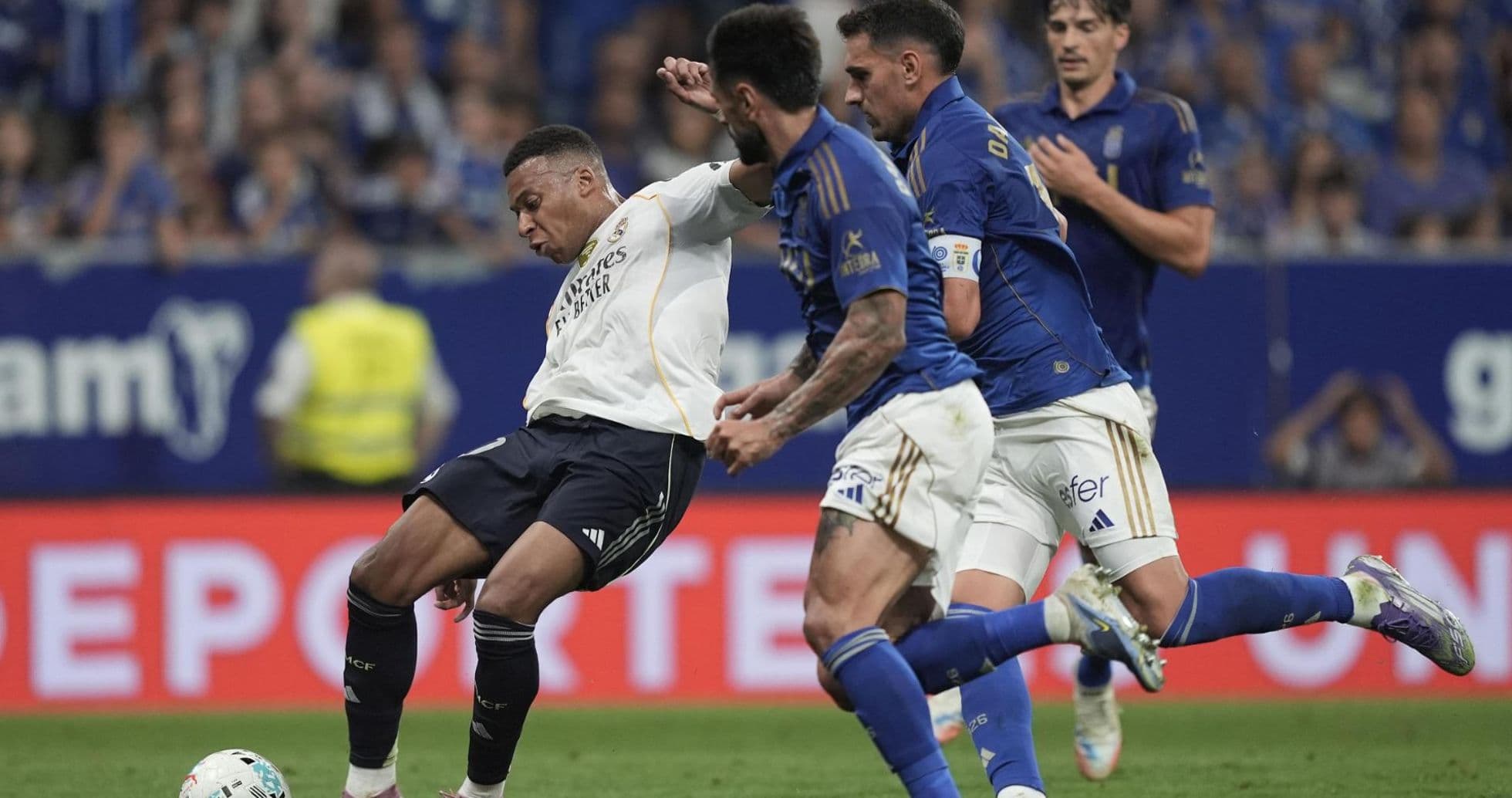
Real Madrid Dominates Oviedo in Tactical 2-0 Victory
Real Madrid’s 2-0 win over Oviedo at Estadio Santiago Bernabéu was a controlled, system-driven performance built on territorial dominance and clean structure rather than sheer volume of chances. In a La Liga match where Real Madrid held 65% possession and completed 616 passes to Oviedo’s 325, Alvaro Arbeloa’s 4-4-2 established positional superiority across all lines, while Guillermo Almada Alves Jorge’s 4-3-3 sought to compress space and counter through the front three. The final xG split of 1.46 to 1.03 underlines that the scoreline reflected efficiency in key moments more than overwhelming shot quality.
I. Executive Summary
Real Madrid’s shape was the story from the outset. With a 4-4-2, they built patiently through Thibaut Courtois and a technically secure back four, using the double pivot to both screen and circulate. Oviedo’s 4-3-3 pressed in phases but mostly retreated into a compact mid-block, accepting long stretches without the ball. The match’s turning points came late in each half: first through G. Garcia just before the interval, then via J. Bellingham after the hour mark and following a series of substitutions that refreshed Madrid’s attacking structure. Oviedo’s limited shot volume (nine total, only one on target) showed how effectively Madrid locked down central zones.
II. Scoring Sequence & Disciplinary Log
There were no cards shown in this match; the events log contains no yellow or red cards for either side, aligning with the statistics where both “Yellow Cards” and “Red Cards” are null for Real Madrid and Oviedo. That absence of disciplinary action matches the relatively low foul count from Madrid (7) against a more aggressive but still controlled 14 from Oviedo.
The first major tactical reward for Madrid’s dominance arrived at 44'. G. Garcia (Real Madrid) scored a Normal Goal, assisted by B. Diaz. The timing is critical: it crowned a half in which Madrid had pinned Oviedo deep, using their wide midfielders and overlapping full-backs to stretch the 4-3-3. Diaz’s involvement from the right half-space was consistent with his role as a line-breaker between Oviedo’s midfield and defence.
The second decisive moment came at 80'. J. Bellingham (Real Madrid) added the 2-0, again a Normal Goal, this time assisted by K. Mbappe. By this stage, Madrid had reconfigured their attacking line through substitutions, and Mbappe’s introduction gave them a more vertical threat. His assist to Bellingham reflected a late-game pattern: exploiting tired Oviedo legs by running at the back line from wider and deeper starting positions.
With no cards to record, the disciplinary log is clean:
- Real Madrid: 0 yellow cards, 0 red cards
- Oviedo: 0 yellow cards, 0 red cards
- Total cards: 0
III. Tactical Breakdown & Personnel
Arbeloa’s 4-4-2 was built on structural security. Courtois, with 1 save and 0.16 goals prevented, had a quiet but concentrated night; Oviedo’s xG of 1.03 suggests they reached a few promising situations, but only one effort truly tested him. The back four of T. Alexander-Arnold, R. Asencio, D. Alaba and A. Carreras benefited from Madrid’s territorial control: Oviedo managed just 9 shots, with only 2 from outside the box and 7 inside, but without consistent access to central finishing zones.
The double pivot of E. Camavinga and A. Tchouameni anchored Madrid’s game. Their presence enabled the team to push full-backs high and keep the wide midfielders – F. Mastantuono and B. Diaz – advanced between lines. Madrid’s 616 passes, 570 accurate (93%), show a high-possession, low-risk circulation model, with the centre-backs and pivots recycling play until a lane opened toward Diaz, Vinicius Junior or G. Garcia.
In attack, the starting partnership of G. Garcia and Vinicius Junior was complementary: Garcia occupying central defenders and attacking the box, Vinicius providing width and dribbling threat. The 44' goal encapsulated this: Diaz in the right half-space, Garcia finishing from a central position after sustained pressure. That goal effectively reshaped the game state; Oviedo, who had been content in a mid-block, now needed to push higher.
Oviedo’s 4-3-3, with A. Escandell in goal, N. Vidal and R. Alhassane as full-backs, and E. Bailly and D. Costas centrally, defended deep for long spells. Escandell made 5 saves and posted 0.16 goals prevented, which, given Madrid’s 7 shots on target and 19 total shots, indicates he did enough to keep the scoreline respectable. The midfield trio of N. Fonseca, S. Colombatto and A. Reina was tasked with shuttling laterally to close Madrid’s passing lanes; however, Madrid’s superior passing accuracy and numbers often created overloads on the flanks.
Oviedo’s front three – I. Chaira, F. Vinas, T. Fernandez – had to live off transitions. With only 35% possession and 325 passes (275 accurate, 85%), they were largely reactive. Their best moments came when Madrid’s full-backs were high and Oviedo could break into the spaces behind, but Madrid’s centre-backs and pivots generally controlled those situations, forcing Oviedo’s shots into low-quality angles.
Substitutions were used by both coaches to adjust the tactical script. At 54', I. Chaira (OUT) made way for S. Cazorla (IN) for Oviedo, shifting some creative responsibility deeper. For Madrid, at 64' T. Alexander-Arnold (OUT) was replaced by D. Carvajal (IN), and A. Tchouameni (OUT) by J. Bellingham (IN), injecting fresh legs and an extra runner from midfield. The 69' changes – G. Garcia (OUT) for K. Mbappe (IN) and T. Fernandez (OUT) for H. Hassan (IN) – redefined the front lines for both sides. Later, at 77', B. Diaz (OUT) for C. Palacios (IN) and F. Mastantuono (OUT) for D. Yanez (IN) allowed Madrid to maintain intensity in wide areas. Oviedo’s late double change at 79' – N. Vidal (OUT) for L. Ahijado (IN) and N. Fonseca (OUT) for P. Agudin (IN) – freshened the flanks but did not fundamentally alter the balance.
The second goal at 80' was the logical product of these tweaks: Mbappe’s verticality from the bench created the assist lane, and Bellingham’s late runs into the box added a new problem Oviedo had not faced in the first hour.
IV. The Statistical Verdict
The numbers corroborate the tactical story. Real Madrid’s 65% possession and 616 passes, 570 accurate (93%), underline a methodical control of the match. Their 19 total shots, 7 on target, and xG of 1.46 show a steady stream of chances rather than a barrage of high-value opportunities. Oviedo, with 35% possession and 325 passes, 275 accurate (85%), were structurally sound enough to avoid collapse, but their 9 shots (only 1 on target) and xG of 1.03 reveal a side reliant on half-chances and isolated transitions.
Defensively, Madrid’s low foul count (7) and absence of cards suggest a controlled aggression, with good positioning reducing the need for last-ditch interventions. Oviedo’s 14 fouls without cards point to a more disruptive approach, trying to break Madrid’s rhythm without crossing the disciplinary line. Goalkeeper metrics are consistent: Courtois’s 1 save and 0.16 goals prevented reflect a largely protected goal, while Escandell’s 5 saves and identical 0.16 goals prevented highlight his role in keeping the margin to two. Overall, the 2-0 scoreline, the xG differential, and the possession figures align: Madrid’s structural superiority and bench quality translated into a professional, tactically coherent home win.
Related News

LaLiga 2026-27 Season Schedule Released: Kickoff on August 15, Clásico on October 25
Atletico Madrid vs Real Madrid: Head-to-head Stats and Past Meetings
Real Madrid Dominates Rayo Vallecano in La Liga Clash
Atletico Madrid Dominates Real Sociedad 3-0 at Reale Arena
Barcelona Dominates Levante in High-Scoring Clash

Sevilla vs Barcelona Stats: Head-to-Head Record and Past Meetings