
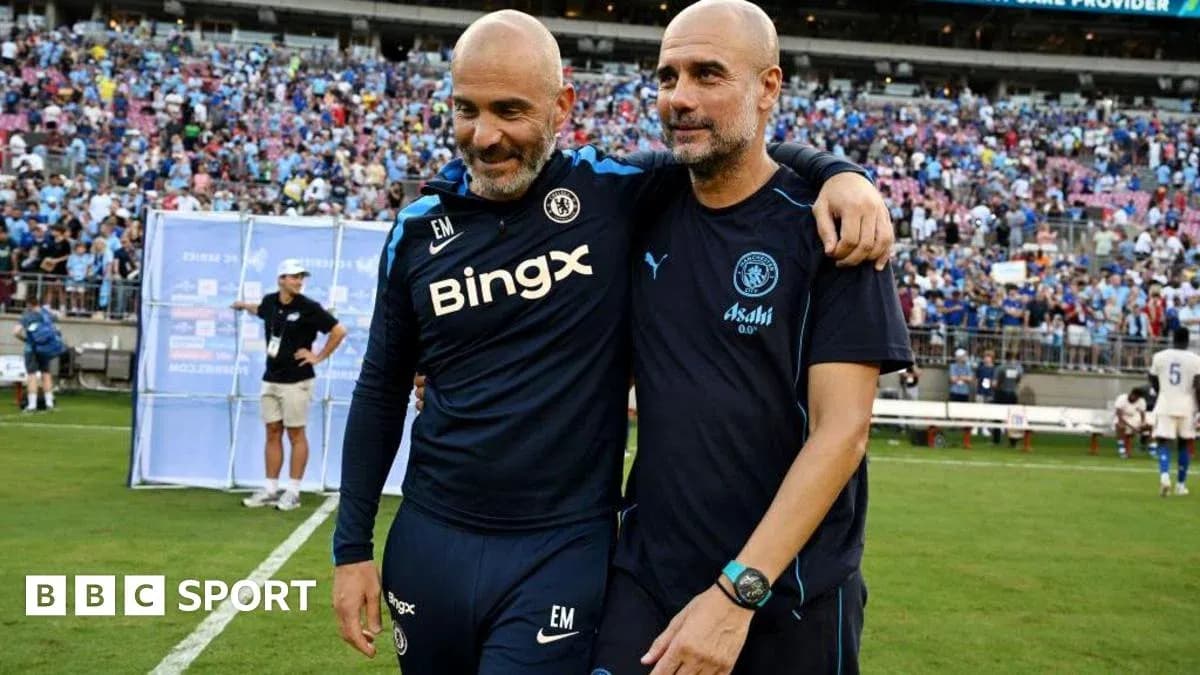
Pep Guardiola's Tactical Revolution in the Premier League
When the next generation of Premier League managers are asked who shaped their footballing ideas, most roads will lead back to the same figure in the dugout: Pep Guardiola.
His time at Manchester City has not just built a dynasty; it has rewritten the league’s tactical language. From the way goalkeepers receive the ball to how full-backs stand when the centre-backs are in possession, Guardiola’s fingerprints are everywhere. And the most striking part? Much of it emerged not from a grand, decade-long blueprint, but from a coach constantly solving problems with whatever pieces he had left on the board.
The Goalkeeper Revolution – And the Twist in the Tale
One of Guardiola’s first calls at City was brutal and symbolic. Joe Hart, a terrace favourite and England’s No 1, was out. Claudio Bravo was in. Later, Ederson followed.
The message was blunt: the goalkeeper would no longer just save shots; he would start attacks.
At the time, it jarred with Premier League convention. The league was still rooted in the idea of the keeper as a pure shot-stopper. Guardiola ripped that up. He wanted someone who could receive the ball under pressure, split the press, and turn goal-kicks into passing patterns.
He was mocked for it early on. Mistakes were magnified, pundits scoffed, fans bristled. Yet within a few seasons, the rest of the league had quietly fallen in line.
By the early 2020s, the old-school keeper was an endangered species. Manchester United moved from David de Gea to Andre Onana. Arsenal swapped Aaron Ramsdale for David Raya. Chelsea cycled from Edouard Mendy to Kepa Arrizabalaga to Robert Sanchez. Suddenly, the controversial stance was not insisting on a ball-playing goalkeeper, but daring to suggest you could win without one.
Then the league evolved again.
As high, man-to-man pressing from goal-kicks became more aggressive, the risks of endless short build-up grew. Opponents squeezed the box, hunted in packs, and forced errors. Space migrated away from the six-yard box and into the middle and final thirds.
Guardiola, the man who had helped create the trend, started to bend it.
Ederson, the archetype of the modern passing keeper, gave way to Gianluigi Donnarumma at City. Donnarumma is not the same kind of playmaker with his feet, but his one-on-one goalkeeping had been central to Paris St-Germain’s Champions League triumph. Guardiola judged that in the tightest matches, that edge was worth a shift in style.
City did not completely abandon their short build-up. Against pressing teams, Bernardo Silva and Rodri often dropped deep, almost on to the goalkeeper’s toes, to receive the ball. At times it resembled a high-level five-a-side game, midfielders spinning away from markers in the shadows of their own goal.
Yet the recalibration was clear. The value of an elite shot-stopper had risen again. United’s decision to replace Onana with Senne Lammens, a more traditional keeper, underlined the sense of a full-circle moment. The league that had raced to copy Guardiola’s passing keepers was now quietly reassessing, just as he did.
The Birth of the Inverted Full-Back – and Its Many Lives
City’s 100-point season in 2017-18 is often remembered for its swagger. What gets overlooked is how much of that swagger came from a tactical workaround born out of necessity.
Early in that campaign, injuries stripped Guardiola of natural full-backs. With no obvious left-back, he scanned his squad for left-footers who could do a job. Oleksandr Zinchenko and Fabian Delph were not orthodox defenders, but they were technically secure and comfortable drifting inside.
So he flipped the role.
Instead of hugging the touchline, the left-back moved infield, sliding alongside the defensive midfielder. That single adjustment tightened City’s grip on the centre of the pitch, sharpened their build-up, and freed the winger to stay wide and stretch the game.
Opponents struggled to cope. The extra man in midfield overloaded their pressing triggers. The left-back, now operating in central pockets, helped City circulate the ball and suffocate teams.
The idea spread quickly. When Mikel Arteta took Zinchenko to Arsenal, he imported the concept wholesale. Arsenal’s most fluid football under him has often come with inverted full-backs stepping into midfield, turning a back four into something far more complex with the ball.
Ange Postecoglou, another admirer of Guardiola’s work, used a similar structure at Tottenham. Pedro Porro and Destiny Udogie frequently tucked in next to the holding midfielder, forming a narrow three in build-up and then sprinting out to defend wide spaces when possession was lost.
Guardiola kept reshaping the role. When Zinchenko was injured in 2018-19, Aymeric Laporte, a left-footed centre-back, played at left-back. It looked awkward on paper. On the pitch, it gave City a back line of centre-backs who could all defend one-on-one and dominate aerially, while still building with precision.
By the Treble-winning season of 2022-23, the idea had been pushed even further. Manuel Akanji and Nathan Ake were deployed as nominal full-backs either side of Ruben Dias and John Stones. Stones often stepped into midfield, turning City’s shape into a kind of morphing 3-2 or 2-3 structure depending on the phase of play.
That opened a new door: using centre-backs wide to reinforce the defence without losing the ball-playing base.
Newcastle’s use of 6ft 7in Dan Burn at left-back is an echo of that. On the ball, he slides inside to form a back three. Out of possession, he shuffles out to defend the flank. It is a role that would have looked bizarre a decade ago; now it fits neatly into a tactical lineage that runs back to Guardiola.
At the other end of the spectrum, he has also leaned into ultra-attacking full-backs. Joao Cancelo’s role became a template: nominally a full-back, but drifting centrally and higher up, arriving in the box, threading passes, shooting from the edge. Nico O’Reilly has followed a similar path, stepping into advanced spaces to influence the final third.
Arteta’s use of Jurrien Timber and Riccardo Calafiori at Arsenal, and Enzo Maresca’s deployment of Malo Gusto and Marc Cucurella at Chelsea, belong to the same school. Full-backs as playmakers. Full-backs as auxiliary midfielders. Full-backs as surprise forwards.
The position has never been the same.
Possession as a Weapon, Not a Comfort Blanket
Guardiola’s fixation with the ball predates his time in England. At Barcelona, after a bruising Champions League tie against Inter Milan in which he used Zlatan Ibrahimovic and played more directly, he privately felt he had betrayed his own ideas. He vowed that if he was going to lose, he would at least do it on his terms.
At City, he has stuck to that promise.
The inverted full-backs, the technical defenders, the midfielders who can receive under pressure from every angle – all of it feeds one central aim: dominate the ball, and by extension, the game.
In 2017-18, City averaged 71.9% possession in the league. That is a staggering number over a full season. Since then, they have never dipped below 60%. Six titles in seven seasons turned high-possession, positional football from a curiosity into the standard for aspiring contenders.
The ripple effect has been stark.
Liverpool under Arne Slot, in his first season, leaned closer to those principles than to Jurgen Klopp’s helter-skelter, heavy-metal template. The tempo remained high, but the emphasis on control and structured build-up grew.
Arteta’s Arsenal, while lauded for their defensive solidity this season, also look to keep the ball for long spells. Their clean sheets are not just about blocks and tackles; they come from starving opponents of the ball.
Brighton have built a sustainable model by hiring coaches who want to impose themselves through possession. Roberto De Zerbi and Fabian Hürzeler both embraced the idea that the ball is the best form of protection, using it to drag opponents around and create overloads rather than simply defend deep.
Others tried to walk the same path, with less success. Scott Parker, Vincent Kompany and Russell Martin all clung to a possession-heavy approach in the Premier League. Their commitment to playing out, to building slowly, never wavered. But the quality of their squads and their reluctance to adapt meant the results did not follow. Their struggles only underlined how hard it is to copy Guardiola without Guardiola’s players – or his flexibility.
From Ferguson’s England to Guardiola’s
Before Guardiola, the Premier League’s dominant tactical imprint belonged to Sir Alex Ferguson. His Manchester United sides played with ferocious intensity, direct running, and rapid transitions. English football celebrated speed, width, and the thrill of the counter-attack.
That DNA has not vanished. Under Michael Carrick, United have leaned back into those roots, embracing a more traditional counter-attacking style. The league still loves a fast break.
Yet the overarching picture has changed. Guardiola walked into a competition shaped by Ferguson’s ideas and, over time, persuaded many of its best teams to think differently. To value control over chaos. To treat possession as the primary battleground.
That is perhaps his most impressive feat in England. Not simply winning, but convincing rivals that his way of winning was worth emulating.
The Myth of the Fixed Ideologue
One of the biggest misconceptions about Guardiola is that he arrives in a league with a rigid system and forces everyone, including his own players, to bend to it.
The reality is more nuanced – and far more dangerous for his opponents.
He does hold firm principles: dominate the ball, occupy spaces intelligently, press with organisation. But within those pillars, he constantly tweaks. Injuries, new signings, emerging weaknesses in the league – all of these prompt adjustments.
No left-back? Convert Zinchenko and Delph, then Laporte. Need more defensive steel? Turn centre-backs into full-backs. Facing more aggressive presses? Reassess the goalkeeper profile and rebuild the structure of the first phase.
He has used traditional wingers and inverted wingers. False nines and classic No 9s. Full-backs who play like midfielders and centre-backs who play like full-backs. Each shift is a response to a problem, not a break from his philosophy.
That is why copying him is so perilous. By the time others have finally drilled their teams to mimic the City of two years ago, Guardiola has already moved on to something else.
His legacy in the Premier League will not just be measured in titles, points totals or records. It will be seen every weekend, in every goalkeeper splitting centre-backs at a goal-kick, every full-back stepping into midfield, every coach trying to control a match by controlling the ball.
The question for the league now is simple: when Guardiola finally walks away from Manchester City, will English football keep evolving in his image, or will someone else dare to redraw the map again?
Related News
Raphinha’s Hat-Trick Powers Barcelona to 7-2 Victory Over Racing Santander
Carabao Cup Fourth Round Draw: Liverpool Set to Clash with Chelsea, Arsenal to Face Fleetwood Town
Key Football Matches to Watch in Azerbaijan This Autumn
Raphinha's Hat-Trick Drives Barcelona to 7-2 Triumph Over Racing Santander
Hansi Flick Leads Barcelona to Record-Breaking Seven Wins in a Row
Gavi Reflects on Injury Return as Barcelona Dominate Racing Santander 7-2