
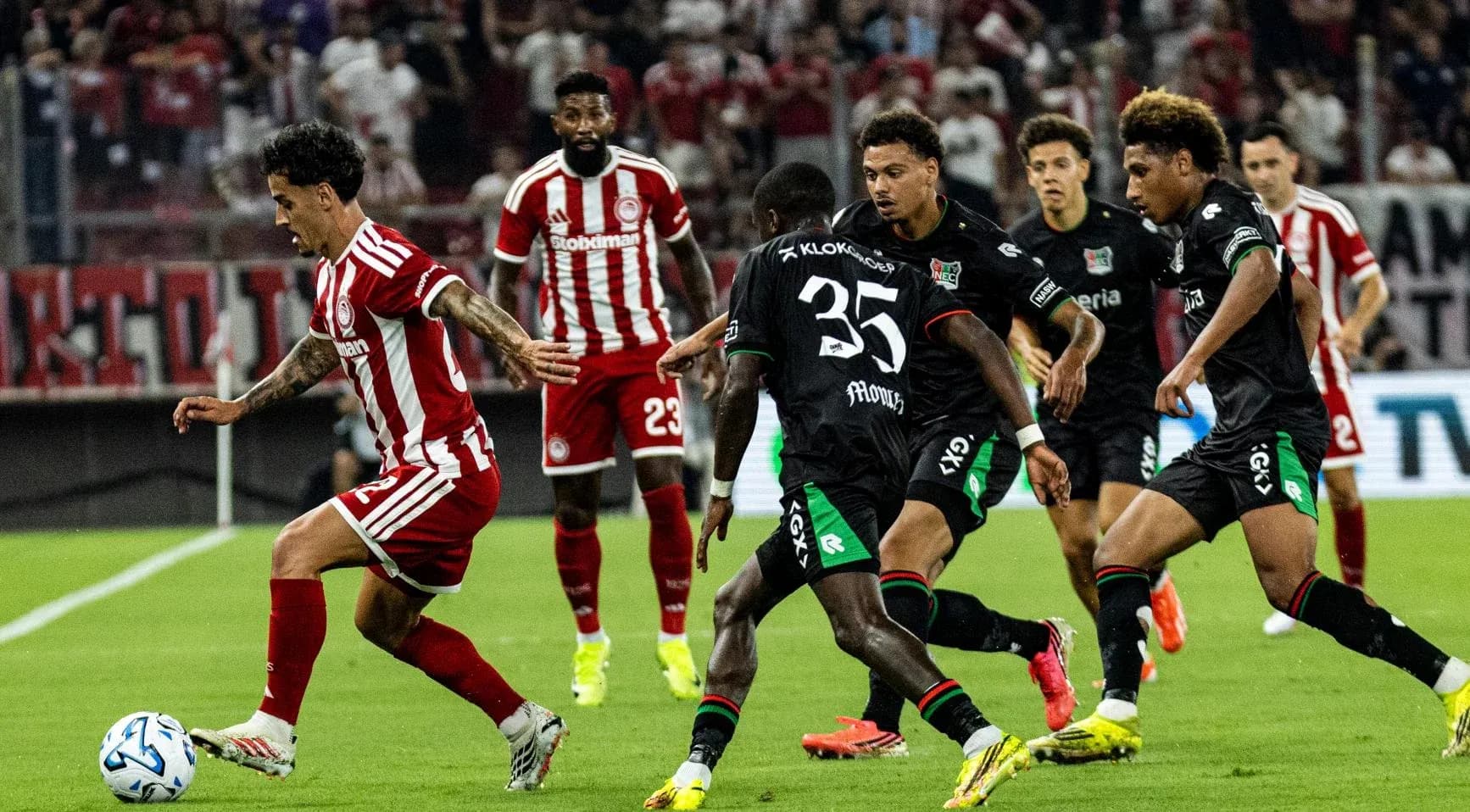
Olympiakos Piraeus vs NEC Nijmegen: Tactical Stalemate in UEFA Champions League
Olympiakos Piraeus and NEC Nijmegen produced a tactically tight 0-0 at Georgios Karaiskakis Stadium in the 3rd Qualifying Round of the UEFA Champions League, a match defined more by structure and defensive discipline than by penalty-box chaos. Across 90 minutes, Olympiakos had a marginal territorial and possession edge (54% to 46%) and slightly cleaner progression through midfield, but NEC’s compact 3-4-2-1 and controlled aggression (16 fouls, 1 yellow card) repeatedly disrupted the hosts’ rhythm. Both sides ended with a similar shot volume (12–13), and the stalemate reflected two game plans that largely neutralised each other rather than any glaring attacking waste.
Olympiakos Setup
Olympiakos set up in a 4-2-3-1 that, in practice, tilted asymmetrically to the right. B. Popovic (Olympiakos Piraeus) anchored a back four of M. Saliakas, P. Retsos, D. Carmo and B. Onyemaechi, screened by the double pivot of Dani García and C. Mouzakitis. Ahead of them, Rodinei and J. Roca worked as wide midfielders with Chiquinho as the central creator behind A. El Kaabi. The structure aimed to create overloads in the right half-space through Rodinei’s advanced positioning and Saliakas’ overlaps, while Chiquinho drifted laterally to connect with the ball-side winger.
The numbers support this territorial intent. Olympiakos completed 394 total passes with 264 accurate at 67%, slightly higher volume but lower efficiency than NEC’s 348 passes at a sharper 73% accuracy. That gap hints at Olympiakos forcing more vertical entries under pressure, especially in the second half, as they tried to break NEC’s back three. Their 5 shots on goal from 12 total attempts, plus 5 efforts inside the box and 2 blocked shots, underline a side that did manage to reach the final third but often found the last line well-protected.
NEC's Defensive Structure
NEC’s 3-4-2-1 under Dick Schreuder was built on a clear defensive spine. G. Crettaz (NEC Nijmegen) was protected by a trio of T. Storm, P. Sandler and D. Fonville, with a four-man midfield line of S. Ouaissa, J. Monteiro, D. Nejasmic and C. Bischoff providing both lateral coverage and counter-attacking lanes. N. Lebreton and B. Linssen supported lone striker T. Chery between the lines, looking to exploit transitions when Olympiakos’ full-backs advanced.
NEC’s shot profile reveals a quietly effective counter-punch: 13 total shots, 7 inside the box and 4 on goal, with 4 attempts blocked. They matched Olympiakos for threat zones despite less of the ball, an indication that their attacks, though less frequent, were more direct and targeted. The higher pass accuracy (73%) with fewer overall passes suggests a focus on clean, purposeful progression rather than sustained circulation.
Tactical Changes
The match’s tactical story shifted around Luis Mendilibar Jose’s substitution wave early in the second half. At 46', G. Martins (IN) came on for J. Roca (OUT), a clear move to inject more creativity and central ball-carrying into the attacking midfield band. By 56', the coach doubled down: Jota Silva (IN) replaced Chiquinho (OUT), adding more vertical running and 1v1 threat, while L. Pirola (IN) came on for D. Carmo (OUT), refreshing the left centre-back slot and allowing a slightly higher defensive line with fresher legs.
The full-back dynamic changed further at 57' when P. Maffeo (IN) came on for M. Saliakas (OUT), giving Olympiakos a more aggressive, overlapping right-back profile to pin NEC’s left side deeper. At 64', Z. Smajlovic (IN) replaced P. Retsos (OUT), completing a near-total reset of the central defensive pairing and suggesting both a desire for better build-up angles and preservation of physical freshness to guard against NEC’s late counters.
NEC’s response, clustered between 70' and 74', showed Schreuder adjusting to maintain energy and disrupt Olympiakos’ growing territorial squeeze. At 70', E. Mor (IN) came on for S. Ouaissa (OUT), adding a more dribble-oriented outlet on the flank, while B. Pereira (IN) replaced T. Storm (OUT), refreshing the right side of the back three. Four minutes later, D. Tadic (IN) came on for B. Linssen (OUT) and I. Hansen-Aaroen (IN) replaced P. Sandler (OUT), effectively rebalancing both the attacking line and defensive structure. These changes nudged NEC towards a slightly more progressive 3-4-2-1 in possession, with more technical quality between the lines but maintained defensive numbers behind the ball.
Discipline and Fouls
Discipline also shaped the match tempo. Olympiakos committed 11 fouls and collected two yellow cards, both for “Foul”: at 11', David Carmo (Olympiakos Piraeus) — Foul, and at 67', Dani García (Olympiakos Piraeus) — Foul. NEC, with 16 fouls, received one booking: at 90+1', Willum Thor Willumsson (NEC Nijmegen) — Foul. The higher foul count for NEC reflected their willingness to break play and prevent Olympiakos from accelerating through midfield, particularly once the hosts introduced fresher, more dynamic attackers.
Goalkeeping Performances
In goal, B. Popovic (Olympiakos Piraeus) made 4 saves, a solid but not overworked outing that owed as much to his back line’s shot suppression as to his own interventions. G. Crettaz (NEC Nijmegen) registered 5 saves, a slightly heavier workload that mirrored Olympiakos’ marginally superior shot-on-goal count. Neither goalkeeper faced overwhelming pressure, but both were decisive enough in routine situations to keep the clean sheets intact.
Statistical Summary
Statistically, the contest was balanced and consistent with the tactical patterns on display. Olympiakos’ 5 corner kicks to NEC’s 2 underline their territorial edge, yet NEC’s 7 shots inside the box to Olympiakos’ 5 show that the Dutch side were at least as effective at engineering high-value shooting positions when they did break forward. Offside figures — 2 for Olympiakos, 6 for NEC — further illustrate NEC’s reliance on stretching the last line with direct runs, occasionally mistimed.
With expected goals and goals prevented not provided, the clearest verdict comes from volume and quality proxies: similar total shots, similar shots on goal, and a near-even split of box entries. Olympiakos’ extra possession and corners did not translate into a decisive advantage in clear chances, while NEC’s compact 3-4-2-1 and well-timed substitutions ensured that, despite spending longer without the ball, they finished the night tactically satisfied with a controlled away draw and a defensive performance that held firm under increasing second-half pressure.
Related News
Luis Díaz Confident Bayern Munich Can Win Champions League
Insights from AFC Champions League Matchday One: K League Clubs’ Strategies
Vincent Kompany's Bayern Munich Future Not Tied Solely to Champions League Outcome
Barcelona's Camp Nou Chosen for 2029 Champions League Final, Munich Set for 2028
Allianz Arena to Host 2028 UEFA Champions League Final
Allianz Arena to Host 2028 Champions League Final for Third Time