
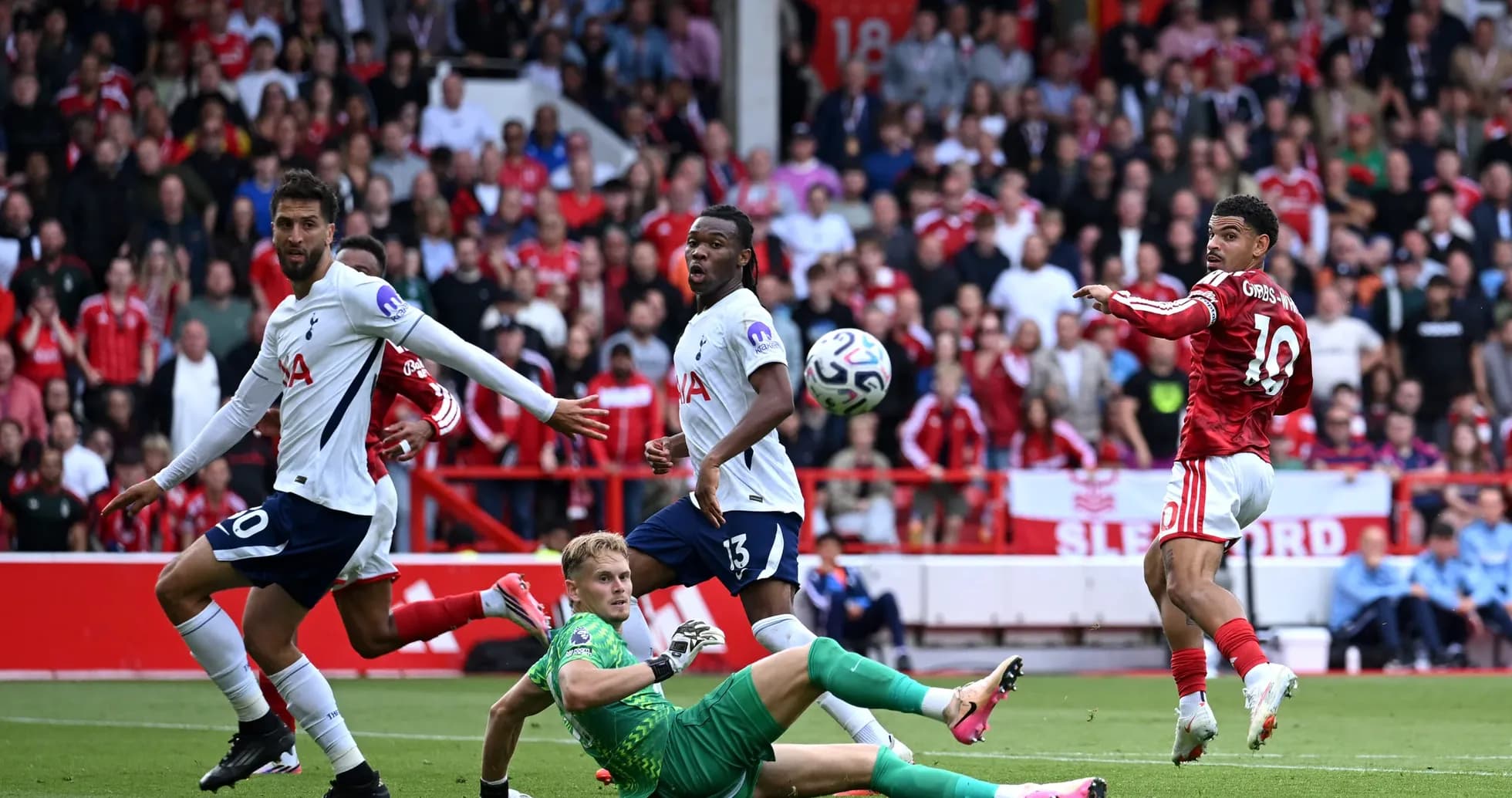
Nottingham Forest vs Tottenham: A Tactical Stalemate
The City Ground under grey September skies hosted two sides still searching for themselves. Nottingham Forest, 16th in the Premier League heading into this game, had built a cautious early-season identity: compact, three at the back, and happy to suffer without the ball. Tottenham arrived in even deeper trouble in 18th, with a goal difference of -5 overall (0 scored, 5 conceded) and a season that had yet to ignite under Roberto De Zerbi.
Over 90 minutes, the 0-0 scoreline told only part of the story. Tactically, it was a clash between Forest’s emerging structure and a Tottenham side caught between high-possession ideals and a toothless final third.
I. The Big Picture – Structures and Seasonal DNA
Forest stayed loyal to their blueprint. Oliver Glasner’s 3-4-2-1 was unchanged in essence: Matz Sels behind a back three of Jair, Nikola Milenković and Murillo, with Ola Aina and Neco Williams as aggressive wing-backs. In front, the double axis of Xaver Schlager and James McAtee aimed to knit play, while Dan Ndoye and Morgan Gibbs-White floated behind lone forward Liam Delap.
The numbers underline why Glasner has leaned into control and caution. Heading into this game, Forest had played 3 league matches in total, without a win (0 victories overall), but with enough resilience to draw 2. Their overall goals for stood at 2 and goals against at 3, giving a goal difference of -1. At home, though, the picture was stark: 0 goals scored and 1 conceded across 2 games, with an average of 0.0 goals for at home and 0.5 goals against. They had kept 1 clean sheet in total and failed to score twice overall. This is a side whose attacking threat has lived more on their travels (2 away goals, averaging 2.0 away) than in front of their own fans.
Tottenham, by contrast, arrived as a possession team without an end product. De Zerbi persisted with a 4-2-3-1: Adam Kinský in goal, a back four of Pedro Porro, Jan Paul van Hecke, Micky van de Ven and Destiny Udogie; Sandro Tonali and Rodrigo Bentancur as the double pivot; Savinho, Conor Gallagher and Mathys Tel behind Omar Marmoush. On paper, it is a fluid, technical front four. On grass, the numbers have been brutal: 3 matches in total, 0 wins, 1 draw, 2 defeats, 0 goals scored overall and 5 conceded. Their overall goal difference of -5 comes from those 0 goals for and 5 against, with an average of 0.0 goals for both home and away. Even their defensive metrics point to fragility: 2 goals conceded at home and 3 away, with overall goals against averaging 1.7.
II. Tactical Voids – Absences and Discipline
Both managers were forced to build around absences that shaped the match’s creative texture.
Forest were again without N. Savona, missing through a knee injury. While not yet a central figure in their attacking patterns, his absence trimmed Glasner’s rotation options in midfield and may partly explain the heavy reliance on a core group who have already logged significant minutes.
For Tottenham, the voids were far more structural. Dejan Kulusevski (knee injury), James Maddison (knock), W. Odobert (knee injury) and Xavi Simons (knee injury) all missed out. That’s an entire creative department stripped away: ball-carriers, set-piece threats, and final-third decision-makers. It left Gallagher and Tel with greater responsibility between the lines and pushed more creative burden onto Savinho and Marmoush.
Disciplinary trends added another layer. Forest’s season-long yellow card profile shows a spike immediately after the interval: 50.00% of their bookings have arrived between 46-60 minutes, with further flashes in the 16-30, 31-45 and 76-90 ranges (each 16.67%). It paints a picture of a side that tackles aggressively as the second half opens, when pressing triggers ramp up and games become stretched.
Tottenham, meanwhile, distribute their yellows almost evenly across the game: 25.00% of their bookings in each of 0-15, 31-45, 46-60 and 76-90. It suggests a team that defends reactively rather than in controlled bursts, picking up cautions whenever their structure is exposed.
Individually, Aina is a disciplinary focal point for Forest. Across 3 league appearances he has collected 2 yellow cards, while also making 7 tackles and engaging in 35 duels, winning 17. For Spurs, Udogie and Mateus Fernandes have both taken a yellow each, with Fernandes committing 5 fouls in 3 appearances. These profiles hint at where the game’s flashpoints naturally arise: wide channels and midfield transitions.
III. Key Matchups – Hunter vs Shield, Engine Room
With neither side boasting a prolific scorer this early in the season, the “Hunter vs Shield” duel became less about goals and more about territory and chance creation.
For Forest, Gibbs-White is the attacking compass. In 3 league appearances he has 1 goal and 1 assist, with 7 shots (2 on target), 81 passes at 82% accuracy, and 8 dribbles attempted with 4 successful. He is not just a creator; he’s also willing to work: 4 tackles, 1 blocked shot and 1 interception. In this match, operating as one of the two attacking midfielders behind Delap, he constantly sought pockets between Tonali and the Spurs centre-backs, looking to turn Spurs’ sterile possession into Forest counter-attacks.
His opposite numbers, Gallagher and Savinho, were tasked with unlocking a Forest defence that had already proven stubborn at home. Jair, Milenković and Murillo formed a narrow, disciplined trio, with wing-backs tucking in to create a five when out of possession. Given Forest’s overall average of just 1.0 goals conceded per game and their 1 clean sheet in total, Tottenham’s misfiring attack was always likely to struggle if they could not destabilise that block with rotations or late runs.
In the “Engine Room”, the duel between Schlager and McAtee against Bentancur and Tonali shaped the game’s rhythm. Forest’s midfield pair focused on screening central zones and springing Gibbs-White and Ndoye on the break, while Tottenham’s double pivot tried to dictate tempo and compress Forest deep. Yet with Spurs still averaging 0.0 goals for overall and having failed to score in all 3 matches in total, their circulation often lacked the incision to turn sterile control into genuine threat.
IV. Statistical Prognosis – What the 0-0 Tells Us
Following this result, the numbers reinforce the narrative of two incomplete projects.
Forest’s goalless draw extends their pattern: solid, structured, but blunt at home. With 0 goals scored at the City Ground this season and 1 conceded, their defensive platform is credible, but their overall attacking average of 0.7 goals per game points to a ceiling unless Delap, Ndoye and Gibbs-White can convert half-chances into goals more regularly. The positive: their penalty record remains perfect overall, with 1 taken and 1 scored, and no penalties missed.
Tottenham’s blank is more alarming. Three games, 0 goals, and 5 conceded overall is not a small-sample quirk; it’s a systemic problem. Even with a clean sheet here – just their second in all competitions this season if we follow the league data’s 1 clean sheet overall before this match – their inability to turn structured build-up into shots and goals persists. The absence of Kulusevski and Maddison strips away improvisation, leaving a possession shell without its creative core.
From an xG and defensive solidity perspective, the trend lines are clear even without explicit xG numbers. Forest project as a low-scoring, low-conceding outfit whose season will be defined by narrow margins and set-piece moments. Tottenham, by contrast, are an attacking project still in beta: the framework of a high-possession, technically rich side is visible, but until the returning playmakers rejoin and the front line finds rhythm, their goal drought and negative goal difference will continue to drag them towards the wrong end of the table.
In the end, the City Ground stalemate felt less like a missed opportunity for either side to explode, and more like a mirror held up to who they currently are: Forest, organised and stubborn; Tottenham, elegant but blunt. The tactics made sense. The numbers, and the scoreline, were unforgiving.
Related News
Tottenham vs Aston Villa Predicted Lineups: Team News for Premier League Clash
Brighton vs Arsenal: Premier League Clash Preview
Manchester City vs Sunderland: Premier League Clash Preview
Tottenham vs Aston Villa: Early Relegation Battle

Brentford vs Chelsea Predicted Lineups: Team News and Match Insights
Brighton vs Arsenal Prediction: Key Stats and Betting Tips