
Nottingham Forest and Bournemouth Share Points in Tactical Standoff
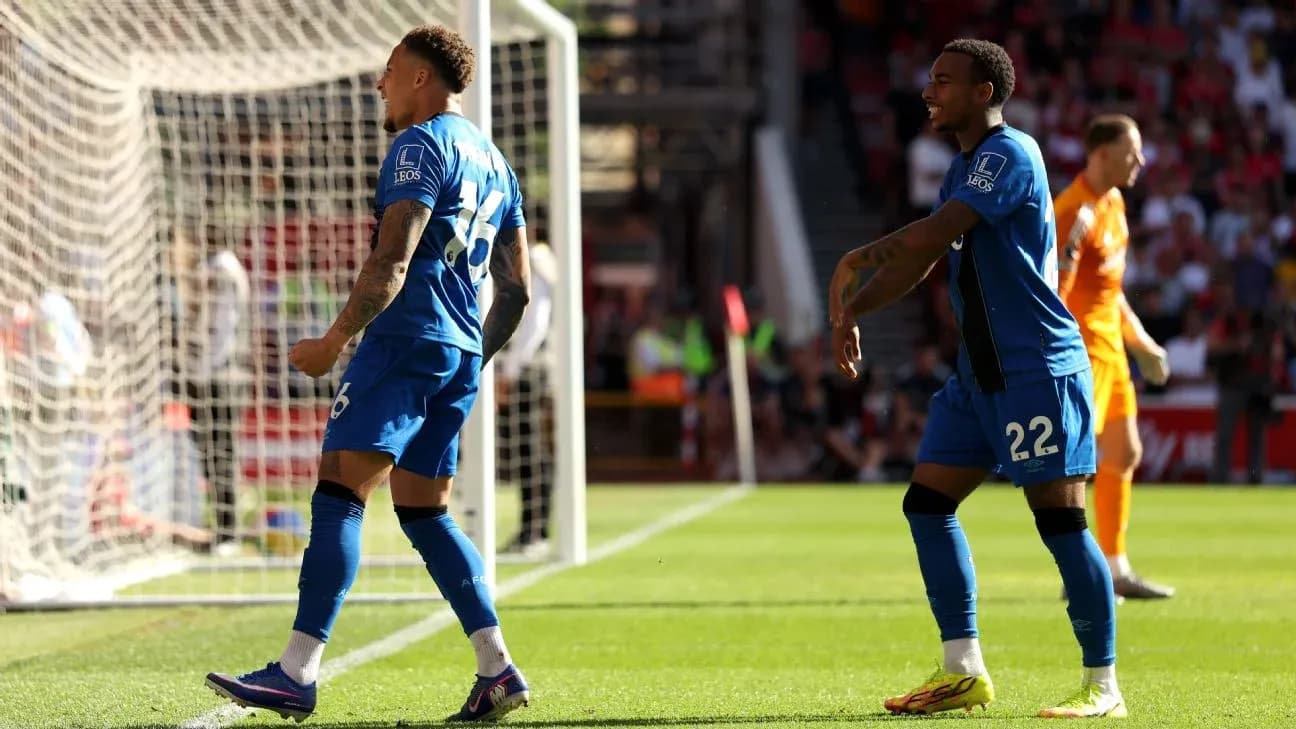
Nottingham Forest and Bournemouth closed their Premier League seasons at the City Ground with a 1-1 draw that neatly reflected the tactical balance of the contest. Vitor Pereira’s Forest, in a clear 4-4-2, tried to compress the game vertically and play quickly into the front two, while Andoni Iraola’s Bournemouth used their 4-2-3-1 to dominate possession and control territory. Forest led 1-0 at half-time and generated the higher xG (1.87 to Bournemouth’s 1), but Bournemouth’s structural superiority with the ball and their second-half adjustments earned them a deserved equaliser and ultimately a point.
Forest's Tactics
Forest’s 4-4-2 was built on a compact mid-block and quick vertical connections. The back four of Neco Williams, Morato, Nikola Milenkovic and Cunha stayed relatively narrow, inviting Bournemouth to circulate wide but protecting the central lane in front of M. Sels (Nottingham Forest). In midfield, Ibrahim Sangare and Elliot Anderson were tasked with screening Bournemouth’s double pivot, while Omari Hutchinson and Morgan Gibbs-White started from wide positions but constantly moved inside to form temporary central overloads.
The opening goal on 34 minutes illustrated Forest’s attacking idea. After Bournemouth’s first yellow card to James Hill for a “Foul” at 33', Forest immediately targeted the right channel. Hutchinson received in the right half-space and slipped a vertical pass between Bournemouth’s lines, where Gibbs-White had drifted off the flank into a classic number 10 pocket. His finish for 1-0 came from a central zone that Bournemouth’s 4-2-3-1 struggled to protect when their full-backs advanced and the wingers did not fully track back.
Bournemouth's Structure
Bournemouth, however, were structurally the more stable side in possession. Their 55% of the ball, 483 passes and 84% completion reflect a team comfortable building from the back. Marcos Senesi and James Hill split to either side of D. Petrovic (Bournemouth), with Tyler Adams dropping between or just ahead of them to form a three-man first line. The full-backs, Adam Smith and Adrien Truffert, pushed high, pinning Forest’s wide midfielders and often forcing Forest’s front two to defend laterally, which gradually wore down their pressing intensity.
The Cherries’ equaliser at 54' came from this territorial dominance and wide overloads. Truffert advanced on the left, received in space and delivered a decisive ball for Marcus Tavernier, who had drifted inside from the right to attack the box. The assist from Truffert and the composed finish from Tavernier for 1-1 punished Forest’s slight delay in shuffling across, with Hutchinson caught high and Sangare dragged towards the ball, leaving a seam between full-back and centre-back.
Second Half Adjustments
Out of possession, Bournemouth’s 4-4-2 pressing shape (with the number 10 stepping up alongside Evanilson) aimed to lock Forest’s build-up to one side. Adams and A. Toth screened passes into Sangare and Anderson, forcing Forest to go longer towards Chris Wood and Igor Jesus. Forest’s 396 passes at 78% accuracy, compared to Bournemouth’s 483 at 84%, underline how much more often Forest were pushed into lower-percentage balls.
The second-half substitution sequence was largely about managing fatigue and maintaining intensity in these structures. At 57', Bournemouth brought on B. Gannon-Doak (IN) for A. Toth (OUT), adding more dynamism and forward thrust from midfield, a clear attacking tweak from Iraola to chase the equaliser and then a winner. Pereira’s response from 62' onwards was to refresh his front line and flanks: T. Awoniyi (IN) came on for C. Wood (OUT) to add depth running behind, L. Netz (IN) for Cunha (OUT) to give more attacking thrust from left-back, and R. Yates (IN) for E. Anderson (OUT) plus N. Dominguez (IN) for Sangare (OUT) at 65' to add legs and defensive energy in central midfield.
Awoniyi’s booking at 67' — “Foul” — came from Forest’s attempt to press higher again with fresh legs, but it also showed the cost of committing aggressively when the structure behind was a touch stretched. Bournemouth, meanwhile, made a triple change on 73': E. Unal (IN) for Evanilson (OUT), J. Kluivert (IN) for E. J. Kroupi (OUT), and A. Adli (IN) for Rayan (OUT). This reconfigured the front line with more mobility and between-the-lines quality, further challenging Forest’s tiring back four.
Final Phases
In the final phase, Forest’s substitutions aimed at preserving their defensive block while keeping a counter-attacking threat. J. McAtee (IN) for Hutchinson (OUT) at 78' gave fresh technical quality between the lines but slightly reduced the raw one-v-one pace on the right. Bournemouth’s last change at 90' — L. Cook (IN) for A. Smith (OUT) — effectively shifted them towards a more central, possession-heavy structure for the closing moments, with less emphasis on overlapping width and more on controlling second balls and circulation.
Both goalkeepers had to manage these evolving patterns rather than deal with overwhelming shot volume. M. Sels (Nottingham Forest) made 3 saves, matching Bournemouth’s 4 shots on goal in terms of key interventions, while D. Petrovic (Bournemouth) also made 3 saves against Forest’s 5 shots on goal. The negative goals prevented figures for both teams (Forest -0.5, Bournemouth -0.5) suggest that each keeper conceded slightly more than the post-shot quality would predict, but neither was overrun; instead, the tactical story was about structural control versus vertical threat.
Statistical Overview
Statistically, the 1-1 feels like a compromise between Forest’s chance quality and Bournemouth’s territorial command. Forest’s 15 total shots, with 10 inside the box and an xG of 1.87, indicate that their 4-4-2, when it did break through Bournemouth’s press, created high-quality opportunities. Bournemouth, with 17 shots but only 6 inside the box and an xG of 1, relied more on volume and distance efforts from their sustained pressure.
Discipline remained manageable: one yellow card each — James Hill (Bournemouth) at 33' for “Foul” and Taiwo Awoniyi (Nottingham Forest) at 67' also for “Foul” — and relatively few fouls overall (Forest 11, Bournemouth 7). Corners (Forest 6, Bournemouth 3) reflected Forest’s threat in transition and on set plays, while Bournemouth’s superior passing metrics and possession underline Iraola’s more ball-dominant blueprint.
Tactical Takeaways
In tactical terms, Forest can take encouragement from how their 4-4-2 generated better xG and dangerous box entries against a possession-heavy opponent. Bournemouth, for their part, showed that their 4-2-3-1 can impose its rhythm away from home, but the shot profile and xG gap are reminders that structural control must be converted into clearer chances to consistently turn draws into wins.
Related News
Bournemouth vs Liverpool Prediction: Key Stats and Betting Tips
Tottenham vs Aston Villa Predicted Lineups: Team News for Premier League Clash
Brighton vs Arsenal: Premier League Clash Preview
Manchester City vs Sunderland: Premier League Clash Preview
Tottenham vs Aston Villa: Early Relegation Battle

Brentford vs Chelsea Predicted Lineups: Team News and Match Insights