
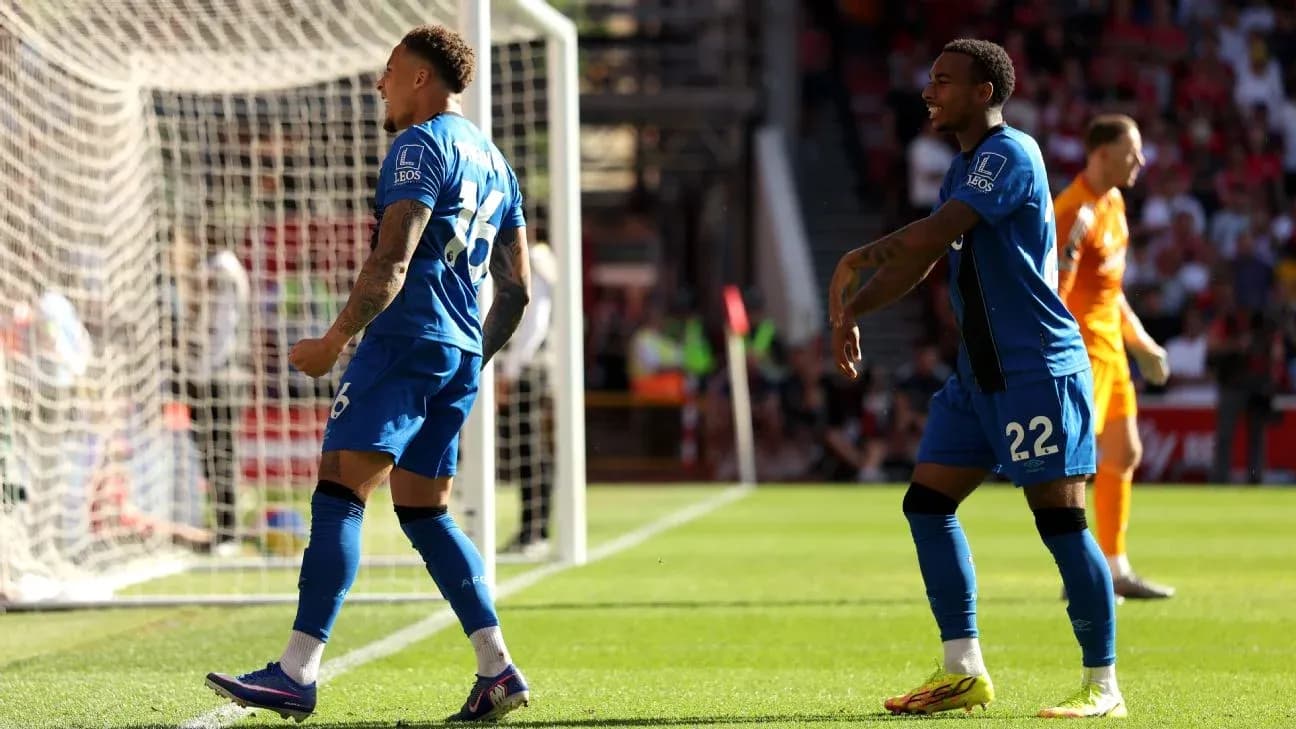
Nottingham Forest vs Bournemouth: Premier League Season Finale
The City Ground’s final act of the 2025–26 Premier League season closed on a knife-edge: Nottingham Forest 1–1 Bournemouth, a result that neatly encapsulated both clubs’ seasonal DNA. Following this result, Forest finish 16th with 44 points and a goal difference of -3, while Bournemouth lock in 6th on 57 points and a goal difference of 4, securing Europa League football after a campaign built on resilience and structure.
I. The Big Picture – contrasting journeys, converging on a draw
Over the season, Forest have lived on the margins. Overall they played 38 league matches, winning 11, drawing 11 and losing 16, scoring 48 and conceding 51. At home they were fragile but stubborn: only 4 wins from 19 at the City Ground, with 20 goals scored and 23 conceded. An average of 1.1 goals for and 1.2 against at home underlines a side rarely blown away, but seldom ruthless.
Bournemouth arrive at the end of a different arc. Overall they lost just 7 of 38, drawing 18 – a team that refuses to break. They scored 58 and conceded 54, a high-variance side that still found a way to finish 6th. At home they were formidable; on their travels they were harder to read: 6 away wins, 8 draws and 5 defeats, with 29 goals scored and 34 conceded, an away average of 1.5 goals for and 1.8 against that speaks to open, chaotic contests.
On this final day, the patterns met in the middle: Forest again unable to turn a home lead into a win, Bournemouth again finding a way not to lose.
II. Tactical voids – absences that shaped the chessboard
The team sheets told their own story of compromise. Vitor Pereira had to patch together a Forest side without O. Aina, W. Boly, C. Hudson-Odoi, Murillo and N. Savona, all listed as missing through injury. That stripped Forest of two experienced defenders, a dynamic wide threat and a key ball-playing centre-back in Murillo. The response was a 4-4-2 built on solidity: M. Sels in goal behind a back four of N. Williams, Morato, N. Milenkovic and Cunha, with a flat midfield line and a front pairing of Igor Jesus and C. Wood.
For Bournemouth, Andoni Iraola was forced into creative solutions as well. R. Christie, a red-card absentee, was unavailable, as were A. Jimenez (suspended) and J. Soler (hamstring). The absence of Jimenez, who collected 10 yellow cards this campaign, removed a combative, high-risk full-back from the equation, nudging Bournemouth towards a more measured back four of A. Smith, J. Hill, M. Senesi and A. Truffert. Without Christie and Soler, Iraola doubled down on a 4-2-3-1 that leaned into mobility and rotations in the band of three: Rayan, E. J. Kroupi and M. Tavernier behind Evanilson.
Discipline has been a season-long subplot for both sides. Heading into this game, Forest’s yellow-card distribution peaked between 46-60 minutes (25.00%) and 61-75 minutes (23.33%), a sign of a side that often has to foul to reset when intensity rises after the break. Bournemouth’s yellows spiked even more dramatically late: 26.14% between 76-90 minutes and 21.59% between 91-105 minutes, the hallmark of a pressing side that pushes the line in closing stages. The absence of Jimenez and Christie removed two of their more combustible elements, but the structural tendency to live on the disciplinary edge remained baked into the system.
III. Key matchups – Hunter vs Shield, Engine Room vs Enforcer
The marquee duel was always going to orbit M. Gibbs-White. With 15 goals and 4 assists in total this season, he has been Forest’s creative heartbeat, operating here from the right of midfield in the 4-4-2 but drifting centrally to find pockets. His 1,208 passes and 49 key passes underline a player who dictates tempo as much as he finishes moves. Against Bournemouth’s back four, the main shield was the double pivot of T. Adams and A. Toth, asked to close the lanes between the lines and track his half-space incursions.
For Bournemouth, the “hunter” role was split. E. J. Kroupi, with 13 goals overall and 2 penalties scored, started as the nominal No.10 but constantly rotated with Rayan and Tavernier, trying to drag Forest’s midfield four out of shape. The Forest shield against that carousel was I. Sangare, flanked by E. Anderson and the work rate of O. Hutchinson. Sangare’s remit was clear: protect the zone in front of Milenkovic and Morato, prevent Kroupi from turning, and win the second balls that Bournemouth’s 4-2-3-1 thrives on.
Out wide, N. Williams’ duel with Tavernier and the overlapping A. Truffert was another decisive front. Williams’ season profile – 96 tackles, 17 blocked shots and 47 interceptions – illustrates a defender who steps out aggressively. His single red card this season is the warning label on that style; he plays on the edge to win territory. Against Bournemouth’s layered left flank, his timing had to be perfect.
Up front, Forest’s pairing of Igor Jesus and C. Wood provided contrasting threats: movement and link play alongside aerial power. They were matched by Senesi and Hill, who have been part of a Bournemouth away defence conceding 34 goals, often exposed by the team’s front-foot approach. The question was whether Forest’s home attack, averaging 1.1 goals per game at the City Ground, could exploit that looseness.
IV. Statistical prognosis – xG logic vs defensive reality
Even without explicit xG numbers, the season data sketches the expected balance. Bournemouth’s overall scoring rate of 1.5 goals per match, combined with their away average of 1.8 conceded, points to high-chance, high-variance encounters when they travel. Forest, by contrast, sit at 1.3 goals scored and 1.3 conceded overall, with 9 clean sheets and 14 matches in which they failed to score. They oscillate between compact and blunt.
Forest’s penalty record – 3 taken, 3 scored, 0 missed – hints at clinical execution when the big moments come, while Bournemouth’s perfect 5 from 5 from the spot reinforces a similar ruthlessness. Neither side is wasteful from 12 yards; the margins come from open play structure rather than set-piece nerves.
Following this result, the 1–1 draw feels like the logical meeting point of these identities. Forest once again found a way to compete without fully imposing themselves at home. Bournemouth again tilted the field without entirely controlling the defensive chaos they invite. The narrative of the season distilled into 90 minutes at the City Ground: one team surviving, the other ascending, both locked in a tactical arm-wrestle that neither could quite finish.
Related News

Bournemouth vs Liverpool Prediction: Key Stats and Betting Tips
Tottenham vs Aston Villa Predicted Lineups: Team News for Premier League Clash
Brighton vs Arsenal: Premier League Clash Preview
Manchester City vs Sunderland: Premier League Clash Preview
Tottenham vs Aston Villa: Early Relegation Battle

Brentford vs Chelsea Predicted Lineups: Team News and Match Insights