
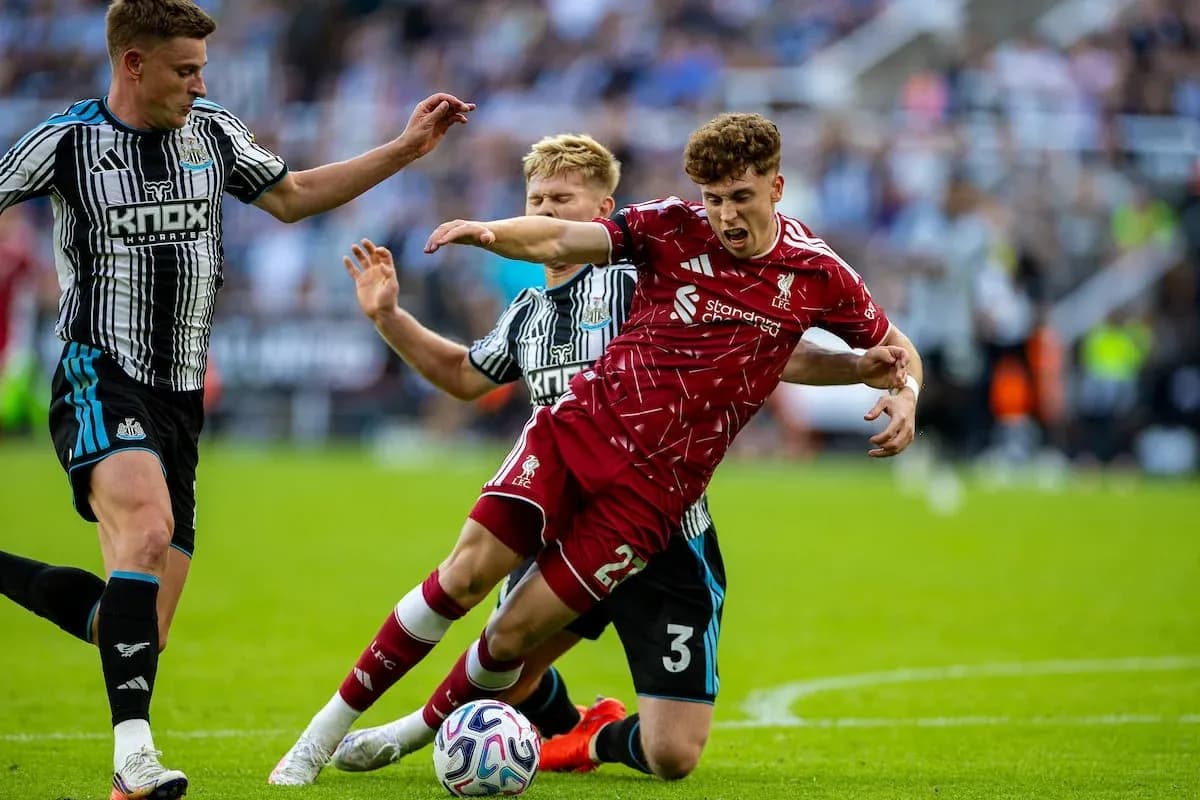
Newcastle and Liverpool Start Premier League Season with 2–2 Draw
Under the late-summer light at St James’ Park, Newcastle and Liverpool opened their 2026 Premier League campaigns with a 2–2 draw that felt less like a settling of accounts and more like the first chapter of a season-long argument.
I. The Big Picture – Two new eras, same ambition
Following this result, both sides sit on 1 point from 1 match. Newcastle are 11th, Liverpool 10th, separated only by alphabetical order and the tiniest of margins. Each has scored 2 goals and conceded 2 overall; the goal difference for both is 0, a statistical mirror that matches the narrative on the pitch.
Both coaches leaned into a 4-2-3-1, but the shapes told different stories. Matthias Jaissle’s Newcastle were vertical and aggressive, building a front four of energy and direct running. Andoni Iraola’s Liverpool, meanwhile, were about rotations and overloads, using technical midfielders and inverted movement to unbalance the hosts.
Newcastle’s overall scoring profile after this game is clear: 2 goals at home, averaging 2.0 goals for and 2.0 against at St James’ Park. Liverpool, on their travels, match that exactly: 2 away goals scored, 2 conceded, for an away average of 2.0 scored and 2.0 conceded. For two clubs with top-four ambitions, the numbers whisper the same message: dangerous going forward, but still searching for defensive control.
II. Tactical Voids – Absences that shaped the contest
The team sheets carried quiet absences that heavily influenced the tactical landscape.
For Newcastle, Joelinton’s injury removed a powerful two-way presence from midfield, the kind of player who knits chaos into structure. V. Livramento’s hamstring injury limited full-back rotation and reduced Jaissle’s options to change the tempo from deep. That absence pushed more responsibility onto Lewis Miley and S. Steur as the double pivot, asking them to cover huge spaces against Liverpool’s roaming tens.
Liverpool were hit even harder in terms of depth. C. Bradley (knee injury) and J. Gomez (injury) trimmed Iraola’s defensive flexibility, while G. Leoni’s knee issue and H. Ekitike’s Achilles tendon injury reduced his options for late-game disruption higher up. With those absentees, the back four of J. Frimpong, J. Jacquet, Virgil van Dijk and M. Kerkez had to go the distance as a unit, with little like-for-like support from the bench.
Disciplinary patterns added another layer. Newcastle’s season card profile, built entirely on this match, is scattered across the timeline: yellow cards in the 16–30, 31–45, 61–75, 76–90 and 91–105 minute ranges, each accounting for 20.00% of their total yellows. It hints at a side that defends on the edge in every phase rather than in short, intense bursts.
Liverpool’s yellow-card story is sharper: 66.67% of their yellows arrived between 16–30 minutes, with another 33.33% in the 76–90 window. That early spike suggests an aggressive, high-pressing start that flirted with the referee’s tolerance, followed by another surge of risk as they chased the game late on.
III. Key Matchups – Hunter vs Shield, and the engine room duel
Hunter vs Shield
Newcastle’s attacking threat was multi-headed rather than centred on a single striker. W. Osula, leading the line, may have left without a goal, but his 1 assist and 2 successful blocks underline his dual role: first presser and link man. His five passes, one of them key, show a forward comfortable dropping into pockets, especially against Van Dijk and Jacquet.
Behind him, A. Elanga and Y. Wissa emerged as the clearest “hunters” in this side. Elanga, already on 1 league goal, was a constant vertical outlet from the right, completing 2 shots (both on target) and winning 5 of 9 duels. His direct running at Kerkez and the left channel forced Liverpool’s line to retreat in phases, stretching the compactness Iraola usually demands.
Wissa, also among the early assist leaders with 1, played a different role: part creator, part enforcer. He took 4 shots (1 on target), made 1 key pass, and won 11 of 19 duels, while also committing 3 fouls and collecting a yellow card. He was the chaos agent between Liverpool’s lines, constantly testing Van Dijk’s ability to step out and engage.
Liverpool’s shield, built around Van Dijk and the new-look right side with Frimpong, had mixed returns. They conceded 2 goals away, and their away goals-against average sits at 2.0. That is not the defensive platform Iraola will want, especially given that Alisson was protected by a double pivot of D. Szoboszlai and R. Gravenberch rather than a pure destroyer.
Engine Room – Control vs disruption
The midfield battle was the true heart of this fixture. For Newcastle, Lewis Miley’s emergence is already a storyline. Across his 76 minutes, he completed 36 passes with 83% accuracy, played 2 key passes, won 5 of 7 duels and added 1 tackle, 1 block and 1 interception. He also took a yellow card, emblematic of a young midfielder unafraid to foul to protect his back four.
Alongside him, Steur offered balance and simple distribution, while higher up, Elanga and Harvey Barnes tried to attack the space behind Liverpool’s full-backs.
Liverpool’s response came through Gravenberch, who quietly dictated large portions of the away side’s possession. He attempted 47 passes at 91% accuracy, supplied 1 assist and 1 key pass, and contributed defensively with 1 tackle and 2 interceptions. His blend of press resistance and vertical passing was the hinge on which Liverpool’s 4-2-3-1 turned into a 2-3-5 in attack.
Szoboszlai, stationed alongside him, operated more as a shuttler, connecting with Florian Wirtz between the lines. Wirtz’s role as a central creator behind Alexander Isak – playing as Liverpool’s nominal 9 – gave Liverpool an interior presence Newcastle struggled to fully contain, particularly when Frimpong surged from right-back to create a wide overload on L. Hall.
IV. Statistical Prognosis – What this draw really says
From a numbers perspective, the two sides emerge almost perfectly balanced. Overall, both have:
- 1 match played
- 0 wins, 1 draw, 0 defeats
- 2 goals for, 2 goals against, goal difference 0
Newcastle at home:
- 1 match, 2 goals scored, 2 conceded
- Home averages: 2.0 scored, 2.0 conceded
Liverpool away:
- 1 match, 2 goals scored, 2 conceded
- Away averages: 2.0 scored, 2.0 conceded
Liverpool’s penalty record is pristine so far: 1 penalty awarded, 1 scored, 0 missed, a 100.00% conversion rate. Newcastle, by contrast, have yet to take a penalty this season.
Without explicit xG data, we read the clues in shot volumes, creative profiles and card timings. Newcastle’s spread of yellows suggests long spells spent defending transitions and counters, but their attacking output through Elanga, Wissa and Osula indicates they can consistently generate chances against elite opposition. Liverpool’s controlled passing core – Gravenberch, Szoboszlai, Wirtz – implies that, as their pressing structure settles, their underlying chance creation will likely outstrip most opponents.
The tactical intersection is clear: Newcastle’s vertical, duel-heavy front line will continue to test teams whose defensive line steps high without perfect protection. Liverpool’s current vulnerability lies in those moments when full-backs like Frimpong and Kerkez both push, leaving Van Dijk and Jacquet exposed to runners like Elanga and Wissa.
Over a season, the numbers hint at a divergence. Liverpool’s technical ceiling in midfield, allied to a flawless penalty record and depth in creative roles, suggests their xG trend is likely to be higher and more stable. Newcastle, while explosive, may see more volatility – games that swing on whether Wissa’s duels break their way or whether Miley can hold the defensive structure without Joelinton.
For now, though, the table and the statistics say the same thing: these are two sides at the very start of their tactical journeys under new leadership, evenly matched on opening day, with enough attacking firepower to suggest that this 2–2 at St James’ Park will not be the last time they trade blows in the upper half of the Premier League.
Related News
Manchester United vs Tottenham Stats: Head-to-Head Record and Past Meetings
Premier League Players and Agents Eye Compensation Claims Against Manchester City Over Guilty Verdict
Premier League Midfielder Shares Ambition to Join Real Madrid
Is Possession Football Losing Its Grip in the Premier League?
Arsenal's Myles Lewis-Skelly Surprises by Naming Tottenham's Mateus Fernandes as Toughest Premier League Rival
Three Premier League Players Making Impressive Early Season Impact