
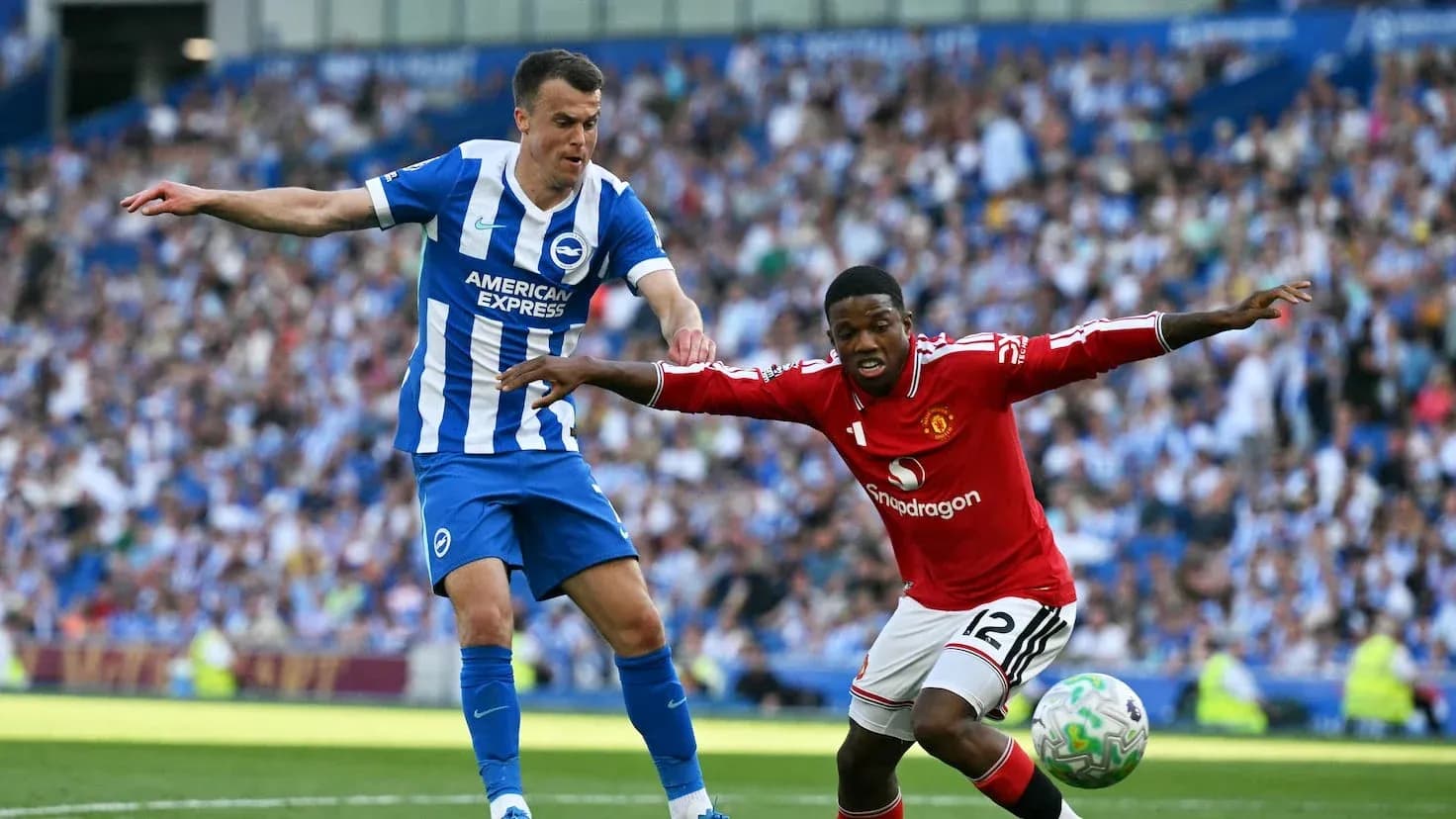
Manchester United's Tactical Mastery in 3-0 Victory Over Brighton
Manchester United’s 3-0 win at Amex Stadium was a clinic in vertical efficiency and penalty-box clarity against a Brighton side that had more of the ball but far less control of the key zones. Both teams lined up in a 4-2-3-1, yet the structures behaved very differently: Brighton’s was possession-oriented and wide, Manchester United’s was compact, direct and ruthless in transition.
Out of possession, Brighton tried to defend high with the back four spread across the pitch and the double pivot of P. Gross and J. Milner stepping forward to lock Manchester United in. That approach left large channels either side of L. Dunk and J. P. van Hecke, which the visitors repeatedly targeted. With 49% possession and only 11 total shots, United showed how deliberately they picked their moments: they accepted phases without the ball, dropped into a mid-block, and then sprang forward with speed through the 4-2-3-1 spine.
In United’s structure, K. Mainoo and M. Mount formed a disciplined double pivot, rarely both ahead of the ball at the same time. B. Fernandes operated between Brighton’s lines, constantly finding pockets behind Gross and Milner, while A. Diallo and P. Dorgu attacked the half-spaces and channels around Brighton’s full-backs. The first goal on 33 minutes – P. Dorgu (Manchester United), assisted by B. Fernandes – typified the plan: United broke quickly, Fernandes found space centrally, and Dorgu’s run exploited Brighton’s high and stretched defensive line.
Brighton’s 51% possession and 463 passes (397 accurate, 86%) reflect their ability to circulate the ball, but not to destabilise United’s block. Their 13 total shots yielded only 2 on target, underlining how often they were forced into suboptimal attempts or blocked efforts (5 blocked shots). The nominal No. 10, D. Gomez, and wide midfielders J. Hinshelwood and M. De Cuyper struggled to receive between United’s lines; instead, Brighton’s attacks were frequently shunted wide and then into crowded crossing situations, which suited H. Maguire and L. Martinez.
Manchester United, by contrast, turned 11 shots into 7 on target with an xG of 1.82, a very efficient shot profile. Their 447 passes (369 accurate, 83%) were slightly fewer and less precise than Brighton’s, but they were far more vertical. The second goal, B. Mbeumo (Manchester United) on 44 minutes from an A. Diallo assist, came from another incisive transition: Diallo’s involvement as a wide playmaker was central, dragging Brighton’s defenders out and releasing Mbeumo into the gaps.
The third goal, B. Fernandes (Manchester United) on 48 minutes, assisted by P. Dorgu and then confirmed by VAR at 50', effectively ended the contest and highlighted the structural mismatch. Brighton’s attempt to push higher after half-time left even more space between their midfield and back line. Fernandes timed his movement into that seam, while Dorgu again exploited the left side of Brighton’s defence. VAR’s confirmation underlined that United’s timing of runs and final-third combinations were on point rather than chaotic.
In goal, B. Verbruggen (Brighton) made 5 saves with a goals prevented figure of 0.32, indicating that despite conceding three, he did mitigate further damage against a high-quality shot profile. His workload reflects how exposed Brighton’s last line became whenever possession was lost high up the pitch. At the other end, S. Lammens (Manchester United) made 2 saves and also posted 0.32 goals prevented, a sign that while Brighton reached shooting positions, they rarely generated truly dangerous, clean looks.
Discipline and game management also fed into the tactical story. Manchester United committed 8 fouls to Brighton’s 11, but were booked only once: 45+3' Kobbie Mainoo (Manchester United) — Foul. Mainoo’s yellow card, arriving just before half-time, illustrated how United’s midfielders were willing to break up play when Brighton threatened to transition, yet overall the visitors maintained composure without sliding into reckless challenges.
Substitutions further underlined the divergent tactical arcs. Brighton’s triple change at 59' – Y. Minteh (IN) came on for M. De Cuyper (OUT), S. March (IN) came on for D. Gomez (OUT), and C. Baleba (IN) came on for J. Milner (OUT) – was an attempt by Fabian Hurzeler to inject direct running and more verticality into a possession-heavy but blunt attack. Later, G. Rutter (IN) came on for J. Hinshelwood (OUT) at 74', pushing Brighton into a more aggressive, forward-loaded shape. Yet with no corner kicks won across the 90 minutes, Brighton’s territorial play never translated into sustained siege pressure.
Michael Carrick’s changes were more about energy conservation and maintaining structural integrity. S. Lacey (IN) came on for P. Dorgu (OUT) at 62', then at 74' J. Zirkzee (IN) came on for B. Mbeumo (OUT), L. Yoro (IN) came on for N. Mazraoui (OUT), and T. Fletcher (IN) came on for M. Mount (OUT), before T. Malacia (IN) replaced L. Shaw (OUT) on 82 minutes. Each swap preserved the 4-2-3-1 shell, kept fresh legs in wide and full-back areas, and ensured the block stayed compact as Brighton chased the game.
Statistically, the verdict is clear: Brighton’s 0.81 xG and 2 shots on target, despite having more of the ball, show a side that controlled circulation but not the penalty area. Manchester United, with lower possession but higher xG (1.82), 7 shots on target and 3 goals, maximised the value of each attack. The 3-0 scoreline at Amex Stadium mirrors the tactical balance: Brighton’s 4-2-3-1 never solved the problem of United’s compact mid-block and explosive transitions, while Carrick’s side translated a disciplined, vertically-oriented game plan into a commanding away win.
Related News
Bournemouth vs Liverpool Prediction: Key Stats and Betting Tips
Tottenham vs Aston Villa Predicted Lineups: Team News for Premier League Clash
Brighton vs Arsenal: Premier League Clash Preview
Manchester City vs Sunderland: Premier League Clash Preview
Tottenham vs Aston Villa: Early Relegation Battle
Brentford vs Chelsea Predicted Lineups: Team News and Match Insights