
Manchester United vs Ipswich: Early Season Identities Take Shape
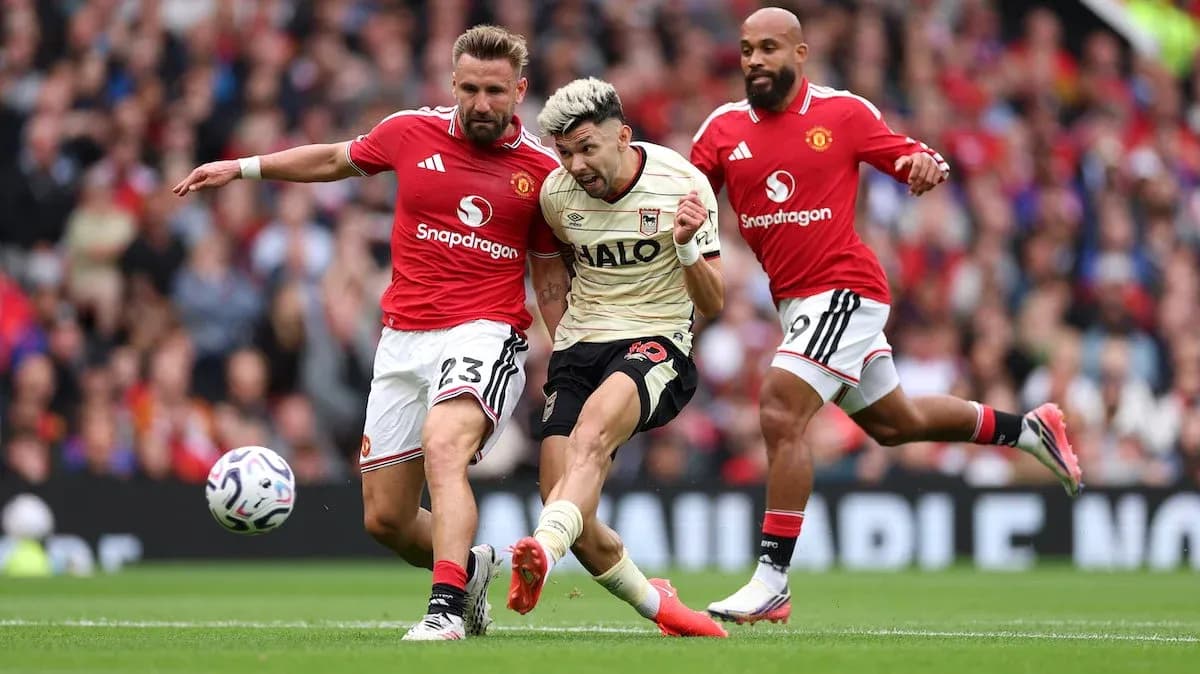
Old Trafford under late‑summer cloud has rarely felt this much like a laboratory. A new Premier League season, a remodelled Manchester United under Michael Carrick, and an Ipswich side learning the top-flight’s cruelty collided in a 5–2 home win that said as much about structure and identity as it did about the scoreline.
I. The Big Picture – Early‑season identities taking shape
Following this result, United sit 10th on three points from two matches, with a goal difference of +1 after scoring 5 and conceding 4 overall. At home they have been explosive: 5 goals for and 2 against in a single outing, an average of 5.0 goals scored and 2.0 conceded at Old Trafford. Away, by contrast, they have yet to score and have shipped 2.
Ipswich leave Manchester in 12th, also on three points from two games but with a goal difference of -2, having scored 4 and conceded 6 overall. Their away profile is stark: on their travels they have scored 2 and conceded 5, an average of 2.0 for and 5.0 against.
Both managers doubled down on a 4‑2‑3‑1, but the similarities ended on the tactics board. United’s version, with S. Lammens behind a back four of D. Dalot, H. Maguire, L. Martinez and L. Shaw, was built to squeeze Ipswich high and funnel possession into an aggressive, technically rich band of three: B. Mbeumo on the right, Bruno Fernandes central and M. Rashford nominally from the left, all servicing M. Cunha.
Ipswich mirrored the shape but not the intent. K. Scherpen marshalled a back line of D. O’Shea, I. Diop, J. Greaves and L. Davis, with S. Lukic and M. Nunez as a double pivot. Ahead of them, A. Fatawu and D. Maeda flanked J. Enciso behind Emersonn. On paper, it was a side built to transition quickly; in practice, it spent long spells trying to survive.
II. Tactical Voids – Absences and discipline
Carrick’s squad was notably patched. C. Baleba (ankle), A. Diallo, T. Heaton, M. Mount (foot), M. Ugarte (knee) and M. de Ligt (back) were all listed as missing, stripping United of depth in midfield control, right‑sided flair, leadership at the back and rotation in goal. That context makes the reliance on K. Mainoo and Y. Tielemans as the double pivot even more pronounced: both were asked to cover huge spaces, recycle possession and protect a centre‑back pairing in which Maguire, not de Ligt, had to step forward as organiser.
Ipswich had their own gaps. Florentino (inactive), A. Matusiwa, J. Philogene and J. Taylor (knee) were all unavailable, depriving Gary O’Neil of an extra ball‑winner, a dynamic wide threat and another midfielder capable of slowing United’s tempo. The result was a pivot that could be overrun when United accelerated through the middle.
From a disciplinary standpoint, both sides came into this game with a clear pattern. United’s yellow cards this season have been concentrated late in halves: 50.00% between 31–45 minutes and 50.00% between 91–105 minutes. Ipswich’s bookings have clustered earlier: 66.67% between 31–45 minutes and 33.33% between 46–60. That timing matters. United tend to tighten the screw as halves close; Ipswich tend to crack just as the game’s rhythm settles. In a match where United were always likely to dominate territory at home, those curves tilted the psychological edge towards the hosts.
III. Key Matchups – Hunter vs Shield, and the engine room
The headline duel was always going to be Bruno Fernandes versus Ipswich’s defensive structure. Heading into this game, Bruno led the Premier League scoring charts with 3 goals and 1 assist in 2 appearances, from 5 shots (4 on target) and 151 passes at 84% accuracy. He arrived not just as a creator but as a finisher, including one successfully converted penalty this season from one attempt, with no misses.
Ipswich’s “shield” around the box – Diop and Greaves behind Lukic and Nunez – was tasked with limiting his influence between the lines. But Ipswich’s overall defensive numbers painted a fragile picture: overall they had conceded 6 goals in 2 matches at an average of 3.0 per game, with 5 of those goals coming away from home at an away average of 5.0 conceded. Against a United side averaging 5.0 goals scored at home, the matchup was always weighted heavily towards the hunter.
Out wide, A. Fatawu and J. Enciso formed Ipswich’s creative axis. Enciso arrived as one of the league’s top assist providers with 2 assists in 2 appearances, 47 passes at 85% accuracy and 11 dribble attempts with 6 successes. Fatawu, too, had 1 assist, 5 key passes and 12 dribble attempts with 6 completed, plus 5 tackles and 1 interception – a two‑way winger capable of both breaking and mending attacks.
Their challenge was to exploit the spaces behind Rashford and Mbeumo when United’s full‑backs advanced. Dalot and Shaw, encouraged to push high, left zones that Ipswich could, in theory, attack through quick diagonals into Maeda and Emersonn. Emersonn himself had 1 goal in 2 appearances and had won 8 of 18 duels, with 2 successful dribbles from 2 attempts – signs of a forward willing to engage defenders one‑on‑one.
But for that to matter, Ipswich needed clean progression through Lukic and Nunez under pressure from Mainoo and Tielemans. United’s young anchor, Mainoo, was pivotal in screening the back four and stepping into midfield traps, while Tielemans’ passing range allowed United to switch play away from Ipswich’s pressure. Every time United broke Ipswich’s first line, Enciso and Fatawu were forced backwards, blunting their threat and pinning Ipswich in a 4‑5‑1 low block.
On the United bench, P. Dorgu loomed as a disciplinary subplot. Already among the league’s leading card collectors with 1 yellow in 2 appearances and 4 fouls committed, his aggression is both a weapon and a risk in closing phases. In a match where Ipswich’s dribblers were likely to chase the game late, his introduction would always carry the possibility of another booking in that 76–90 or 91–105 window where United’s cards have clustered.
For Ipswich, C. Akpom and S. W. Egeli represented late‑game chaos options. Akpom, with 1 goal in 2 appearances and 14 duels contested (5 won), brings penalty‑box presence; Egeli offered fresh legs against a high line. Yet Ipswich’s inability to establish a stable platform in midfield meant those weapons were often introduced into damage‑limitation scenarios rather than balanced contests.
IV. Statistical Prognosis – United’s edge in structure and firepower
Strip away the noise and the numbers align with the eye test. United’s overall attacking average of 2.5 goals per game, turbocharged by 5.0 at home, meets an Ipswich defence conceding 3.0 overall and 5.0 away. Ipswich’s own attacking output – 2.0 goals per game overall, 2.0 on their travels – is respectable, but it is constantly forced to chase deficits created by a porous back line.
United’s penalty record this season is spotless: 1 taken, 1 scored, no misses. Ipswich have yet to take a spot‑kick. In a match where United’s ball‑dominance and box entries were always likely to be higher, that composure from the spot only widened the gap in expected outcomes.
Defensively, United are far from watertight, conceding 2.0 goals per match overall, but the structure is more coherent than Ipswich’s and better protected by their double pivot. With Bruno in peak form, Rashford and Mbeumo stretching the width, and Cunha tying up centre‑backs, the probability landscape heavily favoured a high‑scoring United win – exactly what unfolded.
Following this result, the early‑season story is clear: Manchester United at Old Trafford are a high‑variance, high‑output machine still bedding in a new spine, while Ipswich are a brave, creative side whose open wounds at the back threaten to undo their best work. If these trends continue, United’s climb from mid‑table is a matter of time; for Ipswich, survival will depend on how quickly O’Neil can turn their 4‑2‑3‑1 from a mirror into a shield.
Related News
Bournemouth vs Liverpool Prediction: Key Stats and Betting Tips
Tottenham vs Aston Villa Predicted Lineups: Team News for Premier League Clash
Brighton vs Arsenal: Premier League Clash Preview
Manchester City vs Sunderland: Premier League Clash Preview
Tottenham vs Aston Villa: Early Relegation Battle
Brentford vs Chelsea Predicted Lineups: Team News and Match Insights