
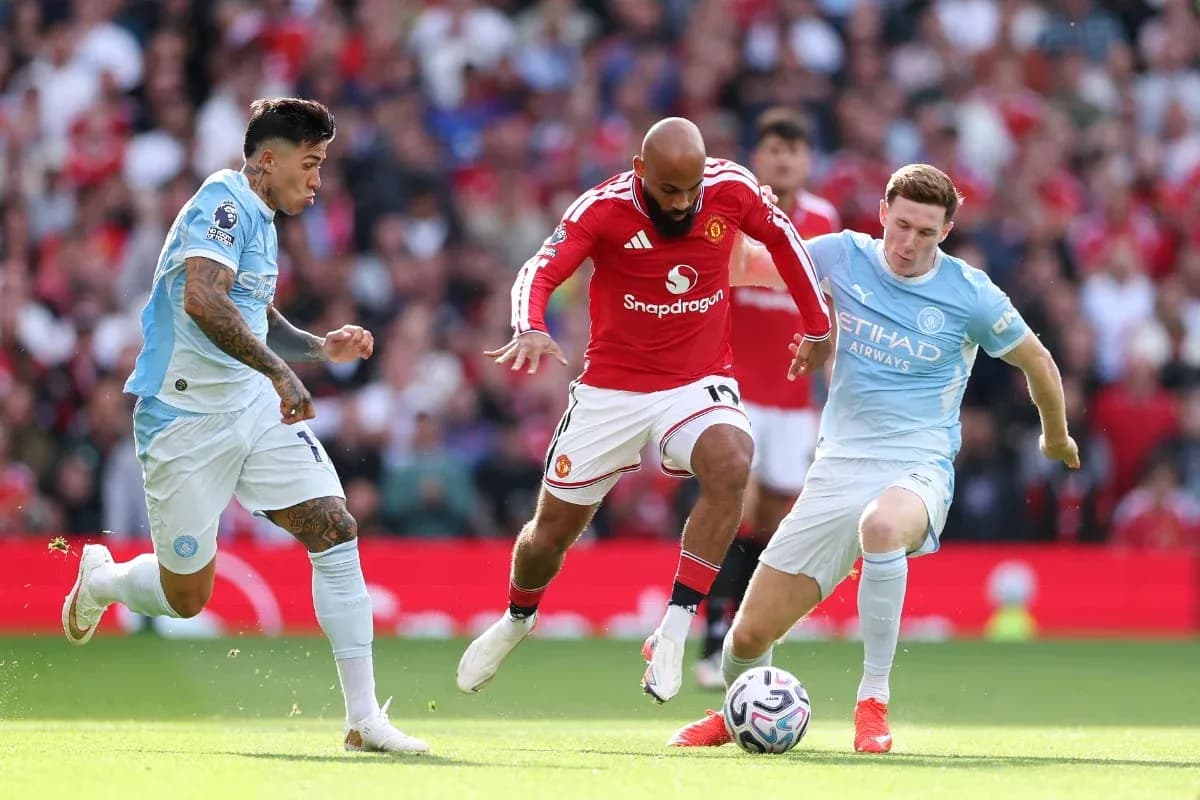
Manchester City Dominates Manchester United in Tactical Battle
Old Trafford under grey Manchester skies, a familiar theatre for drama, instead staged a tight, tactical chess match that ended with a cold, simple truth: Manchester City are already operating at a different level. In a 1–0 away win that preserved their perfect start to the Premier League season, the league’s most ruthless machine ground down a Manchester United side still trying to work out what it wants to be.
This was Round 4 of the regular season, but it felt like a status check. Heading into this game, United were 13th with 4 points from 4 matches, their overall goal difference exactly balanced at 0, seven scored and seven conceded. At Old Trafford they had been more expansive, with 5 home goals for and 3 against across 2 matches, an average of 2.5 goals for and 1.5 against at home. City arrived as early-season juggernauts: 4 wins from 4, 8 goals scored and only 2 conceded overall, a goal difference of +6, and a flawless away record with 5 goals for and 1 against in 2 trips, averaging 2.5 scored and 0.5 conceded on their travels.
Both coaches mirrored each other on the board with a 4‑2‑3‑1, but the same numbers carried very different meanings.
For United, Michael Carrick’s selection was as much about who was missing as who played. An entire spine of experience and defensive security was absent: M. de Ligt (back injury), M. Ugarte (knee injury), L. Shaw, T. Heaton and A. Diallo all listed as unavailable, with C. Baleba also out through an ankle injury. The knock-on effect was visible everywhere. S. Lammens started in goal behind a back four of Diogo Dalot, H. Maguire, Lisandro Martínez and P. Dorgu. In front of them, Y. Tielemans and K. Mainoo formed the double pivot, with B. Mbeumo, Bruno Fernandes and M. Rashford supporting Matheus Cunha.
The structure looked progressive on paper, but it was fragile in key zones. Without Shaw’s balance on the left and Ugarte’s ball-winning presence, United’s defensive transitions were always going to be tested. Their season numbers heading into this match underlined the concern: no clean sheets at home or away in 4 games, and 1.8 goals conceded per match overall. The late-game discipline profile was also worrying: 50.00% of their yellow cards had come between 76–90 minutes, with another 16.67% between 91–105, a pattern of losing composure just as games stretch.
City, by contrast, arrived with a near-complete engine. Only J. Doku was missing through a calf injury, but Enzo Maresca’s side had already developed a new attacking grammar. G. Donnarumma anchored the side in goal; a back four of Matheus Nunes, M. Guéhi, Rúben Dias and J. Gvardiol sat behind a double pivot of E. Fernández and E. Anderson. Ahead of them, the creative trident of P. Foden, R. Cherki and A. Semenyo buzzed around the league’s most feared finisher, E. Haaland.
The “Hunter vs Shield” duel at the heart of this derby was brutally one-sided on form. Haaland entered with 4 goals in 4 appearances, 15 shots with 9 on target, and a rating of 7.91, the league’s standout centre-forward. United’s “shield” was a back line that, in total this campaign, had allowed 7 goals in 4 games, with Maguire both central and exposed. He had played every minute, winning 21 of 34 duels and blocking 1 shot, but his disciplinary line was already heavy: 2 yellow cards from 7 fouls committed, and a place among the league’s top carded defenders. Against Haaland’s relentless movement and City’s layered supply line, that was a dangerous tightrope.
The creative axis on the other side of the ball offered United some hope. Bruno Fernandes came into the derby with 3 goals and 1 assist in 4 matches, 262 completed passes at 85% accuracy, and 9 key passes. He had also converted United’s only penalty of the season, scoring 1 from 1 to keep their spot-kick record perfect so far. His opposite number in the creative stakes, R. Cherki, was quietly becoming City’s new conductor: 2 goals, 2 assists, 10 key passes and 185 completed passes at 91% accuracy in 220 minutes. Cherki’s ability to slip between lines and combine with Haaland and Semenyo made him the most dangerous “10” on the pitch.
Around them, the “Engine Room” battle was defined by contrasts. Tielemans and Mainoo offered United control and progression but little natural destruction. E. Fernández and E. Anderson, by contrast, gave City both a passing platform and a barrier in front of their centre-backs. That difference mapped neatly onto the season trends: City’s overall defensive average of 0.5 goals conceded per game, with clean sheets both home and away, against United’s leaky 1.8 conceded and a complete absence of shutouts.
Discipline added another layer of tactical tension. City’s yellow cards had been clustered in the 31–45, 46–60 and 76–90 minute bands, with 42.86% of their cautions coming late in games. More significantly, they already had a red card on their ledger through P. Foden, who had combined 1 yellow and 1 straight red in just 4 appearances. That volatility meant Maresca had to balance Foden’s creativity and 2 assists with the risk of being reduced to ten men in a high-emotion derby. United, for all their late bookings, had at least avoided red so far.
From the bench, the tactical vectors were clear. Carrick’s attacking changes could come from B. Šeško, J. Zirkzee and S. Lacey, each offering a different type of threat if Cunha tired or if Rashford was forced inside. Mason Mount and Andrey Santos provided alternative shapes in midfield, either to press higher or to add another runner beyond Bruno. Defensively, N. Mazraoui and L. Yoro were the obvious levers to adjust the back four’s balance or add pace if City’s wide rotations became overwhelming.
Maresca’s options were more about control than chaos. M. Kovačić offered a way to lock down the centre and protect a lead, while A. Bouaddi could add fresh legs in midfield. At the back, R. Lewis, A. Khusanov, N. O’Reilly and Vitor Nunes gave City the flexibility to shift into a back three or simply rotate full-backs to cope with United’s wide threats. In attack, I. Ndiaye and Allan were direct alternatives to Semenyo or Cherki if the game demanded more verticality.
Statistically, the pre-match prognosis always tilted blue. City’s overall average of 2.0 goals for and 0.5 against, combined with a perfect record on their travels, met a United side that had already failed to score twice in 4 games and had never kept a clean sheet. The key intersection of strengths and weaknesses was stark: City’s late-game pressure, reflected in their card profile and sustained attacking output, against United’s tendency to collect cards and lose defensive shape in the final quarter.
In the end, the 1–0 away scoreline simply confirmed what the numbers had been whispering. Following this result, City’s perfect form and defensive steel remain intact, their structure around Haaland and Cherki looking ever more inevitable. United, still 13th with a neutral goal difference over the campaign, are left with the feeling of a side whose attacking talent is real but whose tactical foundations, especially without key injured figures, are not yet ready to withstand a fully formed rival.
Related News
Tottenham vs Aston Villa Predicted Lineups: Team News for Premier League Clash
Manchester City vs Sunderland: Premier League Clash Preview
Tottenham vs Aston Villa: Early Relegation Battle
Brentford vs Chelsea Predicted Lineups: Team News and Match Insights
Brighton vs Arsenal Prediction: Key Stats and Betting Tips
Manchester City vs Sunderland Prediction: Key Insights and Betting Tips