
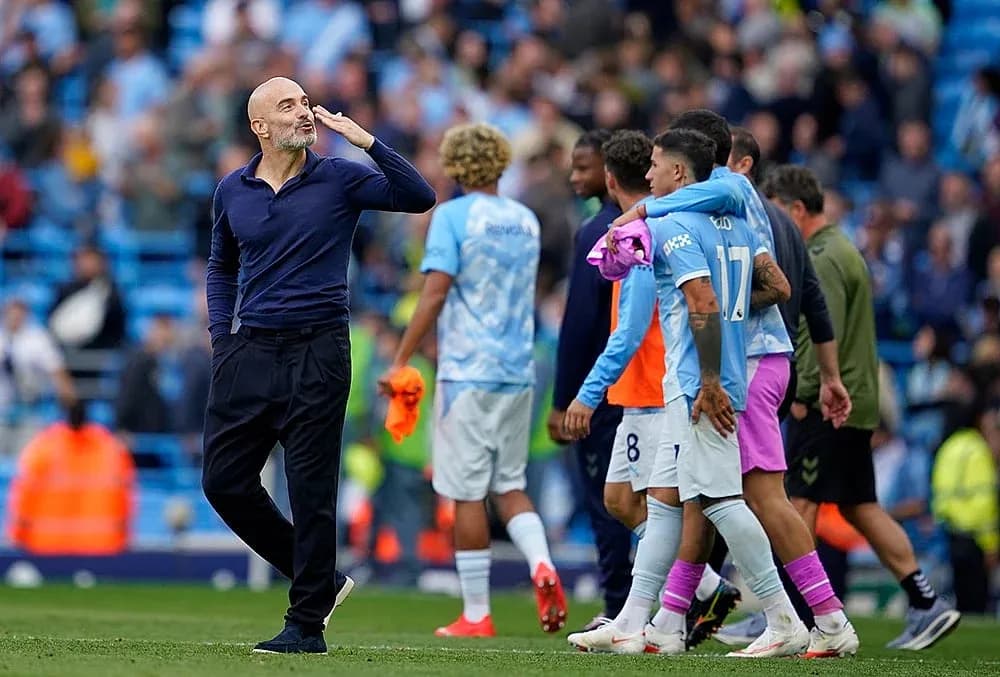
Manchester City vs Coventry: Tactical Analysis of the 1-0 Clash
Under grey Manchester skies at the Etihad Stadium, the narrative was supposed to be routine: the league leaders flexing against the side rooted to the bottom. Manchester City arrived into this Regular Season - 3 clash with Coventry as a machine in motion, three wins from three, top of the Premier League with 9 points and a total goal difference of +5, their attacking rhythm already humming. Coventry, by contrast, stepped into the cauldron with three straight defeats, 0 points, and a total goal difference of -5, still searching for their first goal of the campaign.
The 1–0 scoreline in City’s favour confirms the hierarchy, but the way the squads were constructed and deployed tells a richer story of control, resistance, and the tactical ceiling of both sides.
I. The Big Picture: Structures and Season DNA
Enzo Maresca doubled down on Manchester City’s early-season identity with a 4-2-3-1 that has already become their default – the same structure they have used in all three league matches so far. With City having played 3 league games in total, winning all 3, their attacking returns are stark: 7 goals in total, with 3 at home and 4 on their travels. The total scoring average of 2.3 goals per game, combined with only 2 conceded overall (0.7 per game), underlines why they sit first.
Against Coventry’s 3-4-2-1, Maresca’s shape was about stable superiority in every line. Gianluigi Donnarumma anchored the build-up, shielded by a back four of A. Khusanov, Rúben Dias, Marc Guéhi, and Joško Gvardiol. Ahead of them, Enzo Fernández and E. Anderson formed a double pivot designed to suffocate transitions and dictate tempo, while an aggressive band of three – Antoine Semenyo, Rayan Cherki, and I. Ndiaye – orbited around Erling Haaland.
Coventry, under F. Lampard, arrived with a different kind of identity: one still under construction. Their season numbers tell of a side in survival mode. Across 3 total matches they have failed to score a single goal (0 in total, 0.0 average home, away, and overall) while conceding 5 (1 at home, 4 on their travels, 1.7 in total per game). The shift to a 3-4-2-1 at the Etihad was a clear response to the opponent rather than an expression of a settled philosophy.
C. Rushworth stood behind a back three of A. Amenda, B. Thomas, and Ethan Pinnock, with M. van Ewijk and J. Dasilva tasked with the thankless job of wing-back work against City’s wide overloads. F. Onyeka and M. Grimes tried to form a central dam, while J. Rudoni and E. Mason-Clark supported lone forward T. Awoniyi.
II. Tactical Voids: Absences and Discipline
City’s only notable absentee was J. Doku, ruled out with a calf injury. In a side already rich in creators, his absence narrowed the pure one-v-one threat on the flanks, placing more creative responsibility on Cherki and Semenyo between the lines.
Coventry’s list of missing players was far more structural. Y. Gboho (transfer negotiations), K. Kesler-Hayden (muscle injury), S. Mfuni (loan agreement), L. Woolfenden (knee injury), and H. Wright (muscle injury) all sat out. That stripped Lampard of depth at full-back/wing-back, centre-back, and up front – exactly the zones you want reinforced when facing City’s relentless rotations.
Disciplinary trends across the season added another layer. City’s yellow cards have been spread, with 25.00% of their cautions in each of the 31–45, 46–60, 76–90, and 91–105-minute windows, suggesting a side that occasionally bristles when games become stretched but avoids implosion. No reds, no penalties conceded or taken, and a clean, controlled aggression.
Coventry, however, have shown a more jittery profile. Half of their yellows have come between 16–30 minutes (50.00%), with further spikes late (25.00% from 76–90 and 25.00% from 91–105). That early rashness, particularly in a fortress like the Etihad, risks gifting City set-piece platforms and territorial dominance. Caleb Marfo Yirenkyi, who leads their card charts with 1 yellow in 3 appearances, embodies that edge; his inclusion on the bench here hinted at Lampard’s awareness of discipline as a fault line.
III. Key Matchups: Hunter vs Shield, Engine Room Wars
The headline duel was always going to be Erling Haaland against Coventry’s defensive block. Heading into this game, Haaland had 3 goals in total from 3 appearances, backed by 13 shots (8 on target) and a 7.8 average rating. City’s total attacking average of 2.3 goals per match, combined with Coventry’s total concession rate of 1.7 and 2.0 on their travels, framed this as a mismatch.
Pinnock, B. Thomas, and Amenda formed the last line of resistance. Their remit was simple but brutal: deny Haaland space to run between them, and survive the constant re-positioning of Cherki and Ndiaye. Coventry’s season so far – 0 clean sheets in total, 4 goals conceded away – suggested this shield would bend. That they limited City to a single goal speaks more to their deep block and sheer volume defending than to any broader structural solidity.
In midfield, the engine room battle was decisive. Enzo Fernández and E. Anderson faced F. Onyeka and M. Grimes. Fernández, the metronome, and Anderson, the connector, controlled the central channels, pinning Coventry’s double pivot so deep that Rudoni and Mason-Clark were often forced into auxiliary full-back roles rather than supporting Awoniyi.
Ahead of them, Cherki was the creative fulcrum. With 2 goals and 2 assists in total this campaign, 10 key passes, and a pass accuracy of 92%, he arrived as one of the league’s most incisive playmakers. His pockets of space between Coventry’s back three and midfield four were where City repeatedly pried open the visitors’ shape. Semenyo, with 2 assists in total and 6 key passes, added vertical thrust on the right, constantly dragging wing-backs and wide centre-backs into uncomfortable decisions.
For Coventry, the counterpunch was meant to come through Awoniyi’s hold-up play, with Rudoni and Mason-Clark breaking beyond. But with 0 total goals and 0.0 xG-equivalent output in terms of actual scoring returns so far, the visitors’ attacking patterns remained theoretical more than threatening. Every long ball into Awoniyi was swallowed by the combined authority of Dias and Guéhi, with Gvardiol stepping in aggressively to intercept and then drive City back onto the front foot.
IV. Statistical Prognosis: What This Result Says
Following this result, the numbers harden the narrative. City’s total record moves to 3 wins from 3, 7 scored, 2 conceded, and a total goal difference of +5. At home, they have now played 2, won 2, scoring 3 and conceding 1; an average of 1.5 goals for and 0.5 against at the Etihad underlines a side that can dominate without needing to blow teams away.
Coventry, meanwhile, remain marooned: 3 total defeats, 0 goals for, 5 against, and a total goal difference of -5. On their travels they have played 2, lost 2, conceding 4 and still not scoring. The clean-sheet drought (0 in total) and the fact they have failed to score in all 3 matches reinforce the sense of a team whose primary tactical objective right now is damage limitation.
From an xG-style perspective, City’s profile – high shot volume, elite individual finishers like Haaland, and creators such as Cherki, Semenyo, and P. Foden (2 total assists) – suggests their attacking output is sustainable. They have yet to take or miss a penalty this season, so there is no artificial inflation from the spot.
Defensively, the combination of Donnarumma’s presence, Gvardiol’s all-round contribution (1 total goal, 1 total assist, 7 tackles, 5 interceptions), and the controlled aggression of the back line points to a unit that can keep conceding at or below their current total rate of 0.7 per game.
For Coventry, the statistical prognosis is harsher. A total scoring average of 0.0 and a concession rate of 2.0 on their travels is relegation form. Lampard’s tactical switches – three different formations in three matches – speak to a coach still searching for a stable platform. Until they find a consistent attacking structure that turns Awoniyi’s presence and Mason-Clark’s movement into tangible chances, their story will remain one of gallant resistance rather than genuine threat.
At the Etihad, the squads told the tale: one built to chase titles with layered solutions in every line, the other scrambling to discover an identity sturdy enough simply to stay in the division. The 1–0 felt narrow on the scoreboard, but in the deeper tactical and statistical currents, the gulf between Manchester City and Coventry looked every bit as wide as the table suggests.
Related News
Tottenham vs Aston Villa Predicted Lineups: Team News for Premier League Clash
Brighton vs Arsenal: Premier League Clash Preview

Manchester City vs Sunderland: Premier League Clash Preview
Tottenham vs Aston Villa: Early Relegation Battle

Brentford vs Chelsea Predicted Lineups: Team News and Match Insights
Brighton vs Arsenal Prediction: Key Stats and Betting Tips