
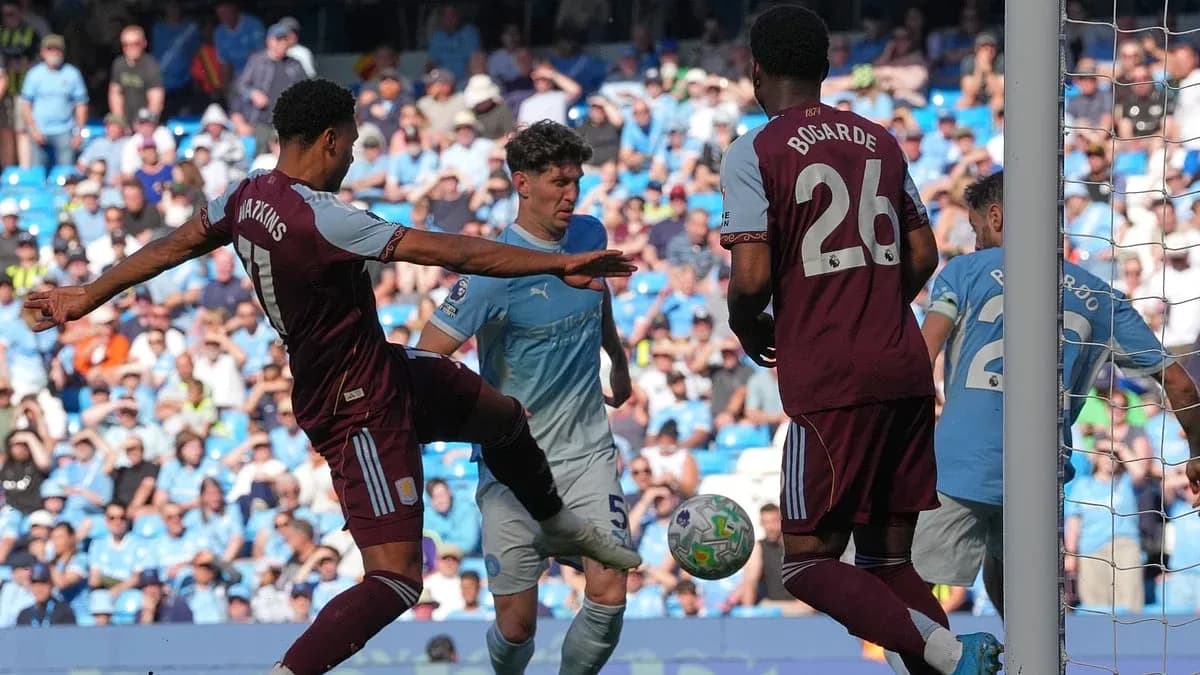
Manchester City vs Aston Villa: Tactical Battle and Key Moments
Manchester City’s 1-2 defeat to Aston Villa at Etihad Stadium unfolded as a story of structural control versus vertical efficiency. Pep Guardiola’s 4-2-2-2 gave City a platform for dominance in territory and possession (52%, 458 passes), but Unai Emery’s 4-2-3-1 was sharper in transition and more ruthless in the box, converting a lower volume of shots (12 to City’s 16) into a higher attacking yield and a comeback win.
City’s shape was clear from the lineup grid. J. Trafford (Manchester City) sat behind a back four of Rico Lewis, John Stones, Ruben Dias and Nathan Ake. In front, Nico and Bernardo Silva formed a double pivot, with A. Semenyo and Savinho as the advanced midfield line, and Phil Foden plus T. Reijnders nominally as a front two. In practice, this morphed into a 2-3-5 in settled possession: Lewis stepped high and narrow, Nico dropped to assist first-phase build-up, and Foden roamed between lines, leaving Reijnders as the highest reference.
Aston Villa’s 4-2-3-1 was more orthodox. M. Bizot (Aston Villa) was protected by a back four of A. Garcia, Victor Lindelof, Tyrone Mings and Ian Maatsen. Douglas Luiz and L. Bogarde anchored midfield, with Leon Bailey and Emiliano Buendia wide, Ross Barkley as the central creator and Ollie Watkins leading the line. Out of possession, Villa were compact in a 4-4-2/4-4-1-1, with Barkley stepping up alongside Watkins to screen City’s pivots.
The first half largely followed a Guardiola script. City controlled rhythm through short passing (458 total passes, 405 accurate at 88%), using the double pivot to circulate around Villa’s first line and pin the visitors deep. Their shot profile – 16 total attempts, 10 inside the box, 6 blocked – reflects sustained pressure against a low block that often had to defend its own area. The breakthrough on 23 minutes, when A. Semenyo scored for Manchester City, was the logical outcome of that territorial squeeze: City managed to access the half-spaces and attack the box with numbers, forcing Villa’s line back and finally finding a clean finish.
Yet the underlying numbers hinted that Villa were not passive victims. Despite less possession (48%), they produced 12 shots, 9 of them inside the box, and finished with a higher xG (1.58 to City’s 1.25). That speaks to Emery’s plan: absorb, then punch directly into space once City’s structure was stretched. Watkins was central to this; his movement on the shoulder of Dias and into the channels behind Lewis and Ake created constant jeopardy even when Villa were defending deep.
Second Half
The second half showcased that plan in full. Emery’s first adjustment came immediately: Matty Cash (IN) came on for A. Garcia (OUT) at 46', adding more athleticism and direct running on the right. Within a minute, Watkins equalised at 47' for Aston Villa, capitalising on the loosened control that often plagues City just after the interval. The goal underlined Villa’s verticality: a quick progression, Watkins attacking space before City could re-form their rest defence.
Guardiola responded by refreshing his attacking lanes. At 58', R. Cherki (IN) came on for A. Semenyo (OUT), and at 59' M. Kovacic (IN) replaced Bernardo Silva (OUT), tilting the structure towards more line-breaking carries and late box arrivals from deeper midfield. But just as City were reshaping, Villa struck again. At 61', Watkins scored his second, assisted by Barkley, a sequence that was then confirmed by VAR at 63'. Barkley’s role between the lines was crucial: he occupied Nico and Kovacic, then turned quickly to release Watkins into the gaps between centre-back and full-back. City’s rest defence – with full-backs high and the double pivot slightly disjointed after the changes – was exposed.
From that point, the tactical battle became one of City’s positional siege against Villa’s compactness and game management. Emery executed a triple substitution on 73' to reinforce legs and structure: Y. Tielemans (IN) for Douglas Luiz (OUT), P. Torres (IN) for Lindelof (OUT), and A. Onana (IN) for L. Bogarde (OUT). Tielemans added composure in possession and better ball retention under pressure, while Torres’ introduction gave Villa a more assured distributor at the back to help them play through City’s press when possible.
Guardiola, in turn, pushed further chips forward: at 77', J. Doku (IN) replaced Reijnders (OUT) to provide direct 1v1 threat from wide, and R. Ait-Nouri (IN) came on for Ake (OUT), a more attacking full-back profile on the left. On 78', J. Gvardiol (IN) replaced Stones (OUT), effectively leaving Dias and Gvardiol to manage transitions while full-backs and wide players flooded forward. The risk-reward balance shifted heavily towards risk; City increased their territorial dominance but left themselves vulnerable to counters they ultimately managed to survive only because Villa chose control over further expansion.
Discipline and duels subtly shaped the closing stages. City committed more fouls (8 to Villa’s 4), a reflection of their need to counter-press aggressively after turnovers. The only card of the match came on 82': Rico Lewis (Manchester City) was booked — “Foul”. That moment captured City’s urgency and occasional desperation in stopping transitions before they reached Dias and Gvardiol.
Emery’s final substitution at 86' – J. McGinn (IN) for Barkley (OUT) – was a classic game-state move. McGinn added defensive work-rate and pressing from midfield, turning Villa’s 4-2-3-1 into something closer to a 4-5-1 in the last minutes, with Watkins increasingly isolated but supported by a tightly packed midfield line.
In goal, both keepers mirrored the balance of the contest. J. Trafford (Manchester City) made 3 saves, with goals prevented measured at 0.28, roughly in line with the quality of Villa’s best chances that did beat him. M. Bizot (Aston Villa) recorded 2 saves and also 0.28 goals prevented, underlining that while City got into shooting positions, many of their 16 attempts were either blocked (6) or from sub-optimal angles that did not excessively test him.
Statistically, the verdict supports the narrative of a controlled but blunt City against a precise Villa. City’s slight edge in possession (52%), corners (9 to 4) and volume of shots did not translate into a higher xG, and their 1.25 xG aligns closely with the single goal they scored. Villa’s 1.58 xG, 5 shots on target and 9 shots inside the box reveal a side that picked their moments and attacked with clarity.
The late drama at 90+2', when a potential goal by Phil Foden for Manchester City was disallowed by VAR, encapsulated the fine margins. Structurally, City had tilted the pitch, but Villa’s compactness, substitutions and transitional threat proved enough to preserve a 1-2 away win that was both tactically coherent and statistically justified.
Related News

Brighton vs Arsenal Predicted Lineups: Team News and Match Insights

Manchester City vs Sunderland Predicted Lineups: Team News and Match Analysis
Bournemouth vs Liverpool Prediction: Key Stats and Betting Tips

Tottenham vs Aston Villa Predicted Lineups: Team News for Premier League Clash
Brighton vs Arsenal: Premier League Clash Preview

Manchester City vs Sunderland: Premier League Clash Preview