
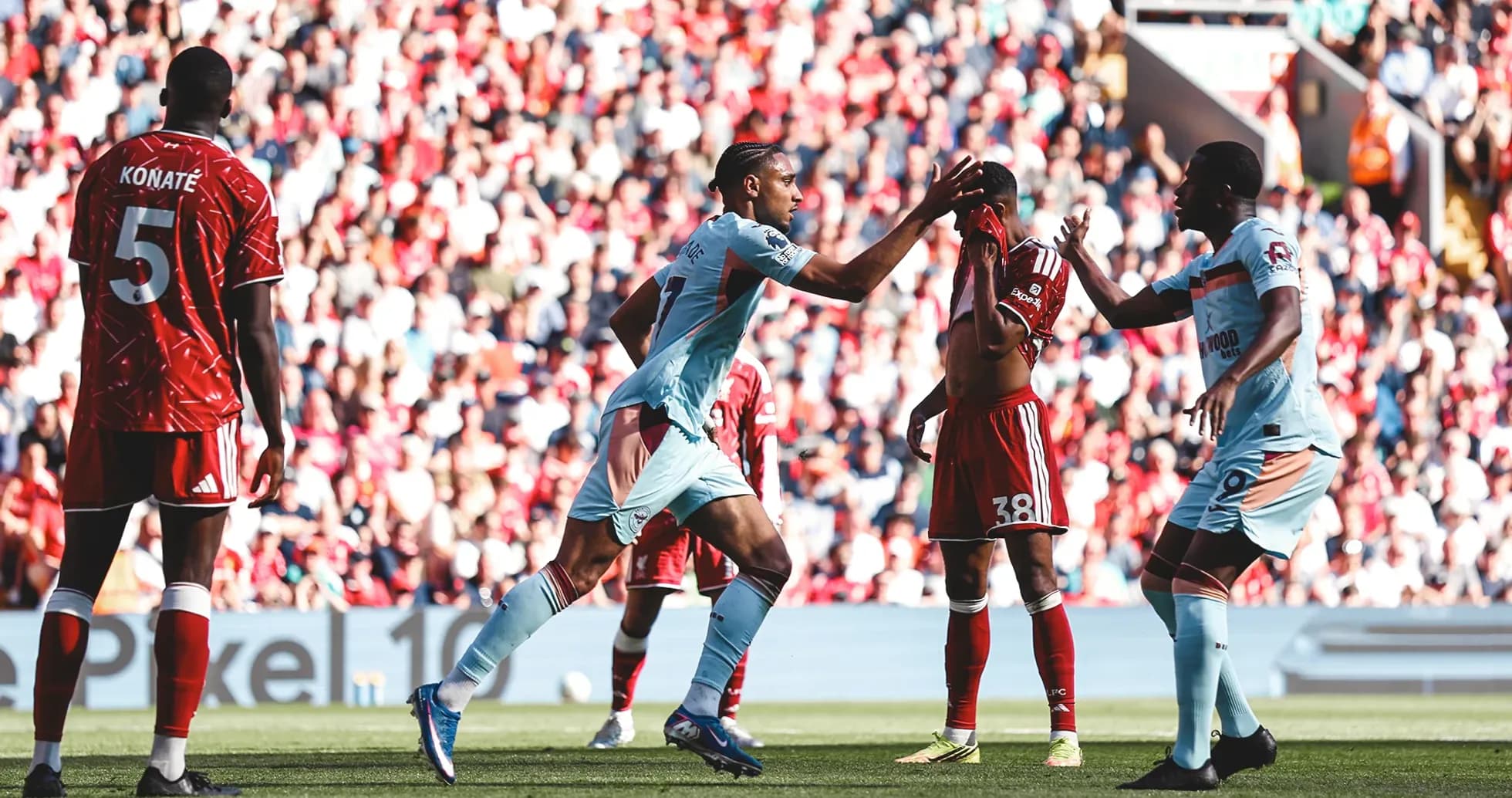
Liverpool and Brentford: A Tactical Stalemate at Anfield
Anfield’s final act of the 2025–26 Premier League season ended in a stalemate, a 1–1 draw that neatly encapsulated the contrasting arcs of Liverpool and Brentford. Following this result, Liverpool closed the campaign in 5th on 60 points, their overall goal difference of 10 built on 63 goals scored and 53 conceded. Brentford, punching above their historical weight, finished 9th with 53 points and an overall goal difference of 3, the product of 55 goals for and 52 against.
I. The Big Picture – Two 4-2-3-1s, two different identities
Both sides set up in a 4-2-3-1, but the shapes were painted in very different colours.
Liverpool’s XI under Arne Slot was bold and front‑footed: Alisson behind a back four of C. Jones, Ibrahima Konaté, Virgil van Dijk and Andrew Robertson. Ahead of them, a double pivot of Ryan Gravenberch and Alexis Mac Allister underpinned an attacking band of three – Mohamed Salah, Dominik Szoboszlai and the young R. Ngumoha – with Cody Gakpo as the nominal striker.
This alignment mirrored Liverpool’s broader seasonal DNA. Heading into this game, they had leaned heavily on the 4-2-3-1, using it in 34 of 38 league fixtures. At home they were strong: 10 wins, 6 draws and just 3 defeats from 19 matches, scoring 34 and conceding 20. That home average of 1.8 goals for and 1.1 against reflected a side that usually imposed itself at Anfield, even if their overall defensive record (53 conceded in total, 1.4 per game) betrayed vulnerability.
Brentford, under Keith Andrews, matched the 4-2-3-1 but with a more pragmatic, transition‑minded twist. Caoimhín Kelleher started in goal, shielded by M. Kayode, S. van den Berg, Nathan Collins and K. Lewis‑Potter. In midfield, the industrious pairing of J. Henderson and Vitaly Janelt sat beneath an energetic trio of D. Ouattara, M. Jensen and Kevin Schade, all servicing the league’s second‑ranked scorer, Igor Thiago.
Their season told a story of stubborn resilience. Heading into this game, Brentford’s away record read 6 wins, 3 draws and 10 defeats, with 22 goals scored and 31 conceded on their travels. That away average of 1.2 goals for and 1.6 against underlined a team that accepted risk, leaned into transitions and trusted its cutting edge to offset defensive exposure.
II. Tactical Voids – Who was missing, and what changed
Both squads arrived at Anfield with notable absences that subtly reshaped the tactical chessboard.
Liverpool were without S. Bajcetic (hamstring), C. Bradley (knee), H. Ekitike (Achilles) and G. Leoni (knee). The absence of Ekitike, who had delivered 11 goals and 4 assists in the league, removed a direct, vertical threat from the bench and forced Slot to lean even more heavily on Gakpo’s all‑round profile and Salah’s creative burden. With Bradley unavailable, the choice of C. Jones as a nominal full‑back hinted at an asymmetric build‑up: Jones stepping inside to form a back three in possession, freeing Robertson to push high on the left.
Brentford’s injury list – F. Carvalho (knee), R. Henry (hamstring) and A. Milambo (knee) – was felt most keenly in their left‑side balance. With Henry missing, Lewis‑Potter filled in at left‑back, giving Brentford a more adventurous outlet in wide build‑up but also a potential defensive soft spot for Salah and Szoboszlai to probe.
Disciplinary profiles for both teams framed the risk zones. Liverpool’s yellow cards this season skewed heavily late: 31.58% of their bookings came between 76–90 minutes, and a further 17.54% between 91–105. Brentford mirrored that late‑game edge, with 26.09% of their yellows in the 76–90 window and 21.74% between 61–75. Both sides, in other words, tended to fray at the edges as legs tired and spaces opened.
Red cards had also shaped their narratives. Dominik Szoboszlai’s solitary dismissal for Liverpool and Kevin Schade’s for Brentford were reminders that both creative hubs carried a combustible streak. Szoboszlai’s season also included a missed penalty, preventing Liverpool from claiming a perfect record from the spot despite a team tally of 1 penalty scored from 1 overall. Brentford, by contrast, had been ruthlessly efficient from 12 yards: 8 penalties scored in total, with Thiago personally converting 8 but also missing 1 over the campaign.
III. Key Matchups – Hunter vs Shield, Engine Room battles
The headline duel was always going to revolve around Igor Thiago. With 22 league goals and 8 penalties scored, he arrived as one of the division’s most ruthless finishers, a 191‑centimetre focal point who relishes duels (524 contested, 202 won) and thrives on early service and quick crosses.
His opposite numbers were Van Dijk and Konaté, the core of a Liverpool defence that, despite conceding 53 overall, had been relatively secure at home with just 20 against. Their task was to manage Thiago’s physicality while protecting the space in front of Alisson from Jensen’s late runs and Schade’s diagonal darts. Any lapse in concentration, particularly in the final quarter‑hour where Liverpool’s card data suggests rising defensive stress, risked inviting Brentford’s penalty‑box specialist into decisive moments.
In midfield, the contest was framed by two creative hubs and two enforcers.
For Liverpool, Szoboszlai and Salah combined as dual playmakers. Szoboszlai’s season – 7.19 average rating, 2,184 passes at 87% accuracy and 78 key passes – underscored his role as the side’s metronome and line‑breaker. Salah, with 7 goals and 7 assists, added incision and gravity, drawing defenders wide and opening central lanes for Gakpo and underlapping runs from Mac Allister.
Brentford’s counterweight came from Janelt and Henderson. Janelt’s positional discipline and work rate were designed to clog the half‑spaces where Szoboszlai operates, while Henderson’s experience and range of passing helped Brentford break Liverpool’s press and find Thiago early. M. Jensen, floating between the lines, acted as the bridge, tasked with exploiting any disjoint between Liverpool’s double pivot and their centre‑backs.
On the flanks, Schade’s duel with Robertson and Jones was pivotal. Schade’s 75 dribbles attempted and 8 league goals spoke to his directness; Robertson’s aggression in pushing high created the classic risk‑reward scenario. If Liverpool pinned Brentford back, the Scot’s overlaps could overload Lewis‑Potter. But every turnover risked Schade and Ouattara springing into the vacated channels.
IV. Statistical Prognosis – A draw that fits the numbers
Following this result, the 1–1 scoreline felt almost mathematically appropriate. Liverpool’s overall averages heading into the game – 1.7 goals scored and 1.4 conceded per match – met a Brentford side sitting at 1.4 scored and 1.4 conceded overall. At Anfield specifically, Liverpool’s 1.8 home goals for against Brentford’s 1.6 away goals against always hinted at a narrow margin rather than a rout.
Defensively, both teams were solid but not impermeable, each boasting 10 clean sheets in total yet still conceding over 50 across the campaign. In xG terms – even without explicit numbers – the profiles suggest a contest where Liverpool’s territorial dominance and volume of chances were offset by Brentford’s efficiency in transition and set‑piece threat, especially with Thiago’s penalty pedigree looming over any box incident.
The late‑game card distributions for both sides suggested that the final 15 minutes would be frenetic, emotionally charged and tactically stretched. That phase was always likely to produce either a decisive goal or a decisive mistake. Instead, it produced equilibrium: Liverpool’s attacking structure, defined by their 4‑2‑3‑1 and creative spine of Szoboszlai, Salah and Gakpo, met Brentford’s resilient, opportunistic version of the same shape, anchored by Thiago and Schade.
In the end, the draw crystallised where these squads stand. Liverpool, 5th and Champions League‑bound, remain a high‑ceiling side still searching for defensive consistency. Brentford, 9th, walk away from Anfield and the season with proof that their 4‑2‑3‑1, built around Thiago’s goals and a hard‑working midfield, can go toe‑to‑toe with the league’s elite without surrendering their identity.
Related News
Brighton vs Arsenal Predicted Lineups: Team News and Match Insights
Manchester City vs Sunderland Predicted Lineups: Team News and Match Analysis
Bournemouth vs Liverpool Prediction: Key Stats and Betting Tips
Tottenham vs Aston Villa Predicted Lineups: Team News for Premier League Clash
Brighton vs Arsenal: Premier League Clash Preview
Manchester City vs Sunderland: Premier League Clash Preview