
Liverpool and Brentford End Season with Tactical Draw at Anfield
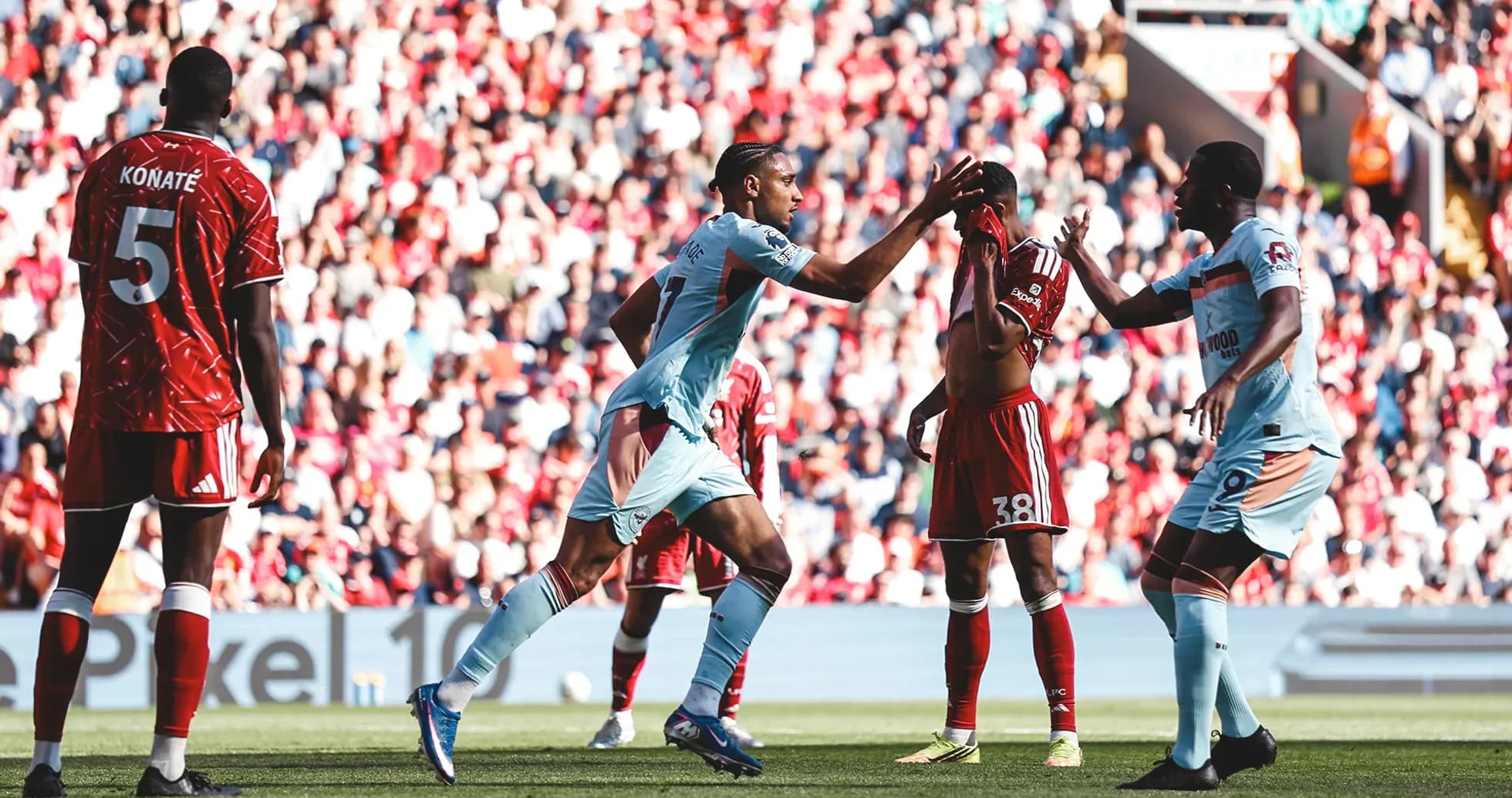
Liverpool and Brentford closed their Premier League seasons at Anfield with a 1-1 draw that was tactically defined by mirrored 4-2-3-1 structures, but very different strategic intentions. Arne Slot’s Liverpool used the system to dominate territory and volume, while Keith Andrews’ Brentford treated the same shape as a counter-punching and containment tool. The numbers tell the core story: Liverpool produced 24 total shots to Brentford’s 11, held 60% possession, and generated 2.9 xG against Brentford’s 1.22, yet needed only a single goal to avoid defeat.
In Liverpool’s 4-2-3-1, the back four of C. Jones, I. Konate, V. van Dijk and A. Robertson played unusually high, compressing the game into Brentford’s half. The double pivot of R. Gravenberch and A. Mac Allister underpinned this aggression. With 503 total passes and 434 accurate (86%), Liverpool circulated the ball with patience, using the pivots to recycle possession and keep Brentford penned in. Mac Allister, in particular, acted as the metronome, dropping alongside the centre-backs to start build-up and then stepping into the right half-space to connect with M. Salah and D. Szoboszlai.
The key attacking mechanism was the overload on Liverpool’s right. Salah, nominally listed as a midfielder, operated as an inverted winger, frequently receiving between the lines to draw Brentford’s left-back K. Lewis-Potter (before his late substitution) and the near-side pivot V. Janelt out of shape. Szoboszlai worked in the right half-space and C. Jones pushed high from right-back, creating a three-man lane that Brentford struggled to close without collapsing their block. The opening goal at 58’ reflected this pattern: Salah found time and angle to deliver, and C. Jones arrived from the defensive line to finish, underlining how Slot used a full-back as an extra attacker rather than a conventional defender.
On the left, Robertson and R. Ngumoha (later replaced by F. Wirtz) provided width, but the primary threat still came through the central and right channels. With 17 shots inside the box out of 24 total, Liverpool consistently managed to access high-value zones. The 14 corner kicks underline how often they forced Brentford into last-ditch clearances and blocks (the visitors made 3 blocked shots to Liverpool’s 8), but the finishing and final decision-making lacked precision.
Defensively, Liverpool’s structure was a 2-2 rest-defense in settled attacks: Konate and Van Dijk stayed back, screened by Gravenberch and Mac Allister. This kept Brentford’s transitions mostly under control, limiting them to 11 total shots and just 2 on goal. The single Brentford goal at 64’, from K. Schade, came in the aftermath of Liverpool’s own attacking dominance, when the home side were slightly stretched after the earlier breakthrough and Brentford finally managed to exploit space behind the advanced full-backs.
Brentford’s 4-2-3-1 was far more conservative. The back four of M. Kayode, S. van den Berg, Nathan Collins and K. Lewis-Potter held a deeper line, with Henderson and Janelt as a compact double pivot ahead of them. In possession, they built with 331 total passes and 262 accurate (79%), but their primary objective was to survive Liverpool’s pressure and then spring forward quickly through the line of D. Ouattara, M. Jensen, K. Schade and I. Thiago. Their 9 shots inside the box from only 11 total attempts show that when they did progress, they were direct and selective, targeting quick entries rather than sustained pressure.
Out of possession, Brentford shifted into a narrow 4-4-1-1, with Jensen or Schade dropping alongside the pivots to form a central block. The discipline events reflect the emotional strain of constant defending: Jordan Henderson was booked for “Argument” even before kick-off time in the event log, then later Nathan Collins and Vitaly Janelt both received yellow cards for “Argument” deep into added time, indicative of a side under sustained stress. Yet structurally they held their line well enough to funnel Liverpool into crowded central areas, where bodies could block and contest shots.
The substitutions on both sides were tactical nudges rather than wholesale system changes. For Brentford, A. Hickey (IN) came on for J. Henderson (OUT) at 60’, effectively rebalancing the side with fresher legs and a more natural defender, helping shore up the right flank as Liverpool’s right-sided overload intensified. Later, R. Nelson (IN) for K. Lewis-Potter (OUT) at 89’ added pace for late counters while keeping the 4-2-3-1 intact.
Liverpool’s changes were about refreshing the attacking line and maintaining tempo. F. Wirtz (IN) for R. Ngumoha (OUT) at 73’ and J. Frimpong (IN) for M. Salah (OUT) at 74’ preserved the wide threat and half-space creativity while adding energy against a tiring block. M. Kerkez (IN) for A. Robertson (OUT) and T. Nyoni (IN) for R. Gravenberch (OUT) at 83’ kept the full-back and midfield intensity high, while J. Gomez (IN) for I. Konate (OUT) at 89’ was a late defensive refresh, ensuring aerial security against any direct Brentford balls.
In goal, Alisson (Liverpool) was largely a spectator in terms of shot-stopping, credited with 1 save, which aligns with Brentford’s 2 shots on goal and reflects how well Liverpool’s high line and rest-defense limited clear attempts. At the other end, C. Kelleher (Brentford) made 7 saves against Liverpool’s 8 shots on target, a crucial factor in the 1-1 outcome. His performance, combined with Brentford’s 1.4 goals prevented figure, underpinned the visitors’ ability to withstand a sustained xG deficit.
The statistical verdict reinforces the tactical reading. Liverpool’s 60% possession, 24 total shots, and 2.9 xG point to a game they controlled territorially and in chance quality, but they were held to a single goal by Brentford’s compact shape and Kelleher’s interventions. Brentford, with 40% possession and 1.22 xG, maximized their limited attacking moments, turning a small number of box entries into a vital equalizer.
Discipline also framed the contest’s tone. Liverpool finished with 2 yellow cards: Ibrahima Konaté booked at 79’ for “Foul” and Alexis Mac Allister at 90+2’ for “Foul”, both tied to defensive interventions as Liverpool tried to secure control in transition. Brentford collected 3 yellows: Jordan Henderson for “Argument” in the pre-kick-off phase of the log, then Nathan Collins at 90+5’ and Vitaly Janelt at 90+4’, both for “Argument”, reflecting late-game frustration as Liverpool pushed for a winner.
Ultimately, the 1-1 scoreline at Anfield reflects Brentford’s resilience and efficiency more than parity of performance. Slot’s Liverpool created enough to win, but Andrews’ Brentford executed their low-to-mid block and counter strategy well enough, aided by their goalkeeper’s 7 saves and an organized 4-2-3-1, to leave with a point that the raw numbers suggest was hard-earned.
Related News

Brighton vs Arsenal Predicted Lineups: Team News and Match Insights

Manchester City vs Sunderland Predicted Lineups: Team News and Match Analysis
Bournemouth vs Liverpool Prediction: Key Stats and Betting Tips
Tottenham vs Aston Villa Predicted Lineups: Team News for Premier League Clash
Brighton vs Arsenal: Premier League Clash Preview

Manchester City vs Sunderland: Premier League Clash Preview