
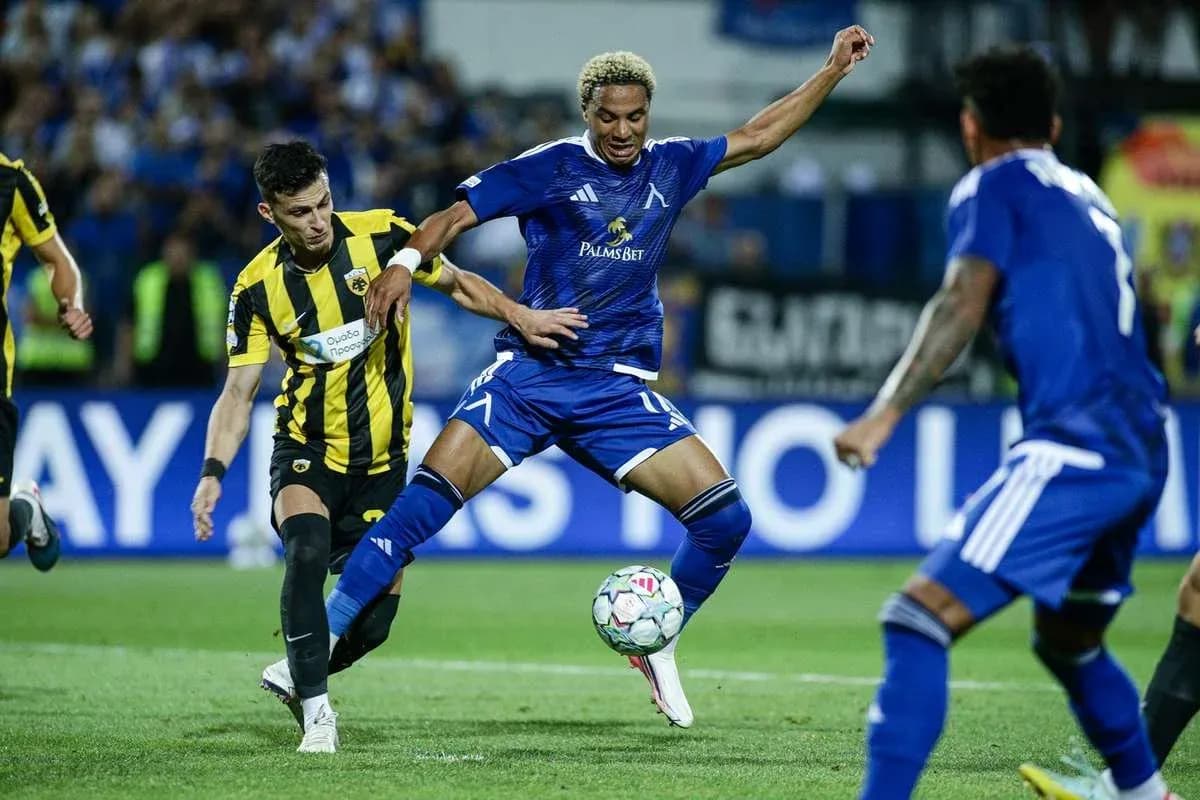
Levski Sofia vs AEK Athens: Tactical Analysis of Goalless Champions League Play-off
Levski Sofia and AEK Athens FC produced a goalless but tactically rich Champions League Play-offs first leg at Georgi Asparuhov Stadium, a match defined by structure, risk management and mid-game adjustments rather than penalty-box chaos. Across 90 minutes, Levski shaded possession at 52% and outshot AEK 15–12, yet both sides ultimately prioritised control over over-commitment, accepting a 0-0 that keeps the tie finely balanced.
Match Strategy
Julio Velazquez set Levski up in a 4-2-3-1 that clearly aimed to dominate phases of build-up and progression. The double pivot of M. Moubarik and Maicon acted as the central platform: 485 total passes with 428 accurate at an 88% completion rate show a team comfortable circulating the ball and resetting attacks. Levski’s shot profile – 15 total attempts, 6 from inside the box and 9 from outside – reflects a side that managed to reach the final third frequently but often had to resort to efforts from range against a well-organised AEK block.
AEK, under Marko Nikolic, mirrored that control in a different way with a 4-4-2 that emphasised compactness and vertical outlets. Their 453 passes with 394 accurate at 87% indicate they were not simply ceding the ball; rather, they were content to sit slightly deeper, then connect quickly through the midfield four into the front two. The shot distribution – 12 total attempts, 5 inside the box and 7 outside – underlines a more selective approach, looking to engineer clearer central looks when they did advance.
Defensive Discipline
Defensively, both back lines were disciplined. Levski’s 4-2-3-1 gave them natural rest defence: the full-backs A. Neves and A. Centelles could step high knowing the double pivot was in place to control transitions. Four blocked shots from Levski’s perspective show an aggressive approach to protecting the edge of the box, stepping out to meet AEK’s shooters early. AEK, by contrast, registered 2 blocked shots, reflecting a deeper, narrower shape that focused on lane denial and forcing Levski wide rather than over-committing to blocks.
Foul Count
The foul count is revealing of the tactical tone. AEK committed 17 fouls to Levski’s 8, a clear sign that Nikolic’s side were willing to break rhythm and disrupt combinations whenever Levski threatened to accelerate centrally. That higher foul volume dovetailed with AEK’s 4-4-2: the two banks of four shifted laterally, and when Levski’s No.10 line – A. Oko-Flex, Serginho, Everton Bala – tried to receive between lines, AEK’s midfielders and defenders stepped in aggressively. Levski, with fewer fouls, relied more on positional defence and counter-pressing triggers rather than tactical fouling.
Set Plays
Set plays were a marginal factor but still tactically telling. Levski earned just 1 corner to AEK’s 2, reinforcing the sense that, despite more total shots, Levski’s attacks often ended before deep territorial pressure could accumulate. AEK’s ability to limit corners, despite defending more, points to effective first-phase clearances and good control of second balls around their box.
Goalkeeper Performance
In goal, both keepers underpinned their teams’ risk profiles. Levski’s goalkeeper S. Vutsov faced 1 shot on target and made 1 save, a reflection of how effectively the home side restricted AEK to lower-quality or off-target efforts. AEK’s goalkeeper T. Strakosha, by contrast, had to make 3 saves from Levski’s 3 shots on goal, a heavier but still manageable workload that matched the pattern of Levski having more volume without overwhelming AEK’s last line. Neither side’s statistics provide values for goals prevented, so the analysis rests on the basic save counts and shot volumes.
Substitution Patterns
The substitution pattern from minute 57 onward marked the key tactical pivot of the evening. At 57', AEK made a double change: P. Mantalos (IN) came on for L. Majer (OUT), and B. Varga (IN) came on for L. Jovic (OUT). These moves suggested a shift towards a slightly different attacking dynamic – Mantalos offering more between-the-lines playmaking from midfield, Varga providing fresh movement up front. The aim was to improve AEK’s capacity to hold the ball in advanced zones and threaten in transition without sacrificing the 4-4-2 structure.
Velazquez responded on 67' with his own attacking adjustment: J. Perea (IN) came on for A. Oko-Flex (OUT). This change indicated a desire for more direct running and penalty-box presence from the second line, trying to convert Levski’s territorial edge into clearer chances. Later, at 79', M. Soula (IN) replaced Everton Bala (OUT), and A. Mitkov (IN) came on for Reinaldo (OUT), refreshing the front line and adding different profiles for the final phase – more energy in wide and central channels to sustain pressure as AEK tired.
Nikolic’s second wave of changes at 81' further underlined a balance between control and counter-threat: M. Gacinovic (IN) came on for A. Koita (OUT), and O. Zubkov (IN) replaced Zini (OUT). Gacinovic’s introduction brought additional defensive work rate and ball-carrying from midfield, while Zubkov’s entry added fresh legs in advanced areas, preserving AEK’s ability to break from their compact shape.
The final minutes saw Levski adjust their defensive personnel to guard against late counters and secure the clean sheet. At 88', S. Hevertton (IN) came on for A. Neves (OUT), and at 89', S. Stoyanchov (IN) replaced Maicon (OUT). These late changes slightly rebalanced the side, adding defensive stability and fresh legs in the middle as the match edged towards its tactical stalemate.
Match Conclusion
Statistically, the 0-0 is consistent with the underlying numbers. Levski’s marginal edge in possession (52% to 48%), higher shot volume (15–12), and more blocked efforts suggest they were the side pushing more consistently, particularly through structured build-up and territorial control. AEK, however, matched them closely in passing efficiency and maintained a disciplined defensive block, using fouls as a strategic tool to prevent Levski from converting that control into high-quality chances.
With no goals and no cards recorded, the tactical story is one of two well-drilled teams prioritising the two-legged context over single-game spectacle. Levski demonstrated they can impose their passing game at this level; AEK showed they can absorb pressure and remain dangerous in transition. The second leg will likely hinge on which coach is prepared to tilt this finely balanced structure further towards risk in search of the decisive breakthrough.
Related News
Lamine Yamal Shares What Barcelona Must Do to Triumph in the Champions League
Luis Díaz Confident Bayern Munich Can Win Champions League
Insights from AFC Champions League Matchday One: K League Clubs’ Strategies
Vincent Kompany's Bayern Munich Future Not Tied Solely to Champions League Outcome
Barcelona's Camp Nou Chosen for 2029 Champions League Final, Munich Set for 2028
Allianz Arena to Host 2028 UEFA Champions League Final