
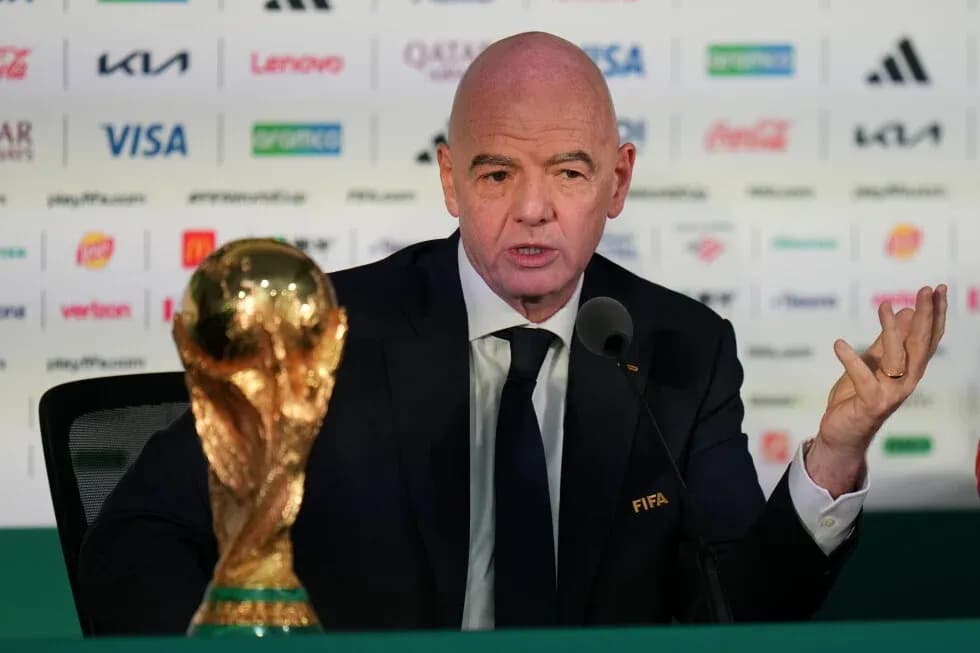
Infantino’s $20 Billion Gamble on World Football
Gianni Infantino has set a clock ticking on world football.
In a letter sent to FIFA’s 211 member federations, the president has given them until Sept. 19 to sign up to a one-off $20 million payout each, in exchange for backing a plan that would effectively sell a slice of the World Cup — and FIFA’s major competitions — to private investors.
At the heart of the proposal is a new $20 billion FIFA subsidiary, tentatively branded FIFA Forward Enterprise, that would control the organization’s competitions and events, from men’s and women’s World Cups to Club World Cups. Private investors would own 20% of it. The anchor investor: Thrive Capital, the firm led by Joshua Kushner, brother of Jared Kushner.
Infantino called it a “singular and unique funding opportunity.” Many in football see something else entirely.
UEFA Leads the Revolt
The backlash was immediate and ferocious.
UEFA, which learned of the plan along with the rest of football through the media, moved to convene an emergency online meeting of its 55 member associations, likely on Thursday. Its public stance left little room for compromise.
“The World Cup is not FIFA’s to sell,” UEFA said, accusing Zurich of trying to rush through a decision that could reshape the sport’s economic and political landscape for more than a decade.
One weapon sits on the table: boycott. European federations have used that threat before, in 2021, when UEFA-led resistance helped bury Infantino’s push to stage the men’s World Cup every two years. The idea now is similar: stop a centralization of power and revenue in FIFA’s hands, especially when driven by private equity.
The timing has only sharpened the anger. A hard deadline, an all-or-nothing financial choice, and minimal consultation with the sport’s biggest stakeholders. UEFA’s verdict on that urgency was cutting: “The rushed deadline… says everything you need to know about this plan.”
A Pattern of Power Plays
Infantino’s presidency, now in its 11th year, has been marked by big, often secretive projects that test the limits of his authority and the patience of his critics.
He previously tried to push through a $25 billion private equity deal in 2018 to create expanded men’s competitions. That scheme, too, met fierce resistance, especially from Europe. He launched the FIFA Peace Prize and handed its inaugural award to then-U.S. President Donald Trump at the World Cup draw in December. He allowed Trump to intervene in the process that cleared United States forward Folarin Balogun to play at the World Cup.
Now he is trying to lock in Joshua Kushner’s Thrive Capital to a 12-year ownership role within FIFA’s structure, underlining a growing alignment with figures close to U.S. political power.
Critics see a president who increasingly behaves like the CEO of a global entertainment conglomerate, not the guardian of a non-profit sporting body based in Switzerland.
Asia, CONCACAF and the Global Unease
The discontent is not confined to Europe.
CONCACAF, the confederation for North and Central America and the Caribbean, issued a blunt statement: “We are deeply concerned by the lack of due process.” The message from Kuala Lumpur was similar. The Asian Football Confederation said it was “disappointed that a matter of such significance entered the public domain before the AFC family had been afforded the opportunity to examine and discuss it.”
Even the European Football Clubs group — representing 850 clubs and operating a joint venture with UEFA to run the Champions League — said it discovered the plan “without warning and through the media.”
The pattern is clear: those who run the game’s major competitions, from the Champions League and European Championship to Copa America, see an existential threat. If FIFA chases higher valuations for private investors, that likely means more World Cups, more Club World Cups, more teams, more matches — and a squeeze on the calendar space and commercial value of continental tournaments.
Academic voices are also sounding the alarm. Sports governance specialist Antoine Duval warned that inviting private equity into FIFA could “incentivize” an even more aggressive commercialization of the World Cup, from extra hydration breaks to dynamic ticket pricing, all designed to squeeze out extra revenue.
The Money on the Table
For many of FIFA’s 211 members, though, the argument will be brutally simple: money now, or less money later.
Infantino’s letter spells it out. If the FIFA Forward Enterprise subsidiary is approved by a majority, each federation receives $20 million from the four-year commercial cycle tied to the 2030 men’s World Cup. Over 12 years, the cash uplift compared with current guarantees is stark: about $86 million instead of roughly $36 million.
If the plan is rejected, the members stick with their previously promised $10 million over the next four years.
For dozens of smaller federations, this is not an abstract debate about governance or the purity of the World Cup. Many rely heavily on FIFA funding to run their operations. Their national teams rarely qualify for major tournaments, their players seldom reach the top club level. Yet in FIFA’s one-member, one-vote system, they hold exactly the same ballot as Brazil, Germany or England.
This imbalance has always been Infantino’s political base. Promising more money helped sweep him to power in 2016 and carried him through unopposed reelections in 2019 and 2023. Now he is betting that the lure of an extra $10 million up front — and tens of millions more over time — will outweigh the alarm bells ringing in Europe and beyond.
British Resistance and the Shadow of the Super League
In Britain, the reaction turned political almost instantly.
Prime Minister Andy Burnham, whose government backs a joint bid by England, Scotland, Wales and Ireland to host the 2035 Women’s World Cup, came out swinging. “Football does not belong to investors,” he said in a video message. “Once you have sold a piece of (the World Cup), you have sold out. Football belongs to the fans. It always has, and it always will.”
British lawmakers have form in this arena. In 2021, threats of legislation from then-Prime Minister Boris Johnson helped crush the European Super League, a project that challenged UEFA’s Champions League and which Infantino had discreetly supported. The memory of that revolt still hangs over any attempt to reshape the sport’s economic order.
J.P. Morgan, which was tied to financing the Super League, now appears again in the fine print. Infantino’s letter notes that the process to bring in a “pool of diverse international investors” alongside Thrive Capital “will be led by J.P. Morgan.”
For many in Europe, that detail will only deepen the sense that football’s most sacred properties are being packaged for sale.
Infantino’s Long Game
Behind the noise, a more personal question hangs over all of this: what does Infantino want his role to be?
Officially, he is on course for a fourth and final term as FIFA president, running through 2031. He has faced no serious opposition so far. But the creation of a powerful, semi-autonomous subsidiary like FIFA Forward Enterprise — controlling competitions, revenues and long-term contracts — offers a different kind of platform.
Some observers have long suspected that Infantino sees himself as more than a term-limited president. A CEO or commissioner role at a spin-off entity would extend his influence well beyond the traditional boundaries of FIFA’s statutes.
This latest project has ignited frustration far beyond the usual European critics. Confederations around the world now have less than four months to decide whether to mount a challenge. The deadline to enter the presidential race is Nov. 18, ahead of an election scheduled for March 18 in Rabat, Morocco — a nation that has become one of Infantino’s key allies and will co-host the 2030 World Cup.
The stakes are stark. On one side, a president offering unprecedented cash to the global game’s have-nots. On the other, a growing coalition warning that once a piece of the World Cup is sold, it may never truly belong to football again.
By Sept. 19, the federations must choose which future they are willing to buy into — and at what cost.
Related News
Ilia Topuria Accuses Justin Gaethje After UFC Defeat
Tyson Fury vs Anthony Joshua Fight Date and Venue Confirmed
Switzerland Calls Up In-Form Sion Striker Winsley Boteli for Nations League
Bournemouth Secures Historic 2-1 Win Over Real Sociedad in Spain
Portugal Announces Squad for 2026 UEFA Nations League; Cristiano Ronaldo Expected to Play
Raphinha Channels Ronaldo Nazario as Barcelona's Leading Striker After Position Change