
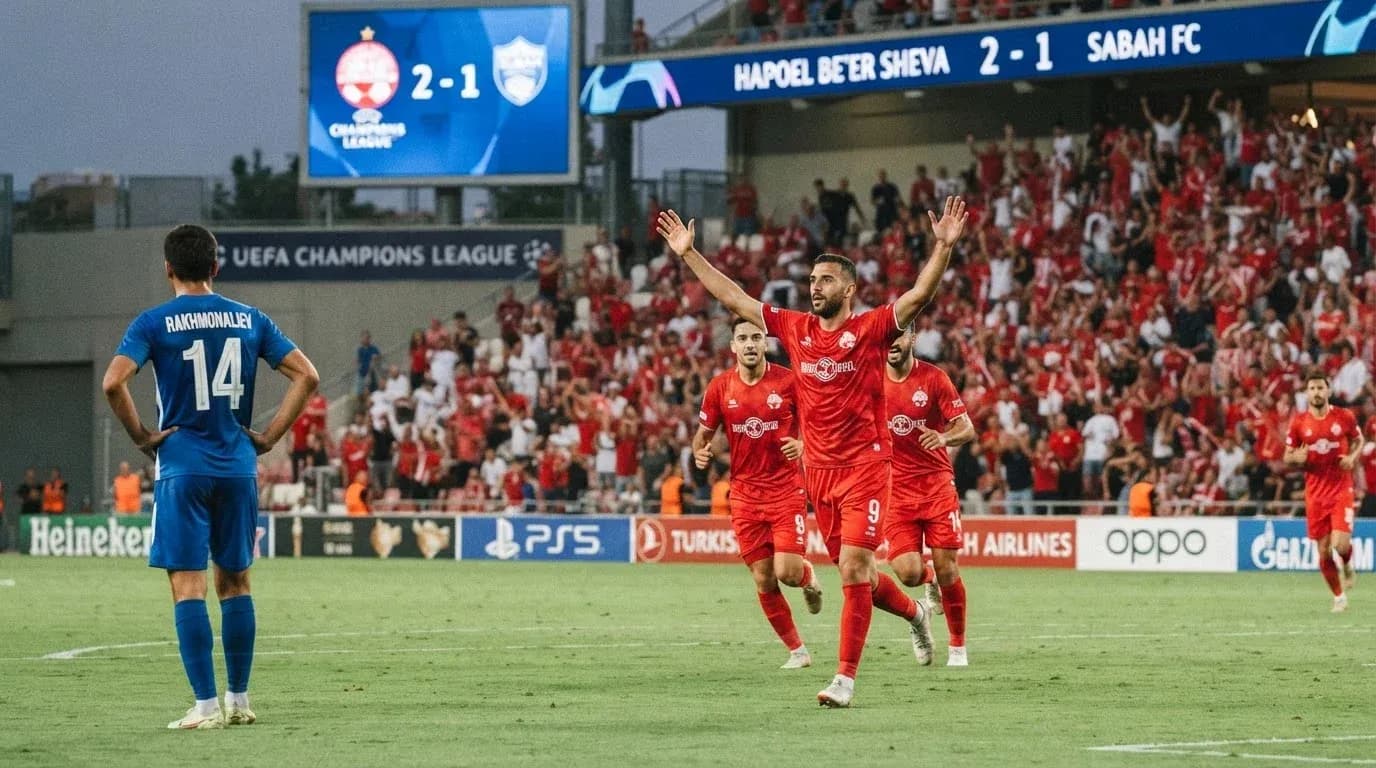
Hapoel Beer Sheva’s Tactical Dominance Over Sabah FA in UEFA Play-offs
Hapoel Beer Sheva’s 2-1 win over Sabah FA at Rapid-Giulesti Stadium was built on structural control and territorial dominance rather than sheer volume of clear chances. In a UEFA Champions League Play-offs tie where the Israelis saw 67% of the ball and produced 18 shots to 8, Ran Kozuch’s 4-3-3 gradually suffocated Valdas Dambrauskas’ 4-2-3-1, overturning an early deficit through sustained pressure and intelligent use of the front three and advanced midfield line.
Structurally, Hapoel Beer Sheva’s 4-3-3 was very stable and ball-oriented. The back four of G. Mizrahi, Miguel Vitor, I. Rotman and P. Amador held a relatively high line, supported by a three-man midfield of N. Yehoshua, Lucas Ventura and E. Peretz. With 659 total passes and 90% accuracy (595 accurate), the home side circulated patiently from side to side, using the full-backs to stretch Sabah FA’s first pressing line and create interior lanes for Peretz and Yehoshua to receive between the lines.
The front three of J. East, I. Zlatanovic and Z. Ahmed played with clear roles. East and Ahmed started wide but repeatedly drifted inside, allowing full-backs to overlap and creating overloads in the half-spaces. Zlatanovic acted as the reference point between Sabah FA’s centre-backs and double pivot, often pinning S. Solvet and R. Dashdamirov and opening pockets for late midfield runs. The first equaliser at 43' from J. East came as a product of this pressure and positional occupation, with Hapoel Beer Sheva already camped in the final third after a long spell of possession.
Sabah FA’s 4-2-3-1 was reactive by design. With only 33% possession and 305 passes (237 accurate, 78%), their plan was to defend compactly and spring forward through the line of three behind J. Mickels. U. Rakhmonaliyev and I. Lepinjica formed a screening double pivot in front of the back four, while X. Severina, A. Isayev and V. Simic tried to break forward quickly when the ball was regained. The early goal at 6' from Simic, assisted by T. Puchacz, reflected this: a quick transition exploiting space before Hapoel Beer Sheva’s structure had fully settled.
Out of possession, Hapoel Beer Sheva pressed selectively rather than constantly. The front three guided Sabah FA’s build-up wide, encouraging passes into full-backs A. Zedadka and Puchacz, where the home side could trap the ball and regain it. The shot profile underlines the territorial tilt: 16 of Hapoel Beer Sheva’s 18 attempts came from inside the box, complemented by 5 blocked shots, indicating repeated entries into dangerous zones and a Sabah FA back line forced into last-ditch interventions. Conversely, Sabah FA managed only 5 shots inside the box and 0 blocked shots, underlining how rarely they were able to sustain pressure in advanced areas.
Discipline and duels also tilted towards the hosts’ intensity. Hapoel Beer Sheva committed 12 fouls to Sabah FA’s 6 and collected all three yellow cards in the match, but the reasons—“Tripping” for Miguel Vitor, “Roughing” for I. Rotman and “Foul” for A. C. Ganah—fit a side defending high and aggressively after turnovers. Sabah FA’s lower foul count matched their deeper block and more conservative engagement zones, trying to keep shape rather than contest every duel.
The key tactical turning point came in the second half with the use of substitutions. At 56', Sabah FA replaced X. Severina (OUT) with O. Mbina (IN), a move aimed at injecting more vertical threat and physicality in transition. Kozuch responded by reshaping his own front line: at 66', A. C. Ganah (IN) came on for Z. Ahmed (OUT), offering fresh legs and direct running from wide; at 71', M. Abu Rumi (IN) replaced J. East (OUT), maintaining the intensity of the wide press and defensive work from the flanks.
These changes preserved Hapoel Beer Sheva’s ability to pin Sabah FA back and were rewarded at 79', when Zlatanovic scored the decisive goal, assisted by Peretz. The pattern reflected their overall approach: midfielders stepping into advanced positions, forwards occupying centre-backs, and the ball being worked patiently into the box rather than relying on speculative long-range efforts (only 2 shots from outside the box).
Late-game management was also clearly structured. At 85', H. Kanaan (IN) replaced N. Yehoshua (OUT) and Y. Malede (IN) came on for Zlatanovic (OUT), signalling a shift towards protecting the lead with fresher legs in midfield and up front to press and chase clearances. Sabah FA’s last substitution at 89', with E. A. Santos Junior (IN) for S. Solvet (OUT), suggested a search for more dynamism at the back or an additional aerial presence, but by then Hapoel Beer Sheva’s block was well set and their rhythm with the ball was controlling the tempo.
In goal, both sides’ structures protected their keepers reasonably well. Hapoel Beer Sheva registered 7 shots on target, forcing 4 saves from S. Pokatilov (Sabah FA), while Sabah FA’s 5 shots on target drew 4 saves from O. Marciano (Hapoel Beer Sheva). The near parity in saves despite the shot disparity underscores how Hapoel Beer Sheva’s possession and box entries translated into a higher volume of efforts, but not necessarily a huge gap in clear-cut chances; Sabah FA’s transitions still produced moments that tested Marciano.
Set-piece and rest-defence details further illustrated the tactical divide. Hapoel Beer Sheva won 3 corners to Sabah FA’s 2, but more importantly, their rest-defence structure—two centre-backs plus at least one holding midfielder behind the ball—limited Sabah FA’s ability to counter directly from defensive set-pieces. Offside numbers (3 against Hapoel Beer Sheva, 1 against Sabah FA) show the home side’s willingness to run in behind repeatedly, stretching the back line and creating the space between the lines that their midfielders exploited.
Overall, this was a match where Hapoel Beer Sheva’s 4-3-3, high pass volume and territorial dominance slowly eroded Sabah FA’s compact 4-2-3-1. Early transitional success for Sabah FA could not be sustained against a side that controlled rhythm, space and substitutions, and the 2-1 scoreline accurately reflects a tactical battle decided by structure, field position and intelligent second-half adjustments.
Related News
Lamine Yamal Shares What Barcelona Must Do to Triumph in the Champions League
Luis Díaz Confident Bayern Munich Can Win Champions League
Insights from AFC Champions League Matchday One: K League Clubs’ Strategies
Vincent Kompany's Bayern Munich Future Not Tied Solely to Champions League Outcome
Barcelona's Camp Nou Chosen for 2029 Champions League Final, Munich Set for 2028
Allianz Arena to Host 2028 UEFA Champions League Final