
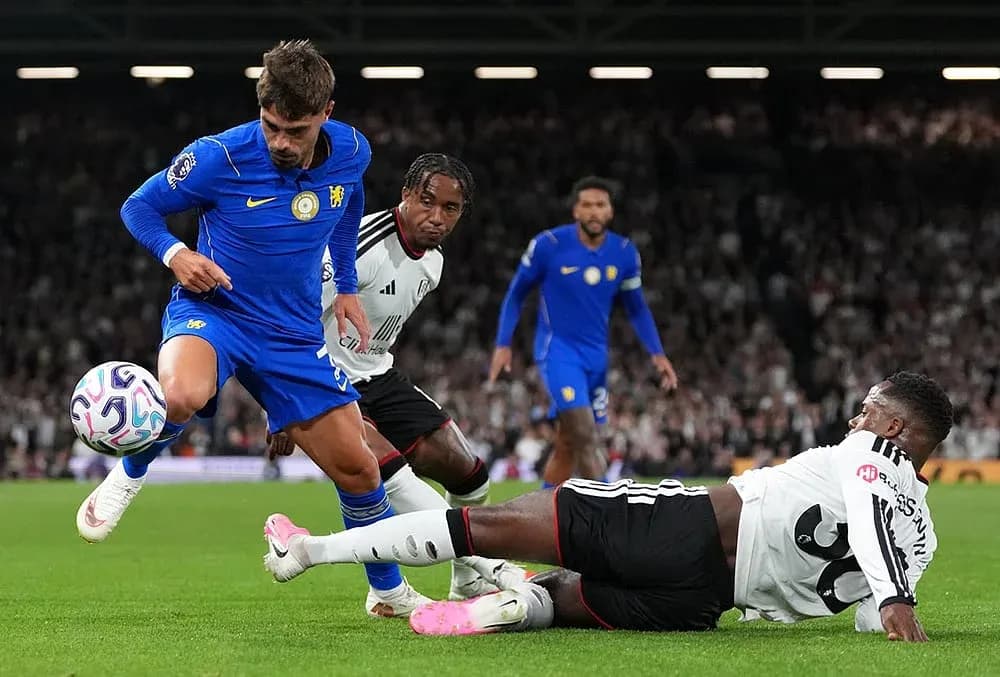
Fulham vs Chelsea: Premier League Showdown Ends 3–2
The first Monday night at Craven Cottage in the 2026–27 Premier League season ended with a familiar, uneasy feeling for Fulham. Under the lights by the Thames, they traded punches with a revamped Chelsea but were ultimately edged 3–2, a result that crystallised the early-season identities of both sides.
I. The Big Picture – Two Paths Out of the Blocks
This was Round 1 of the Premier League, and it already felt like a statement night. Fulham, at home in a 4-2-3-1 under Alvaro Arbeloa, went toe to toe with a Chelsea side reshaped by Xabi Alonso into a 3-4-2-1. The scoreline told its own story: 2–1 down at half-time, Fulham rallied but still slipped to a 3–2 defeat.
Following this result, Fulham sit 12th with 0 points, their overall record reading one defeat from one, with 2 goals scored and 3 conceded. At home, it is the same: one match, no points, 2 for and 3 against. The goal difference of -1 underlines a side that can hurt opponents but leaves the back door ajar.
Chelsea, by contrast, leave the Cottage with the sense of a project taking shape. They are 6th with 3 points, having won their only game so far. On their travels they have played 1, won 1, scoring 3 and conceding 2, again for a goal difference of +1. It is the kind of gritty away win that has often separated contenders from pretenders in this league.
II. Tactical Voids – Who Was Missing, and What It Meant
Both managers arrived with key absentees that subtly reshaped the tactical picture.
For Fulham, the suspension of J. Andersen due to a red card and the knee injury to T. Cairney stripped Arbeloa of two pillars: a commanding organiser at the back and a tempo-setter between the lines. In their absence, the back four of T. Castagne, C. Bassey, J. Cuenca and A. Robinson had to knit together on the fly, with S. Berge and A. Iwobi tasked with anchoring and progressing play from the double pivot.
Chelsea’s absentee list was longer and more varied. A. Anselmino was inactive, while M. Caicedo, M. Sarr and E. Emegha were all out injured. W. Fofana missed out through suspension, and J. Henderson was sidelined by a wrist injury. That forced Alonso to trust his core to a relatively young spine: M. Lacroix as the central defender, R. Lavia as the holding midfielder, and a front three of C. Palmer, M. Rogers and Joao Pedro.
Disciplinary patterns already hint at how these squads behave under stress. Fulham’s only yellow cards so far have come in a late-game surge: 100.00% of their bookings have arrived between 76-90 minutes. It paints the picture of a side that chases games aggressively, sometimes recklessly, as the clock winds down.
Chelsea’s bookings are front-loaded. Two-thirds of their yellow cards have arrived between 0-15 minutes, with the remaining 33.33% between 61-75 minutes. R. Lavia, already on the league’s yellow-card radar, embodies that edge: one caution in his 65 minutes, three tackles and one interception. Chelsea start games on the front foot, both in intensity and in risk.
III. Key Matchups – Hunter vs Shield, and the Battle for Control
The “Hunter vs Shield” duel in this fixture was Chelsea’s attacking trident against a Fulham defence still adjusting to life without Andersen.
Cole Palmer is already one of the league’s standout performers. In his opening appearance he delivered 1 goal and 1 assist, with 4 shots (2 on target), 32 passes at 87% accuracy, and 3 key passes. He also won 10 of his 16 duels and completed 5 of 8 dribbles. Operating in the right half-space of the 3-4-2-1, Palmer repeatedly found pockets behind Fulham’s double pivot and between their centre-backs.
Alongside him, Joao Pedro mirrored that end-product: 1 goal and 1 assist, 3 shots, 2 key passes and a 7.9 rating. His movement across the front line dragged C. Bassey and J. Cuenca into uncomfortable territory, stretching Fulham’s defensive shape. M. Rogers completed the trio with 1 goal of his own, 5 key passes and a perfect 3/3 dribble record, giving Chelsea a three-headed threat that Fulham never fully contained.
On Fulham’s side, the most reliable “shield” was actually a full-back: T. Castagne. In his 90 minutes he contributed 1 assist, 1 shot on target, 40 passes at 85% accuracy, 2 key passes, plus 1 tackle, 1 block and 1 interception. He also won 7 of 11 duels and completed his only dribble. Castagne’s advanced positioning on the right was both a weapon and a risk: he gave Fulham width and delivery but left spaces for Rogers and Hato to exploit in transition.
In the engine room, R. Lavia’s duel with Fulham’s midfield was decisive. With 22 passes at 95% accuracy and 2 key passes, Lavia not only shielded the back three but also connected Chelsea’s build-up into the feet of Palmer and Joao Pedro. His 3 tackles and 1 interception blunted Fulham’s attempts to play through the middle, forcing them wide and into more predictable patterns.
IV. Statistical Prognosis – Attacking Promise, Defensive Questions
With only one match each played, the sample is small but revealing. At home, Fulham are averaging 2.0 goals for and 3.0 against. Overall, those numbers are identical. They are not failing to score – they have yet to draw a blank – but they are conceding too easily, and have no clean sheets.
On their travels, Chelsea are averaging 3.0 goals scored and 2.0 conceded, with no clean sheets but clear attacking potency. Their biggest away win so far is this very 3–2 at Craven Cottage, a result that suggests their xG profile will likely be tilted towards high-event, high-risk football.
Neither side has taken or missed a penalty yet this season; both clubs show 0 total penalties, with 0 scored and 0 missed, so spot-kicks have not distorted their attacking metrics.
The intersection of Fulham’s late-card aggression and Chelsea’s early-game intensity sets the tone for how these squads may evolve. Fulham look like a side that will have to outscore opponents unless the return of Andersen and the leadership of B. Leno can tighten their defensive line. Chelsea, meanwhile, already have a functioning attacking hierarchy: Palmer as the creative and scoring hub, Joao Pedro as the roaming finisher, and Rogers as the vertical runner.
Following this result, the numbers hint at a clear tactical verdict: Chelsea’s offensive structure and individual quality in the final third are ahead of Fulham’s defensive organisation. Unless Fulham find greater balance between their adventurous full-backs and their centre-backs’ protection, nights like this – thrilling but ultimately fruitless – may become a theme of their campaign, while Chelsea’s 3-4-2-1 looks primed to turn more tight away fixtures into three-goal statements.
Related News

Manchester United vs Tottenham Stats: Head-to-Head Record and Past Meetings

Premier League Players and Agents Eye Compensation Claims Against Manchester City Over Guilty Verdict

Premier League Midfielder Shares Ambition to Join Real Madrid

Is Possession Football Losing Its Grip in the Premier League?

Arsenal's Myles Lewis-Skelly Surprises by Naming Tottenham's Mateus Fernandes as Toughest Premier League Rival

Three Premier League Players Making Impressive Early Season Impact