
Dinamo Zagreb's Tactical Siege: A 3-2 Extra-Time Victory
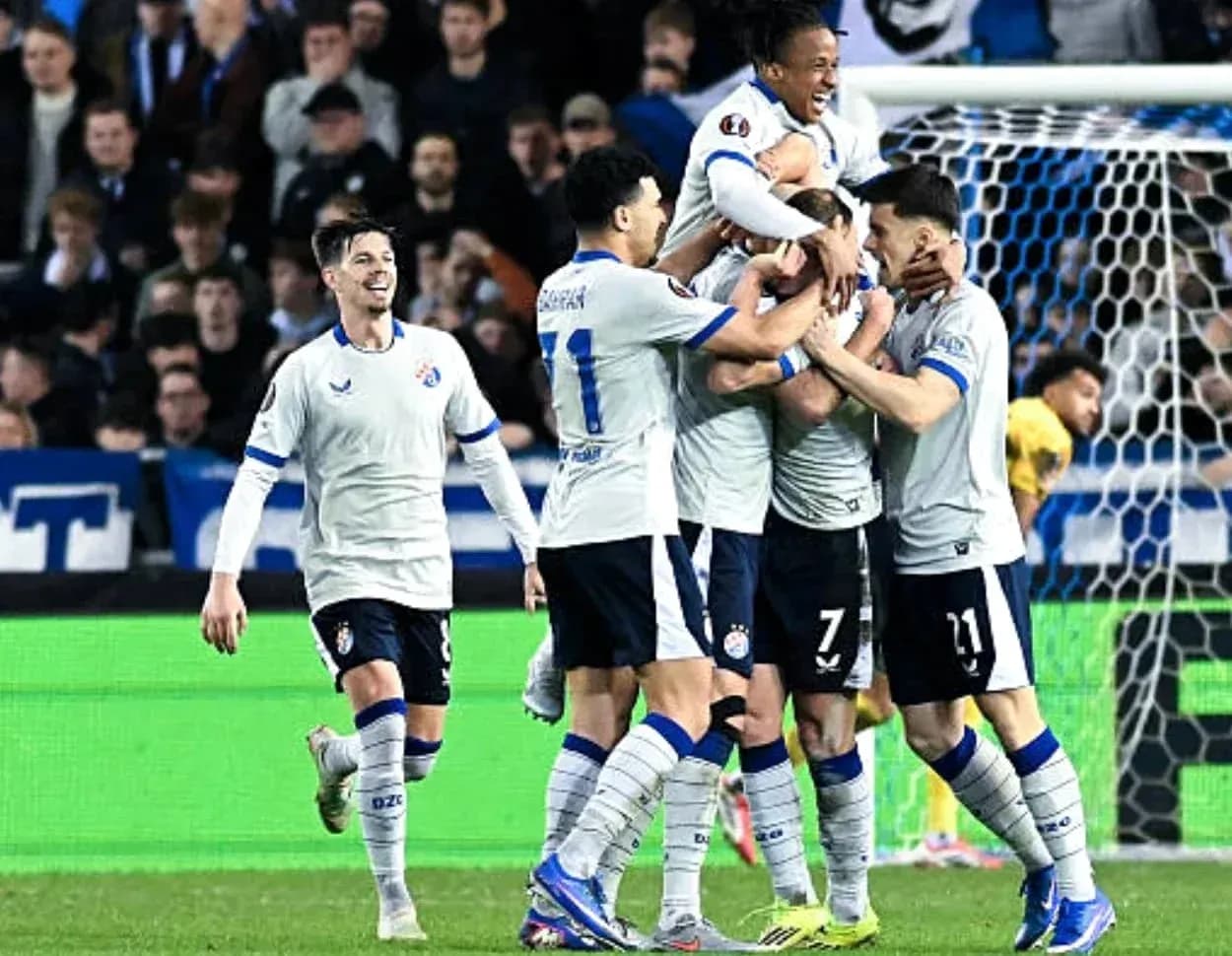
Dinamo Zagreb’s 3-2 extra‑time win over FC Thun at Stadion Maksimir was a classic territorial siege against a deep block, decided by structural persistence and superior conditioning rather than chance. Across 120 minutes, Dinamo converted overwhelming control of space and ball into a late breakthrough, while Thun’s compact 4-4-2, initially so effective in transition, gradually collapsed under numerical and physical strain after going down to ten men.
Mario Kovacevic set Dinamo up in a 4-1-4-1 with J. Misic as the single pivot behind an aggressive line of four attacking midfielders. The plan was clear: stretch Thun’s 4-4-2 horizontally, pin the full-backs with wide threats and flood the half-spaces with interior runs from M. Zajc and G. Vidovic. The numbers underline how completely Dinamo imposed that script: 76% possession, 702 total passes with 618 accurate at 88%, and 29 total shots. The 18 efforts from inside the box and 7 blocked shots show a side living in the final third, constantly forcing Thun to defend their own area.
Thun’s 4-4-2 under Luca Privitelli Gian was built around vertical efficiency. Early on, it worked perfectly. With only 24% of the ball and 231 passes (134 accurate, 58%), Thun were never interested in long settled spells. Instead, they targeted the channels around Dinamo’s centre-backs, using B. Labeau and F. Dursun to run into space once the first line of pressure was beaten. Their 8 total shots, 6 inside the box, reflect a game plan of few but high-quality incursions rather than volume.
First Half
The first half belonged to Thun in terms of scoreboard impact. Their early 2-0 lead was a product of exploiting Dinamo’s initial rest-defence issues. With both full-backs high and the eight/eight pair pushing on, transitions left S. Dominguez and S. McKenna exposed against direct balls. Thun’s midfield four stayed narrow out of possession, denying clean central progression and forcing Dinamo wide, where crosses could be contested and cleared. That narrowness also meant that when Thun did regain the ball, simple vertical passes could break multiple lines at once.
Second Half
Kovacevic’s response after the break was both structural and personnel-based. The 46' substitution of B. Goda (OUT) for M. Perez Vinlof (IN) on the left side freshened the flank and maintained width but, more importantly, the triple change phase around the hour mark recalibrated the attacking structure. G. Vidovic (OUT) for L. Kacavenda (IN) and M. Lisica (OUT) for F. Topic (IN) at 58', followed by M. Orsic (OUT) for A. Hoxha (IN) at 59', shifted Dinamo towards an even more aggressive, almost 4-2-4/2-3-5 attacking shape.
Kacavenda operated higher between the lines, effectively as a second striker at times, while Topic attacked the right half-space and A. Hoxha provided directness on the flank. This increased the density of Dinamo players in the last line, making it harder for Thun’s back four to maintain clear reference points. The result was more chaos in the box, reflected in Dinamo’s 6 shots on goal and the volume of blocked efforts, as Thun were forced into emergency defending.
The match’s tactical hinge came with Marco Bürki’s dismissal. Initially part of a disciplined back four, Bürki’s red card for “Professional foul last man” at 67' (after a VAR “Card upgrade” review at 66') fundamentally altered Thun’s defensive mechanics. Reduced to ten men, Thun had to compress even deeper, sacrificing any real outlet and accepting a siege. Their 1 corner kick all match, versus Dinamo’s 14, underlines how little territorial relief they enjoyed.
From that point, Thun’s 4-4-2 morphed into a 4-4-1/5-3-1 hybrid, with wide midfielders dropping into the back line and one forward left to chase long clearances. Substitutions such as B. Labeau (OUT) for N. Burgy (IN) at 68' and later N. Reichmuth (OUT) for L. Dahler (IN) at 77' were clearly about reinforcing defensive zones rather than chasing a third goal. Even the late introduction of C. Ibayi (IN) for F. Fehr (OUT) at 106' served more as a fresh runner for transitions than a structural shift.
Dinamo, by contrast, doubled down on wave attacks. The full-backs, especially after Perez Vinlof’s introduction, pushed extremely high, often forming a back two with Dominguez and McKenna while Misic anchored in front. This created a stable rest-defence to deal with rare counters and allowed five, sometimes six, players to occupy the last line. The 14 corners were not just a statistic; they were a tactical weapon, repeatedly pinning Thun deep and resetting pressure whenever clearances went behind.
In goal, I. Filipovic (Dinamo Zagreb) was largely a spectator in the later phases, registering 1 save as Dinamo squeezed the game into Thun’s half. His opposite number, N. Steffen (FC Thun), was far busier, making 4 saves under relentless pressure. Those numbers align with the shot profiles: Dinamo’s 6 shots on goal against Thun’s 3. Steffen’s interventions, combined with the 3 blocked shots by Thun’s defenders, kept the tie alive deep into extra time despite the structural inferiority.
Discipline also played a tactical role. Dinamo collected 5 yellow cards (Miha Zajc, Bruno Goda, Josip Mišić, Fran Topić, Arber Hoxha), many linked to aggressive counter-pressing and emotional intensity as they chased the game. Thun’s 1 yellow card for Christopher Ibayi and Bürki’s straight red underline a different profile: fewer fouls overall (13 to Dinamo’s 15), but one decisive defensive emergency that broke their numerical parity.
The statistical verdict is clear: Dinamo’s dominance in possession (76% vs 24%), passing volume (702 vs 231) and accuracy (88% vs 58%) translated into territorial suffocation and chance creation. Thun’s approach produced efficiency—6 of 8 shots from inside the box—but could not sustain itself once reduced to ten and pinned in a low block for almost an hour. Over 120 minutes, the structural logic of the game favoured the side able to keep the ball, rotate fresh attackers, and maintain a stable rest-defence. Dinamo Zagreb did exactly that, and the late extra‑time winner was the tactical culmination of a long, methodical siege rather than a moment of randomness.
Related News
Vincent Kompany's Bayern Munich Future Not Tied Solely to Champions League Outcome
Barcelona's Camp Nou Chosen for 2029 Champions League Final, Munich Set for 2028
Allianz Arena to Host 2028 UEFA Champions League Final
Allianz Arena to Host 2028 Champions League Final for Third Time
Barcelona's Nou Camp Chosen for 2029 UEFA Champions League Final Over Wembley and Dortmund
Five English Clubs Secure Wins in Champions League Opening Round