
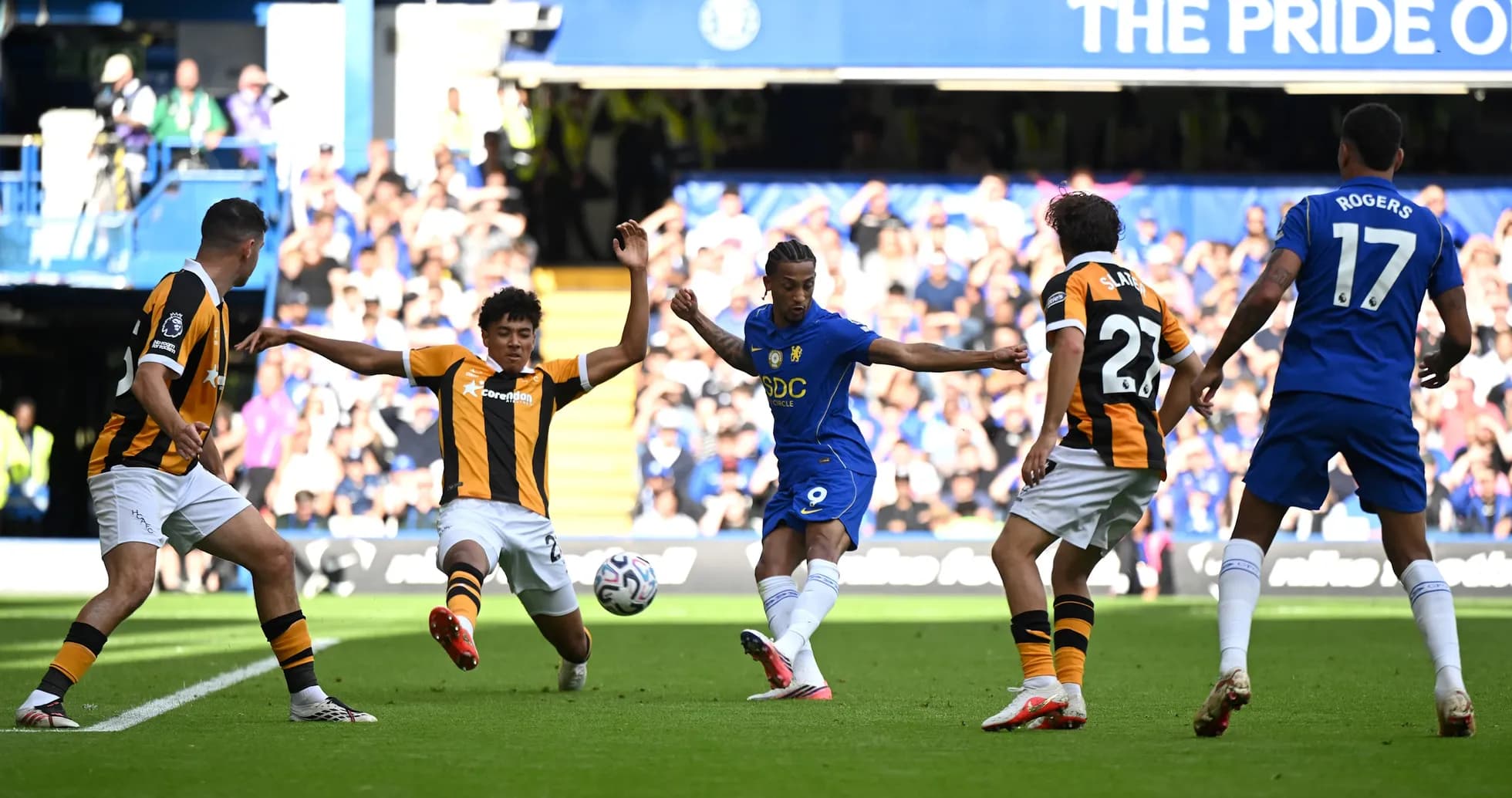
Chelsea and Hull City Draw 2-2: A Tactical Analysis
The afternoon at Stamford Bridge closed with the scoreboard locked at 2-2, but the numbers behind it tell a richer story of two sides whose identities are already sharply drawn just four games into the Premier League season.
I. The Big Picture – Clash of Blue Fire and Amber Steel
Heading into this game, Chelsea were building an attacking reputation. Overall this campaign they had scored 10 goals and conceded 9, giving them a goal difference of +1 after 4 matches. At home they had been even more volatile: 6 scored and 5 conceded across 2 fixtures, with averages of 3.0 goals for and 2.5 against. Xabi Alonso’s side arrived as the league’s entertainers, fifth in the table on 7 points, with no clean sheets and a promise of chaos every time they kicked off.
Hull City came to London with a completely different DNA. Sitting third with 8 points, they had built their early-season surge on defensive order. Overall they had scored 5 and conceded just 2, a goal difference of +3, and they had not lost home or away. On their travels Hull had been efficient rather than expansive: 3 goals for and 2 against in 2 away matches, averaging 1.5 scored and 1.0 conceded, backed by 1 away clean sheet and 3 clean sheets in total.
The final 2-2 draw at Stamford Bridge felt like Chelsea dragging Hull into their kind of game – open, transitional, stretched – while Hull still found a way to leave with their unbeaten record intact.
II. Tactical Voids – Who Was Missing, and What It Meant
Chelsea’s squad sheet carried notable absences. In midfield, the injury to M. Caicedo stripped Alonso of his most natural ball-winner and positional anchor. Without him, the double pivot of R. Lavia and R. James had to cover more ground and more responsibility, especially in defensive transitions. J. Henderson’s wrist injury removed an experienced organiser and passer who could have calmed the tempo late on, while the injuries to E. Emegha and M. Palestra reduced attacking rotation options from the bench.
Hull’s list of absentees was longer and more structural. I. Ansah’s back injury, J. Butland’s arm injury, and the groin problems for D. Gyabi and C. Hughes, plus E. Matazo’s knee injury and H. Morita’s calf issue, all chipped away at their depth, particularly in midfield. That made the workload on starters like M. Crooks and R. Slater heavier, especially against a Chelsea side that constantly rotated positions between the lines.
Disciplinary trends also framed the contest. Chelsea’s yellow cards this season have been front-loaded and emotional: 33.33% of their bookings had come in the opening 0–15 minutes, with a late-game surge of 22.22% between 76–90. That pattern hints at a team that can start over-aggressively and then chase games with risky challenges late on. Hull’s card profile was more methodical but spiked after half-time: 30.77% of their yellows had arrived between 46–60 minutes, the phase where they often ramp up their pressing to protect or chase a result. In a match that finished level, those rhythms of aggression shaped the midfield battle and the tone of the second half.
III. Key Matchups – Hunter vs Shield, Engine Room vs Enforcer
The headline duel was always going to be Chelsea’s front four against Hull’s back five.
The “hunter” in chief was João Pedro. Overall this campaign he had 3 goals and 3 assists in 4 league appearances, with 8 shots (4 on target) and 7 successful dribbles from 10 attempts. His 7 key passes and 3 assists underline that he is not just a finisher but the reference point for combination play. Operating as the lone striker in the 4-2-3-1, he constantly dropped into the half-spaces to link with C. Palmer and M. Rogers, dragging Hull’s centre-backs into uncomfortable zones.
Behind him, Palmer and Rogers formed the creative storm. Palmer, with 2 goals and 2 assists, 12 shots and 9 key passes, functioned as Chelsea’s primary playmaker between the lines, his 80% pass accuracy reflecting a blend of risk and control. Rogers, also on 3 goals and 1 assist, offered vertical threat from the left, with 12 dribble attempts and 10 key passes making him the side’s most direct ball-carrier into the box.
Opposing them, Hull’s “shield” was not just the back line but a collective. The 5-4-1, used in all 4 league games so far, is built around layers of protection. At the heart of it, J. Egan and S. Ajayi had to deal with João Pedro’s movement, while N. Mendy and R. Giles closed off wide channels against Rogers and Pedro Neto. In front of them, M. Crooks – who had already made 6 tackles and 2 blocks in just 2 appearances – acted as the enforcer, stepping out to disrupt Palmer’s rhythm.
Further forward, Hull’s own “hunter” was M. Belloumi. With 2 goals and 1 assist, plus 10 tackles, 3 successful blocks and 9 interceptions, he embodied the dual nature of this Hull side: creative in transition, relentless without the ball. His duels with J. Hato on Chelsea’s left were a fascinating subplot: Hato, who had already produced 7 tackles, 2 blocks and 2 interceptions this season, had to balance his progressive instincts with the need to track Belloumi’s runs.
Up front, O. McBurnie was the battering ram and lightning rod. With 6 shots (3 on target), 5 fouls committed, 9 drawn, and 2 yellow cards already this season, he thrives in the grey areas of physicality. His clashes with L. Colwill and W. Fofana were as much psychological as tactical, testing Chelsea’s composure in aerial duels and second balls.
IV. Statistical Prognosis – What the Numbers Say About These Squads
Even with the 2-2 scoreline, the underlying profiles of these teams remain sharply contrasted.
Chelsea’s attack is among the league’s most potent. Overall they average 2.5 goals per match, with 3.0 at home, and they have yet to fail to score in any game. But the defensive fragility is baked in: 2.3 goals conceded per match overall, 2.5 at home, and still no clean sheet. This is a side built to outscore rather than contain, relying on the individual quality of João Pedro, Palmer and Rogers to overwhelm opponents.
Hull, by contrast, are built from the back. Overall they average 1.3 goals scored and just 0.5 conceded, with 3 clean sheets in 4 matches. On their travels they score 1.5 and concede 1.0 on average, a profile that suggests measured risk rather than deep retreat. The presence of a two-way threat like Belloumi and a physical focal point like McBurnie means they can hurt teams in transitions and set pieces without abandoning their structure.
Following this result, the prognosis is clear. Chelsea’s ceiling is high, powered by an attacking trio that already ranks among the league’s most productive. But until they solve their defensive openness and find a replacement rhythm for the absent Caicedo, they will live on the edge of matches like this one. Hull, meanwhile, look built for the long haul: compact, disciplined, and with just enough individual quality in Belloumi and McBurnie to turn tight games.
If the league table is a long story, this 2-2 at Stamford Bridge reads like an early chapter in which Chelsea’s fire and Hull’s steel both proved real – and neither yet decisive.
Related News
Tottenham vs Aston Villa Predicted Lineups: Team News for Premier League Clash
Brighton vs Arsenal: Premier League Clash Preview
Manchester City vs Sunderland: Premier League Clash Preview
Tottenham vs Aston Villa: Early Relegation Battle

Brentford vs Chelsea Predicted Lineups: Team News and Match Insights
Brighton vs Arsenal Prediction: Key Stats and Betting Tips