
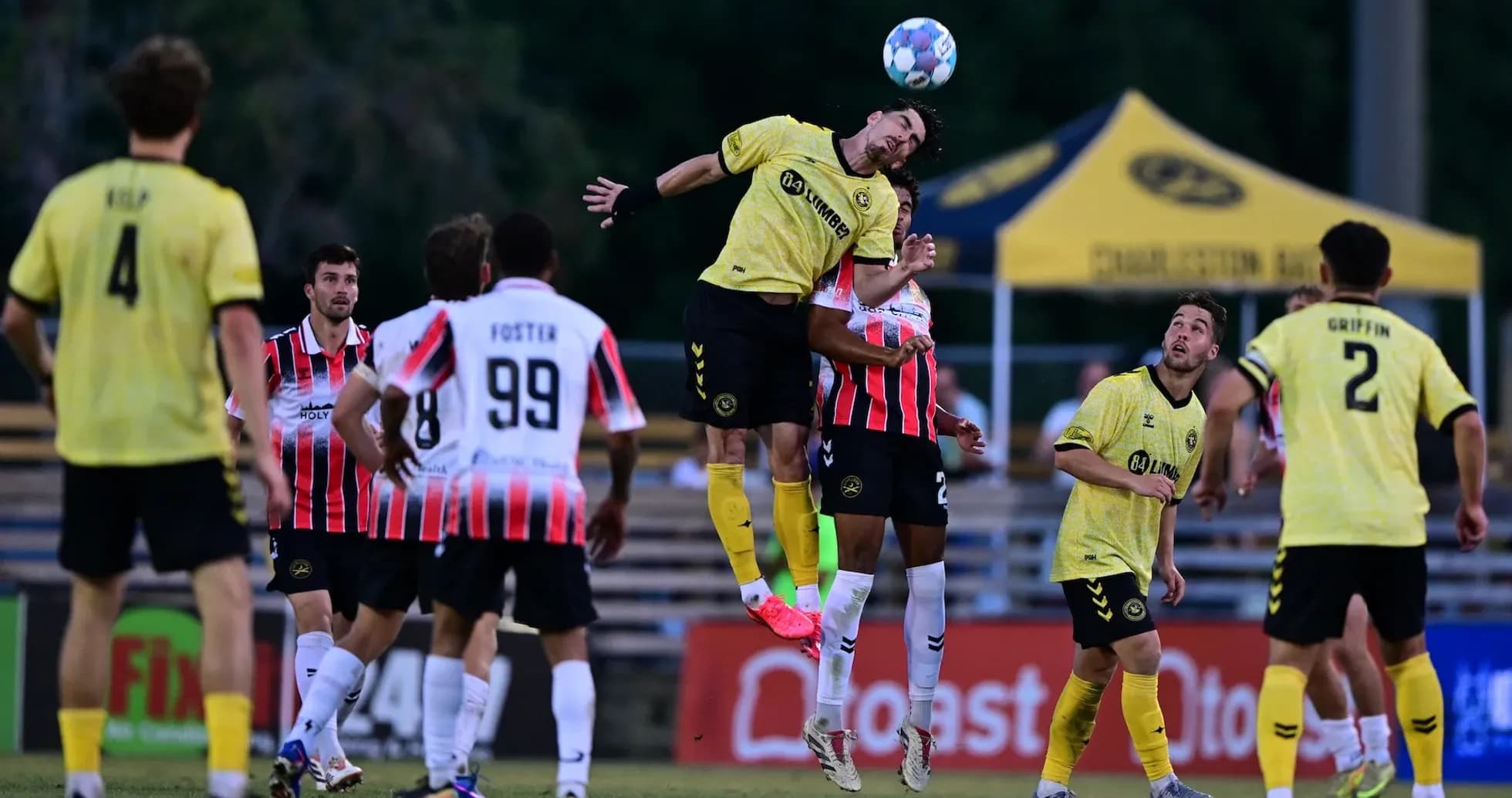
Charleston Battery Triumphs in USL League One Cup Shootout
Under the lights at Patriots Point Soccer Complex, Charleston Battery and Pittsburgh Riverhounds played out 120 minutes of stalemate, only for the group-stage narrative of the USL League One Cup to be rewritten from the penalty spot. Following this result, Charleston’s campaign-long authority was reaffirmed: a side already top of Group 6 with 8 points and a +7 goal difference in total now added a shootout win to a profile built on control, clean sheets, and ruthless moments in both boxes. Pittsburgh, third in the same group and carrying a total goal difference of -1, again showed why their margins are so fine: competitive over the stretch, but punished when it came to the decisive details.
I. The Big Picture – contrasting identities over 120 minutes
Charleston’s season DNA has been clear. Heading into this game, they had won all 3 of their fixtures in total, scoring 7 and conceding just 1. At home, they had been minimalist and efficient: 1 goal for, 0 against, with a home average of 1.0 goals scored and 0.0 conceded. On their travels, they had been expansive, averaging 3.0 goals for and 0.5 against away. That blend of defensive parsimony and attacking punch framed this as a test of patience rather than chaos.
Pittsburgh arrived with a more volatile profile. In total they had 1 win and 2 losses from 3 fixtures, scoring 4 and conceding 3. At home they were explosive and secure – 3 goals for, 0 against, averaging 3.0 scored and 0.0 conceded – but away they were a different team entirely: 1 goal for, 3 against, with an away average of just 0.5 scored and 1.5 conceded. The fixture’s goalless 120 minutes, then, were as much about Charleston’s ability to suffocate as Pittsburgh’s struggle to translate home swagger into away threat.
II. Tactical Voids and Discipline – where the margins tightened
There were no listed injuries or suspensions, so both coaches could lean into their preferred cores. Ben Pirmann’s Charleston were anchored by J. Berner in goal and a back line fronted by D. Martinez, G. Smith, J. Akpunonu, and N. Messer. In front of them, the double presence of K. Pakhomov and S. Suber gave Charleston a solid central spine, with E. Ycaza and L. Blackstock tasked with threading transitions into M. Foster and the focal point, M. Berry.
Rob Vincent’s Pittsburgh mirrored that structural solidity. M. Sheridan stood behind a defensive block of P. Barnes, V. Souza, O. Mikoy, and L. Kelp, while the midfield of E. Goldthorp, R. Mertz, D. Griffin, and C. Ahl supported the attacking duo of S. Bassett and T. Amann. On paper, it was a match-up of two compact, workmanlike units rather than a clash of open, end-to-end systems.
Discipline told its own story. Heading into this game, Charleston’s yellow-card profile showed a clear spike between 46-60 minutes, with 50.00% of their cautions arriving just after half-time. They also had smaller bursts early (16.67% between 0-15 and 16-30) and late (16.67% between 76-90). Pittsburgh’s yellows followed a similar pattern, with 42.86% between 46-60 and a spread across 0-15, 31-45, 61-75, and 76-90. Crucially, Pittsburgh’s season had already included a red card between 76-90, a late-game flashpoint that underlined how their intensity can tip into risk just as legs tire and decisions slow.
In a knockout-style climax decided by penalties, that disciplinary backdrop mattered. Both sides had to manage the emotional and physical spikes of the second half and extra time; Charleston’s cleaner record and habit of keeping their structure intact under pressure aligned with how they navigated the shootout.
III. Key Matchups – Hunter vs Shield, Engine Room vs Enforcer
Without explicit top-scorer data, the “Hunter vs Shield” duel was more about roles than raw numbers. For Charleston, the attacking weight fell on M. Berry, supported by the movement and creativity of M. Foster and E. Ycaza. Berry’s job was to test a Pittsburgh defence that, away from home, had conceded 3 goals in 2 matches, an away average of 1.5 against. Pittsburgh’s “shield” was the central axis of V. Souza and O. Mikoy in front of Sheridan, tasked with breaking Charleston’s rhythm and preventing the kind of early goal that typically allows the Battery to control tempo.
On the other side, Pittsburgh’s hunter was T. Amann, with S. Bassett offering secondary threat. Their challenge was formidable: in total, Charleston had conceded just 1 goal in 3 fixtures, with 2 clean sheets overall and 1 at home. The pairing of G. Smith and J. Akpunonu, screened by Pakhomov and Suber, formed a barrier that matched their season-long numbers: a total average of only 0.3 goals against per game.
In the “Engine Room” duel, the creativity of Ycaza and the connective play of Blackstock were pitted against the work rate and ball-winning of D. Griffin and the orchestration of R. Mertz. Pittsburgh needed Mertz and C. Ahl to find pockets between Charleston’s lines, but the Battery’s structure – especially with Suber anchoring – restricted those spaces. As the minutes ticked into extra time, the bench became a secondary battleground: Charleston could call on the fresh legs of L. Zamudio, D. Kuzemka, C. Allan, A. Cabrera, A. Hughes, K. Held, and J. Wayne; Pittsburgh had options in A. Dikwa, M. Viera, B. Larsen, J. Walti, J. Garcia, A. Flowers-Gamboa, W. Agostoni, and M. Budler. The depth on both sides preserved intensity but did not break the deadlock.
IV. Statistical Prognosis – xG shadows and defensive solidity
There is no explicit xG data in the snapshot, but the season profiles point to a clear probabilistic reading. Heading into this game, Charleston’s total average of 2.3 goals scored and 0.3 conceded suggested they typically generate and limit chances at a level consistent with a strong favourite, especially at home where they combine a 1.0 scoring average with a perfect defensive record. Pittsburgh’s total average of 1.3 goals for and 1.0 against, combined with their away struggle (0.5 scored, 1.5 conceded), hinted at a side likely to create fewer high-quality chances on the road and to concede more territory.
The 0-0 across 120 minutes, then, was less a contradiction and more an extreme expression of Charleston’s defensive solidity and Pittsburgh’s away bluntness. The Battery’s ability to repeatedly post clean sheets – 2 in total from 3 matches – aligned with the way Berner and his back line smothered Pittsburgh’s forays. Conversely, the Riverhounds’ failure to score away in one of their prior fixtures (1 total away goal from 2 matches) foreshadowed the difficulty they would have breaking through here.
From a tactical and statistical standpoint, the penalty shootout became an extension of those underlying trends. Both teams had taken no penalties in the competition before this match – 0 total attempts, 0 scored, 0 missed – so there was no prior edge from the spot. But the side that habitually controls games, concedes almost nothing, and manages emotional spikes better was always likely to handle the shootout moment with greater composure. Charleston’s 4-2 success from 12 yards was the logical culmination of a campaign defined by structure, discipline, and a quiet ruthlessness when the margins narrowed to a single kick.
Related News

Indy Eleven Edges Lexington in USL League One Cup Showdown
Louisville City Edges Detroit City in Penalty Shootout
Lexington vs Indy Eleven: Key USL League One Cup Clash
Lexington vs Indy Eleven: USL League One Cup Group Stage Preview
Detroit City vs Louisville City Match Preview

Lexington vs Indy Eleven Predicted Lineups: Team News and Match Insights