
Burnley vs Wolves: A Stalemate that Defines Relegated Identities
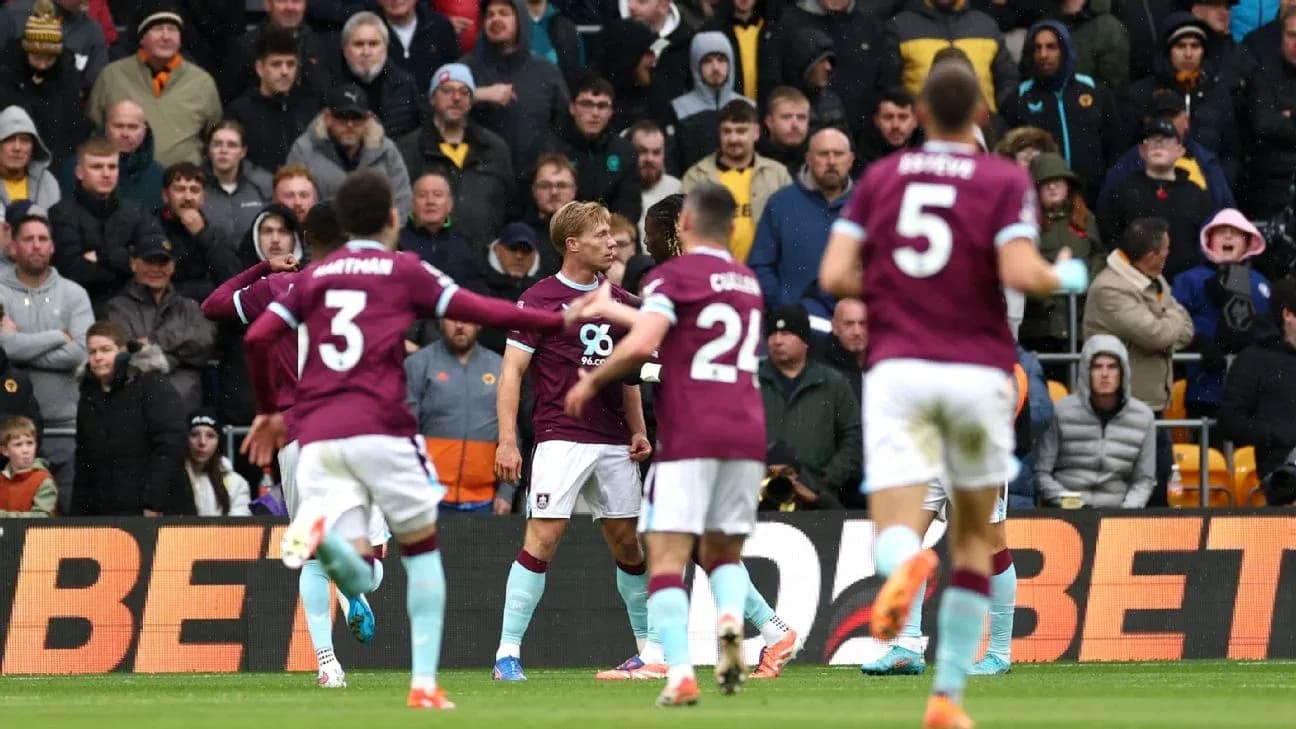
Turf Moor’s final act of the 2025–26 Premier League season ended with a stalemate that said as much about both squads’ flaws as their fight. Burnley and Wolves, locked in 19th and 20th respectively heading into this game, played out a 1–1 draw that confirmed their relegation paths but also crystallised the tactical identities they’ve been wrestling with all year.
I. The Big Picture – Two Relegated Identities Collide
This was Regular Season – 38, a dead rubber in terms of survival, but not in terms of pride. Burnley, at home, came in with 22 points, a goal difference of -37 (38 scored, 75 conceded overall), and a season defined by fragility without the ball. At Turf Moor they had managed only 2 home wins from 19, scoring 18 and conceding 29; an average of 0.9 goals for and 1.5 against at home underlined their struggle to turn possession into control.
Wolves arrived in even deeper trouble: 20 points, goal difference -41 (27 scored, 68 conceded overall). On their travels they were winless: 0 away victories, 6 draws, 13 defeats, with just 8 away goals and 34 conceded. An away average of 0.4 goals for against 1.8 conceded painted a team that rarely imposed itself outside Molineux.
The match itself followed that pattern. Wolves, in a 3-4-2-1, struck before the break, leading 1–0 at half-time. Burnley, in their familiar 4-2-3-1 – their most-used shape this season with 13 league appearances – clawed back after the interval to make it 1–1 by full time. It was an ending that summed up both clubs: Wolves’ structure without enough cutting edge, Burnley’s endeavour without enough control.
II. Tactical Voids – Absences and Edge
Both managers were forced to navigate key absences. Burnley were again without J. Beyer (hamstring) and J. Cullen (knee), removing a ball-playing centre-back option and a midfield organiser. That pushed Mike Jackson towards a double pivot of Florentino and L. Ugochukwu, a more destructive, less creative base.
For Wolves, Rob Edwards had to cope without L. Chiwome, M. Doherty, E. Gonzalez and S. Johnstone. The loss of Doherty in particular stripped away an experienced wide outlet for the back three, forcing a heavier load onto R. Gomes and D. M. Wolfe in the wing-back corridors.
Discipline has been a defining subplot for both squads. Burnley’s season-long yellow card profile shows a spread of cautions but with a notable late-game spike: 19.70% of their yellows arriving between 91–105 minutes and 18.18% between 76–90. Wolves, by contrast, compress their aggression into the heart of the second half: 27.50% of their yellows between 46–60 minutes and another 20.00% between 61–75. That pattern held in microcosm here: Burnley’s late pressure was always at risk of tipping over, Wolves’ mid-game intensity flirting with bookings as they tried to protect their lead.
Individually, the disciplinary tone is clear. For Burnley, H. Mejbri’s 10 yellows this season and K. Walker’s 9 underline how their energy and recovery runs often spill into fouls. J. Laurent, on the bench here, carries a red card on his seasonal record, evidence of a midfield willing to push the line. Wolves have their own enforcers: André and Y. Mosquera both sitting on 12 yellows each, and another midfielder, João Gomes, on 10, show a spine that tackles on the edge to protect an often-exposed back line.
III. Key Matchups – Hunter vs Shield, Engine Room vs Enforcer
The clearest “Hunter vs Shield” narrative belonged to Z. Flemming. Listed as a forward here but Burnley’s top scorer from midfield over the season with 11 goals in total, he led the line in the 4-2-3-1. His 38 shots (21 on target) and willingness to duel – 274 duels, 114 won – gave Burnley a reference point between Wolves’ three centre-backs.
He was tasked with unsettling a Wolves defence that, on their travels, had conceded 34 goals and never really solved the structural leaks of a back three. L. Krejci, S. Bueno and Mosquera formed the last line, with Mosquera in particular bringing physical presence and timing – he has blocked 17 shots over the season, an impressive figure that underlines his willingness to step out and smother danger. Here, that duel with Flemming – mobility and clever movement against a proactive blocker – shaped much of the penalty-box narrative.
Behind Flemming, Burnley’s creative triangle of L. Tchaouna, H. Mejbri and J. Anthony tried to exploit the spaces behind Wolves’ wing-backs. Mejbri, who has 4 assists this season and 21 key passes, operated as the connective tissue between the double pivot and the front four. His tendency to draw fouls (47 won) and commit them (24) encapsulates Burnley’s risk-reward approach in tight zones.
Opposite him, Wolves’ “Engine Room vs Enforcer” battle was defined by André. The Brazilian, Wolves’ top yellow-card collector, is also a metronome: 1306 passes at 91% accuracy and 18 key passes. In this 3-4-2-1 he sat alongside A. Gomes and D. M. Wolfe, trying to give Wolves a platform to release Hwang Hee-Chan, M. Mane and A. Armstrong. André’s job was twofold: screen Flemming’s drops into midfield and launch quick transitions into the channels where Burnley’s full-backs, especially Walker, like to advance.
Walker’s season tells its own story: 1440 passes at 77% accuracy, 13 key passes, 56 tackles and 10 blocked shots. In this game he was simultaneously Burnley’s outlet and their insurance, tasked with containing Wolves’ left-sided rotations between Mane and Hwang while still providing width in possession.
IV. Statistical Prognosis – xG Patterns and Defensive Reality
Even without explicit xG numbers, the season-long data gives us a clear Expected Goals-style prognosis for how this match was always likely to look.
Burnley, overall, average 1.0 goals for and 2.0 against per game. At home, that shifts to 0.9 scored and 1.5 conceded. Wolves, overall, average 0.7 goals for and 1.8 against; away, 0.4 scored and 1.8 conceded. On probability alone, a low-scoring Burnley edge or a draw was always the likeliest outcome. A 1–1 feels almost like the median of both sides’ attacking limitations and defensive vulnerabilities.
Burnley’s four clean sheets at home all season and Wolves’ single away clean sheet suggested that both defences would crack at least once under sustained pressure. The fact that Wolves led at half-time but couldn’t close it out mirrors their broader campaign: structured enough to compete, not resilient enough to finish the job. Burnley’s comeback fits their late-season pattern of sporadic surges inside an otherwise fragile framework.
Following this result, both teams leave the Premier League with their identities clear but incomplete. Burnley have a focal scorer in Z. Flemming, energetic creators like Mejbri, and experienced carriers such as Walker, yet a defensive structure that leaks too often. Wolves possess a hardened midfield core in André and Mosquera, but an attack that, especially away, never generated enough volume.
This 1–1 at Turf Moor was less a twist in the tale than an epilogue: two relegated squads showing, one last time, exactly who they have been all season.
Related News
Brighton vs Arsenal Predicted Lineups: Team News and Match Insights
Manchester City vs Sunderland Predicted Lineups: Team News and Match Analysis
Bournemouth vs Liverpool Prediction: Key Stats and Betting Tips
Tottenham vs Aston Villa Predicted Lineups: Team News for Premier League Clash
Brighton vs Arsenal: Premier League Clash Preview
Manchester City vs Sunderland: Premier League Clash Preview