
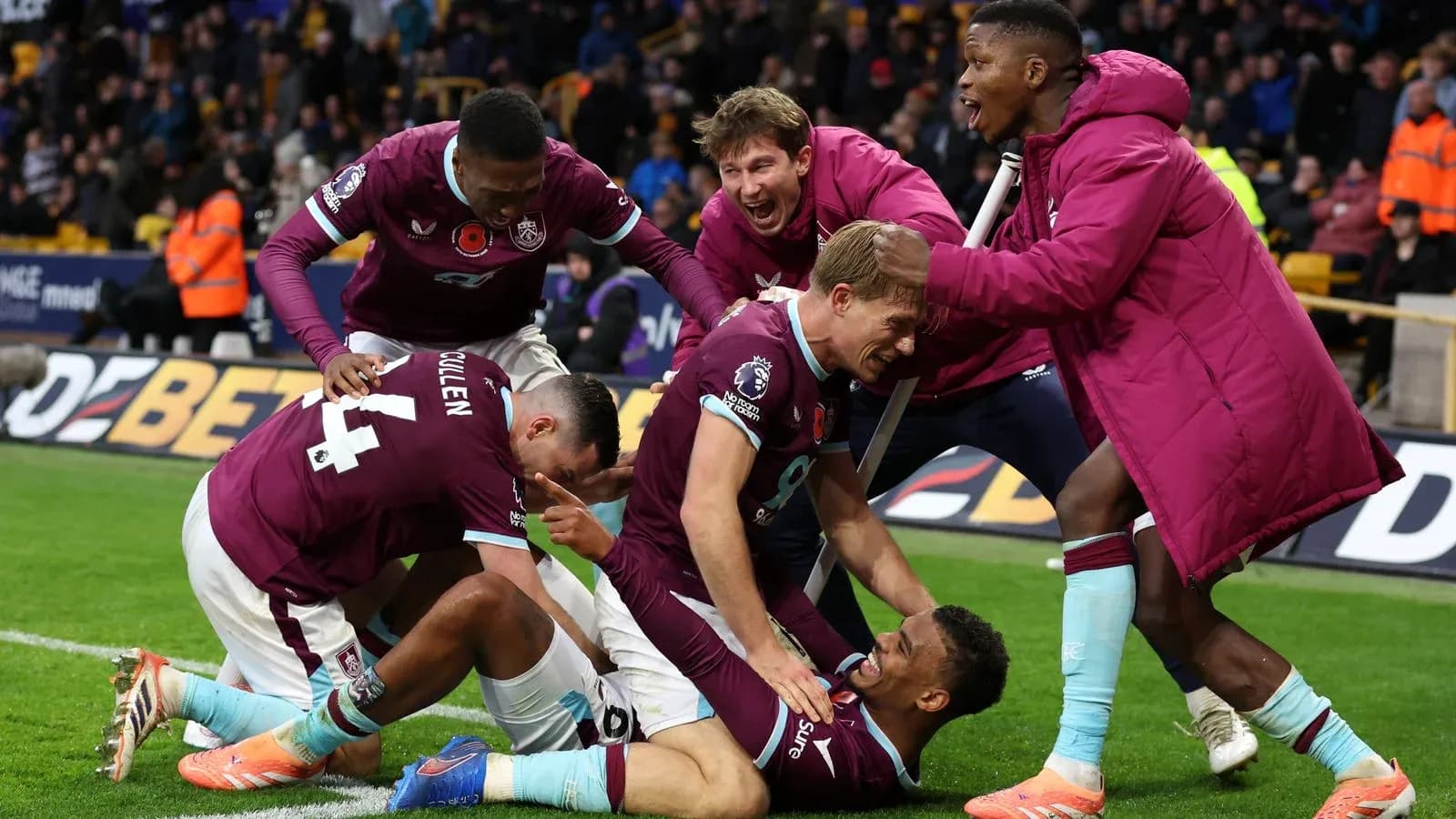
Burnley vs Wolves: Tactical Arm-Wrestle Ends in Draw
Burnley’s 1-1 draw with Wolves at Turf Moor was a tactical arm-wrestle defined by contrasting structures and a sharp shift in momentum after the interval. Wolves, in a 3-4-2-1 under Rob Edwards, struck early and then leaned into a compact, counter-attacking posture. Burnley, set up by Mike Jackson in a 4-2-3-1, dominated territory and the ball but needed a second-half adjustment in tempo and personnel to translate control into a point.
Wolves’ early penalty, confirmed by VAR after Ladislav Krejčí’s involvement in the fourth minute and converted by A. Armstrong on 5 minutes, allowed the visitors to immediately retreat into their preferred medium-low block.
The back three of Y. Mosquera, S. Bueno and L. Krejci formed a narrow triangle in front of J. Sa, with the wing-backs in the nominal midfield line responsible for jumping to Burnley’s full-backs. This gave Wolves a clear 3v1 against Z. Flemming in central zones and forced Burnley wide.
Burnley’s 4-2-3-1 had a clear possession identity: Florentino and L. Ugochukwu as a double pivot, with H. Mejbri as the central connector behind Flemming. With 70% possession and 558 passes (488 accurate, 87%), Burnley built patiently, often through K. Walker and Lucas Pires stepping high from full-back. The problem in the first half was vertical speed and occupation of Wolves’ last line; Wolves’ 3-4-2-1 compressed the central lane, and Burnley’s wide trio of L. Tchaouna, Mejbri and J. Anthony struggled to receive between lines facing forward.
The disciplinary pattern reflected the intensity of Wolves’ defensive work and Burnley’s frustration. Hwang Hee-chan’s yellow card on 41 minutes for an “Off the ball foul” highlighted Wolves’ readiness to disrupt transitions even away from the immediate contest. Burnley’s irritation surfaced in first-half stoppage time when Hannibal Mejbri was booked at 45+9' for “Argument”, an indicator of the psychological pressure of chasing the game despite territorial dominance.
Second Half
The tactical hinge came right after the break. On 47 minutes, Burnley finally broke through: Z. Flemming equalised with a “Normal Goal”, assisted by L. Tchaouna. The pattern leading to that moment was consistent with Burnley’s plan—sustained pressure, full-backs advanced, and the attacking midfield line rotating to create a shooting lane for the central forward. That goal forced Wolves to reconsider the depth of their block and briefly opened the game.
From there, Jackson’s substitutions refined Burnley’s structure. On 66 minutes, Z. Amdouni (IN) came on for H. Mejbri (OUT), a like-for-like swap in the No.10 space but with a slightly more penalty-box-oriented profile. Later, at 75 minutes, J. Ward-Prowse (IN) replaced L. Ugochukwu (OUT), adding long-range distribution and set-piece quality to a midfield that already controlled the ball but needed more incision. Simultaneously, M. Edwards (IN) came on for L. Tchaouna (OUT), keeping the wide right role fresh with a more direct dribbler.
These changes preserved the 4-2-3-1 shell but altered the internal dynamics: Ward-Prowse’s passing range encouraged earlier switches to isolate J. Anthony on the left before he too was replaced at 84 minutes by J. Bruun Larsen (IN), while A. Barnes (IN) for Flemming at the same minute turned Burnley’s front line into a more traditional target-man reference. Barnes’ presence also contributed to the late emotional edge; he was booked at 90+4' for “Argument”, underlining his combative influence in the closing stages.
Wolves’ substitutions were aimed at refreshing legs in a defensive context rather than changing the system. At 66 minutes, T. Arokodare (IN) came on for A. Gomes (OUT), adding a more direct outlet higher up the pitch. At the same time, Toti (IN) replaced L. Krejci (OUT), a like-for-like change in the back three to maintain defensive intensity. On 74 minutes, H. Bueno (IN) for D. M. Wolfe (OUT) adjusted the left side of the midfield line, and J. Abbey (IN) for A. Armstrong (OUT) removed the original penalty scorer but added fresh pressing energy up front. Finally, Pedro Lima (IN) for R. Gomes (OUT) on 82 minutes maintained Wolves’ wing presence while keeping the 3-4-2-1 intact.
The goalkeepers’ performances were shaped by these tactical choices. M. Weiss (Burnley) faced a relatively modest workload in terms of volume, making 3 saves behind a side that had 70% of the ball but still conceded 16 total shots and 10 from inside the box. Wolves’ plan to attack quickly into space after turnovers meant that when they did arrive in the final third, the chances were often dangerous, reflected in their 2.05 xG. Weiss’s goals prevented figure of 0.29 suggests he marginally outperformed the average expectation on the shots he faced.
At the other end, J. Sa (Wolves) was central to preserving the point. He made 7 saves as Burnley generated 8 shots on goal from 16 total attempts. Despite seeing only 30% possession and completing 223 passes (164 accurate, 74%), Wolves’ defensive block and Sa’s shot-stopping combined to hold Burnley to 1.06 xG. The identical goals prevented value of 0.29 for Sa underlines that both goalkeepers marginally tilted the balance in their teams’ favour, even as the scoreline finished level.
Statistically, Burnley’s dominance in ball possession and passing contrasted sharply with Wolves’ superior xG. Burnley’s 7 corner kicks to Wolves’ 7 and a 10–11 foul count show a relatively balanced game in set-piece and physical terms, but the quality of Wolves’ chances—particularly via counters and the early penalty—was higher. Burnley’s 6 blocked shots versus Wolves’ 7 highlighted both teams’ commitment to protecting the box.
Discipline closed with symmetry: Burnley and Wolves each collected 2 yellow cards, total 4. After Hwang Hee-chan’s first-half booking and Mejbri’s stoppage-time “Argument” caution, the late-game tension produced twin yellows at 90+4': Ashley Barnes (Burnley) for “Argument” and Yerson Mosquera (Wolves) also for “Argument”. Those moments encapsulated a match where Burnley’s structural control met Wolves’ resilience and counter-punching threat, leaving both sides with a point that felt, in very different ways, both earned and incomplete.
Related News
Bournemouth vs Liverpool Prediction: Key Stats and Betting Tips
Tottenham vs Aston Villa Predicted Lineups: Team News for Premier League Clash
Brighton vs Arsenal: Premier League Clash Preview
Manchester City vs Sunderland: Premier League Clash Preview
Tottenham vs Aston Villa: Early Relegation Battle
Brentford vs Chelsea Predicted Lineups: Team News and Match Insights