
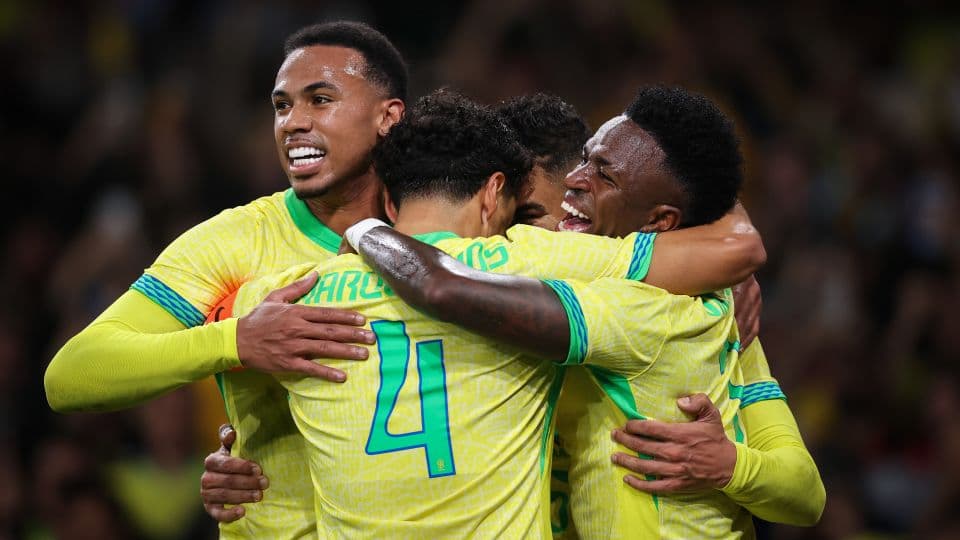
Brazil Aims to End 24-Year World Cup Drought in 2026
After a 24-year wait, Brazil is ready to chase its sixth World Cup trophy this summer in North America. This nation, obsessed with football and proud of five previous titles—the most of any country—has endured over two decades without lifting the trophy since their last triumph in 2002.
Eliminations have been harsh: France ended Brazil's run in 2006, the Netherlands in 2010, and then came the infamous 7-1 loss to Germany in 2014, a match that left fans devastated. The team bowed out in the quarterfinals again in 2018 and 2022, extending the frustration.
For many young Brazilians, a World Cup victory is a story from the past, passed down through generations—from Ronaldo Nazário’s heroics in 2002, Romário’s influence in 1994, to legends like Pelé and Garrincha decades earlier. Now, a fresh generation led by Vinícius Júnior hopes to write its own chapter.
Low Expectations Among Fans
Despite Brazil's rich history, optimism seems muted. An April poll by Datafolha showed only 29% of Brazilians believe the team can win, the lowest support since 1994. Nearly half doubt the squad will reach beyond the quarterfinals, where Brazil has faltered recently.
Several issues clouded Brazil's road to the tournament, including off-field controversies and poor performances. In May 2025, former Brazilian Football Confederation president Ednaldo Rodrigues was removed amid allegations of election fraud. Around that time, Carlo Ancelotti was appointed head coach during Brazil's worst World Cup qualifying campaign ever, finishing fifth in CONMEBOL with 28 points—10 behind leaders Argentina.
The heavy 4-1 defeat to Argentina in Buenos Aires, despite Lionel Messi’s absence, was called "embarrassing" by captain Marquinhos, who publicly apologized to fans. This loss cost Dorival Júnior his job and paved the way for Ancelotti’s arrival.
The Shadow of Belo Horizonte
Brazilian football’s darkest hour remains the 2014 World Cup semifinal disaster at Mineirão stadium in Belo Horizonte. The team fell behind 5-0 within 30 minutes, eventually losing 7-1 to Germany. It was a blow that shocked the nation and became known as the Mineiraço. The defeat still haunts Brazilian soccer culture, often referenced to describe crushing humiliation.
“7-1 has entered the language,” said South American football expert Tim Vickery. “Any massive defeat is now called a 7-1. It’s a stain that won’t go away unless they win another World Cup.”
Since 2002, Brazil has struggled against European opponents in knockout rounds, losing to teams like France, the Netherlands, Germany, Belgium, and Croatia. Beating a European side in the later stages remains a key challenge.
If Brazil tops Group C as expected, they could face England—Euro finalists in 2020 and 2024—in the quarterfinals. Even then, a victory over England might not satisfy fans hungry for the sixth star on their jersey.
Legacy of 1970 and the Weight of Style
Brazil’s 1970 World Cup victory in Mexico set a standard of excellence and flair that still defines expectations. Known as "O Time Belo" or “The Beautiful Team,” that squad transformed how the world saw football. The yellow jersey became synonymous with skill and joy, raising Brazil from a third-tier South American team in 1958 to the pinnacle of global soccer within a decade.
That success shaped every subsequent generation, burdening them to not only win but to do so with style. Teams like the celebrated 1982 squad, considered one of the greatest never to win the title, are still admired for their artistry despite falling short.
This long drought feels heavier because it’s about more than trophies; it’s about living up to a legacy of beautiful football.
Vinícius Júnior Carries the Hopes
Each Brazilian World Cup win has had a standout star: Pelé, Garrincha, Romário, Ronaldo. The current hope rests on Vinícius Júnior, who has already become a leading figure.
“It’s his cup,” said 2002 champion Cafu. “All eyes will be on Vini Jr. If he stays calm and focused, he can lead Brazil back to the top.”
In Qatar 2022, Vinícius was important but still in Neymar Jr.'s shadow. Now, at 25, he’s the team’s forefront, unshaken by pressure. He scored in all three group matches, joining legends Ronaldo and Rivaldo with such a feat. A two-time Champions League winner and FIFA’s best men’s player in 2024, his achievements already surpass many.
Winning the World Cup would put him in a class of his own.
Neymar’s Possible Farewell
At 34, Neymar’s return to the squad surprised some due to recent injuries and a hiatus since October 2023. Yet, his selection sparked celebrations across Rio de Janeiro. As Brazil’s all-time leading scorer, Neymar might still influence their campaign.
“Neymar is invaluable,” said Brazil icon Ronaldo. “He might not play every game but his presence matters.”
Twelve years after missing the 2014 semifinal due to injury, Neymar embodies the hope of redemption. His style echoes the spirit Brazil showed in 1970.
Looking Ahead
After a 1-1 draw against Morocco in Brazil’s opener, former champion Roberto Carlos urged the squad to "play with love" and embrace the chance to make history. Brazil faces Norway, led by Erling Haaland, at MetLife Stadium in New York, with a spot in the quarterfinals on the line. Reaching the final four would mark progress unseen since 2014.
Related News
FIFA World Cup 2026 Commentary Team: Complete List of Presenters and Analysts
World Cup 2026 Best XI: Messi, Rodri, Mbappe Lead the Lineup
Spain’s Tactical Mastery Behind Their Second World Cup Triumph
Gianni Infantino Criticizes World Cup 2026 Detractors Amid Event's Success
FIFA President Gianni Infantino Responds Strongly to 2026 World Cup Critics
Kylian Mbappé Pens Open Letter to France Fans After 2026 World Cup