
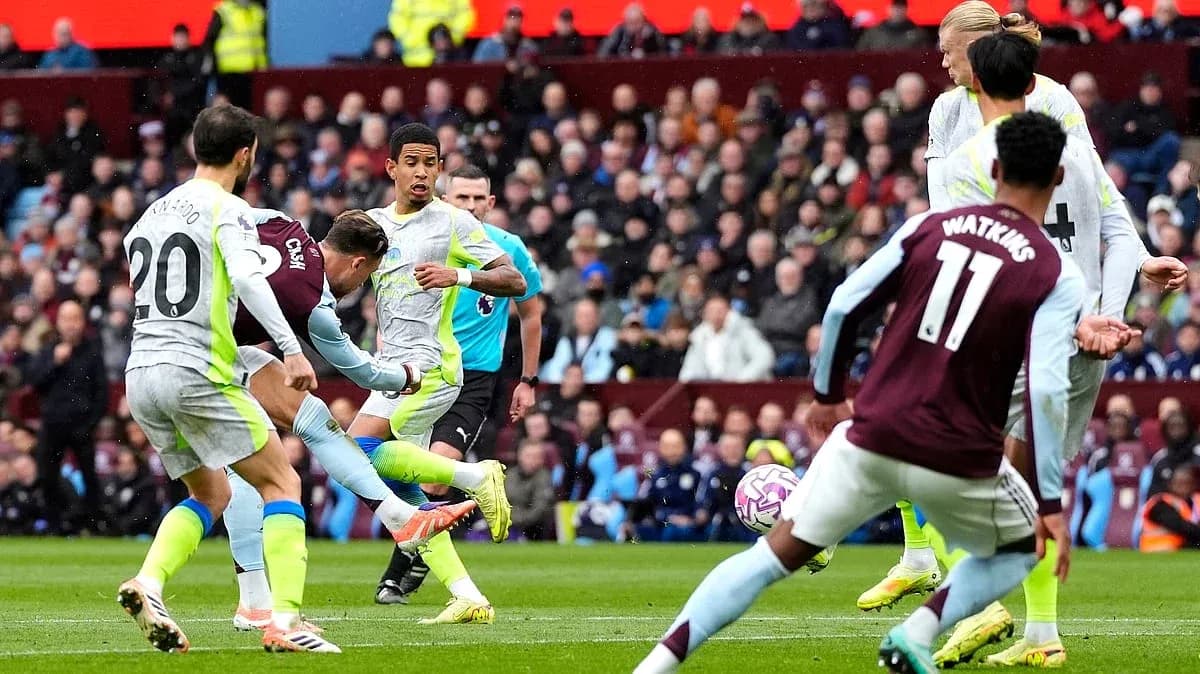
Aston Villa's Tactical Triumph Over Manchester City at Etihad
The Etihad Stadium’s final act of the 2025–26 Premier League season unfolded under a strange tension. Manchester City, heading into this game already locked into 2nd with 78 points and a formidable overall goal difference of 42 (77 scored, 35 conceded), hosted an Aston Villa side whose own resurgence had carried them to 4th on 65 points, with a leaner overall goal difference of 7 (56 for, 49 against). On paper, it looked like a coronation of City’s home power: 14 wins from 19 at home, scoring 45 and conceding just 14. Instead, the afternoon ended with a twist — a 1–2 defeat that felt like a tactical ambush rather than a dead‑rubber drift.
City’s seasonal DNA had been one of control and volume. At home they averaged 2.4 goals for and only 0.7 against, backed by 9 clean sheets and just a single blank in front of goal. Aston Villa, by contrast, had built their top‑four push on a more volatile profile: on their travels they averaged 1.3 goals for and 1.4 against, with only 3 away clean sheets and 6 away games without scoring. Yet Unai Emery’s 4‑2‑3‑1 here was not timid; it was tailored to disrupt City’s 4‑2‑2‑2 and to weaponise transitions.
Pep Guardiola’s selection was a statement of fluidity over orthodoxy. J. Trafford in goal was shielded by a back four of R. Lewis, J. Stones, R. Dias and N. Ake, a line built for rest‑defence and aggressive build‑up. Ahead of them, Nico and B. Silva formed a double pivot, but with clear asymmetry: Bernardo dropping into half‑spaces to dictate, Nico tasked with shuttling and plugging counters. The advanced midfield band of A. Semenyo and Savinho offered vertical running and width, while P. Foden and T. Reijnders as nominal forwards hinted at a false‑nine‑by‑committee approach — constant rotation, no fixed reference point.
Aston Villa’s structure was more classical but no less nuanced. M. Bizot replaced the absent E. Martinez, whose finger injury removed a vocal leader from the back line. In front of Bizot, A. Garcia, V. Lindelof, T. Mings and I. Maatsen formed a back four that had to live on the edge against City’s positional play. The double pivot of L. Bogarde and Douglas Luiz was Emery’s insurance policy: one to screen and chase, one to dictate and break lines. Ahead of them, L. Bailey and E. Buendia flanked R. Barkley, all servicing O. Watkins as the lone striker.
The tactical voids were almost entirely claret and blue. Villa were without Alysson, B. Kamara and Martinez, all listed as Missing Fixture. Kamara’s knee injury stripped Villa of a natural ball‑winning shield in front of the defence, forcing Emery to lean on Bogarde’s energy and Douglas Luiz’s positional intelligence. Martinez’s absence not only altered the build‑up rhythm but removed a penalty specialist and organiser. That Villa survived and then thrived without that spine underlined the collective discipline of the structure.
Discipline, in fact, had been a defining storyline for both sides over the season. City’s yellow‑card timing showed a late‑game edge: 20.90% of their yellows arrived between 76–90', another 19.40% between 46–60', a clear sign of a team that pushes intensity after half‑time and into the closing stages. Aston Villa, meanwhile, were most combustible right after the interval: 29.31% of their yellows came between 46–60', with another 17.24% between 61–75'. They also carried a notable disciplinary flashpoint with a red card in the 61–75' window. In a game that finished 1–2, it is easy to imagine the rhythm: City tightening the screw after the break, Villa riding the storm, living on the line of bookings but never tipping into chaos.
The “Hunter vs Shield” duel was always going to be framed by the league’s top scorers. E. Haaland, City’s spearhead across the campaign with 27 league goals and 8 assists, was conspicuous by his absence from the starting XI here, but his season still defined how Villa had to prepare. Haaland’s 102 shots, 59 on target, and his 3 penalties scored from 4 (with 1 missed) meant Villa’s centre‑backs and Bizot had trained all week for a penalty‑box predator. Instead, they faced Foden and Reijnders drifting into pockets, a different kind of threat — one that asked Lindelof and Mings to defend space as much as bodies.
On the other side, O. Watkins brought 16 goals and 3 assists into this fixture, the focal point of Villa’s attack. His 283 duels and 56 dribble attempts across the season spoke of a forward who lives in the grind, constantly backing into centre‑backs, spinning channels, and dragging lines around. Against a City defence that, overall, conceded just 0.9 goals per game and kept 16 clean sheets, Watkins needed support from the second line. That is where R. Barkley’s late arrivals and Bailey’s direct running became decisive, turning Villa’s sporadic attacks into genuine threats.
In the “Engine Room” battle, Bernardo Silva versus Douglas Luiz was the game’s quiet epic. Bernardo, who had amassed 2 goals, 4 assists and 10 yellow cards across the league campaign, is City’s metronome and irritant in one body — 2,196 passes with 47 key passes, 53 tackles and 6 successful blocks tell the story of a midfielder who both constructs and destroys. Douglas Luiz, by contrast, was Villa’s stabiliser, asked to manage distances in front of a back four that on their travels conceded 1.4 goals per game. Every time Bernardo drifted into the right half‑space, Douglas had to decide: step out and leave space behind, or hold and allow City’s rhythm to build.
From the bench, the shapes of Plan B were clear. For City, R. Cherki, second in the league’s assist charts with 12, offered a different creative profile — 61 key passes and 105 dribble attempts made him the obvious candidate to unlock a deep block late on. J. Doku and O. Marmoush added raw pace and directness, while M. Kovacic and M. Nunes could tilt the midfield into a more aggressive pressing machine. Villa’s counter‑punch options lay with Y. Tielemans and J. McGinn to add craft and bite, and L. Digne to offer overlapping width and high‑quality delivery from the left, his 6 assists from full‑back a testament to his crossing threat.
Statistically, the season suggested a City win. At home they had lost only twice in 19, scoring more than three times as many as they conceded. Villa, on their travels, had a negative away goal difference (24 scored, 27 conceded) and a tendency to wobble after half‑time, as their yellow‑card peaks between 46–60' and 61–75' indicated. Expected Goals models, if overlaid on these season‑long numbers, would likely have tilted towards a City victory built on territorial dominance and shot volume.
Yet following this result, the story was different. Villa’s 1–2 win at the Etihad felt like a perfect storm of Emery’s structure, Watkins’ relentlessness and a back line that, without Martinez, still found a way to bend but not break. City’s campaign numbers remain imposing, but this finale served as a reminder: even a machine that averages 2.4 goals at home can be disrupted if the opponent’s block is disciplined, the transitions are sharp, and the key duels — Bernardo versus Douglas Luiz, Watkins versus Dias and Stones — tilt, even slightly, towards the underdog.
Related News
Bournemouth vs Liverpool Prediction: Key Stats and Betting Tips

Tottenham vs Aston Villa Predicted Lineups: Team News for Premier League Clash
Brighton vs Arsenal: Premier League Clash Preview

Manchester City vs Sunderland: Premier League Clash Preview
Tottenham vs Aston Villa: Early Relegation Battle

Brentford vs Chelsea Predicted Lineups: Team News and Match Insights