
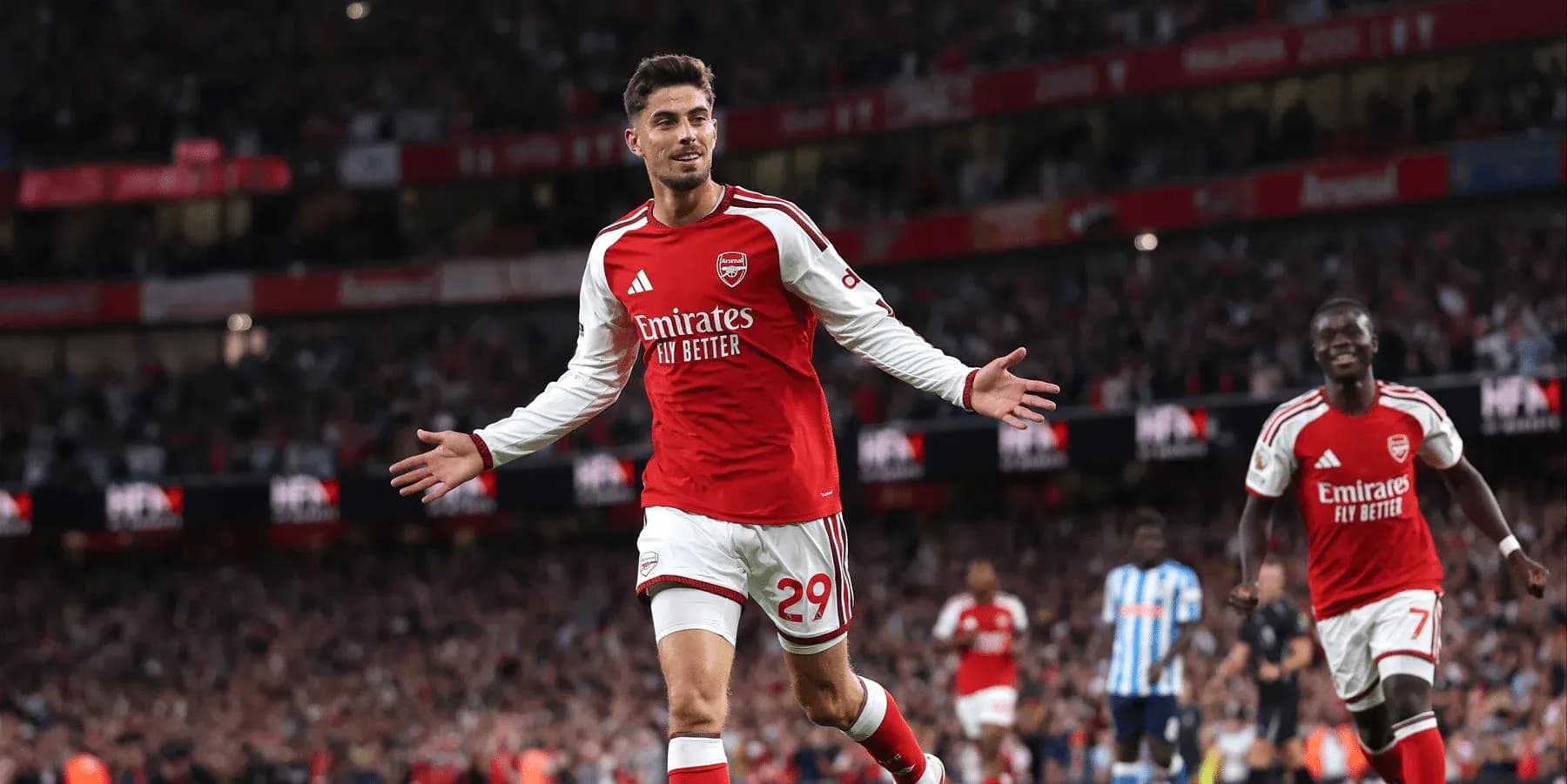
Arsenal Dominates Coventry in Premier League Opener
Under the Emirates lights, Arsenal opened their 2026 Premier League campaign with a statement win, a 3–0 dismantling of newly promoted Coventry that felt as much like a tactical manifesto as a scoreline. By the final whistle, Thomas Bramall had overseen a performance that lifted Arsenal to 2nd in the table with 3 points and a goal difference of +3, while Coventry slipped into early trouble in 19th, their own goal difference a mirror image at -3.
I. The Big Picture – Structure and Intent
Mikel Arteta’s choice of a 4-2-3-1 was familiar in outline but subtly retooled in personnel. With W. Saliba and J. Timber both missing through injury, the back four of B. White, C. Mosquera, Gabriel and R. Calafiori represented a blend of continuity and evolution. Ahead of them, D. Rice anchored with M. Lewis-Skelly, allowing a fluid line of three – B. Saka, M. Odegaard and C. Tzolis – to orbit around K. Havertz as the nominal nine.
Across from them, Frank Lampard’s Coventry arrived in a 4-1-4-1, a shape designed to compress the central lane and survive long stretches without the ball. M. Grimes sat as the single pivot, with L. Tchaouna and B. Thomas-Asante wide and C. Yirenkyi plus F. Onyeka trying to contest Arsenal’s metronomes between the lines. E. Simms, alone up front, was more reference point than consistent outlet.
Heading into this game, the numbers were a blank slate; following it, they are already stark. At home, Arsenal have played 1, won 1, scored 3 and conceded 0, giving them an average of 3.0 goals for and 0.0 against at the Emirates. Coventry, on their travels, have played 1, lost 1, scored 0 and conceded 3, with an away average of 0.0 goals for and 3.0 against. The symmetry underlines what the eye saw: one side fully at ease in its model, the other still learning the demands of this level.
II. Tactical Voids – Absences and Discipline
The team sheets told their own story before a ball was kicked. Arsenal’s injury list was heavyweight: Bruno Guimaraes, W. Saliba and J. Timber all ruled out. The absence of Saliba and Timber might have invited anxiety in years past, but here it simply accelerated the integration of Mosquera and Calafiori. Mosquera’s presence allowed Gabriel to stay on his natural left side, while Calafiori, a natural ball-carrier, gave Arsenal an extra playmaker in the first phase.
For Coventry, L. Woolfenden and H. Wright were both unavailable, stripping Lampard of a centre-back option and a muscular forward who could have shared the burden with Simms. The result was a bench heavy with midfielders but light on alternative structures.
Discipline added another layer. Across the season so far, Arsenal’s only yellow card has landed in the 31–45 minute window, a single booking that already accounts for 100.00% of their cautions in that range. That card belonged to Gabriel, whose 90 minutes combined 57 passes at 94% accuracy with 2 fouls committed and 2 drawn – a reminder that his aggression, while valuable, always walks a fine line.
Coventry’s early disciplinary profile is just as concentrated: their only yellow card this campaign also arrived in the 16–30 minute period, 100.00% of their cautions so far. It was C. Yirenkyi who took it, his 62 minutes defined by hard running, 2 fouls committed and the constant strain of chasing Arsenal’s rotations. No red cards have been shown to either side this season, and with neither team awarded a penalty yet – and none missed – the story of this match was told entirely in open play.
III. Key Matchups – Hunter vs Shield, Engine Room vs Enforcer
The “Hunter vs Shield” duel was played down Arsenal’s right. B. Saka, already among the league’s top-rated attackers, delivered 1 goal from his single shot on target, adding 34 passes at 88% accuracy and 2 key passes. His direct opponent, J. Dasilva, was repeatedly isolated as White surged beyond him. White’s 78 passes at 94% accuracy and 2 key passes underlined how Arsenal’s right-back functioned as an auxiliary playmaker, not just a defender.
For Coventry, the shield never quite solidified. Grimes, as the lone holder, was tasked with screening Odegaard and cutting off the half-space channels. Instead, Odegaard orchestrated the game with 56 passes at 92% accuracy, 3 key passes and 1 goal. Each time Coventry’s midfield line stepped out, he drifted into the blind spots behind Yirenkyi and Onyeka, receiving on the half-turn and feeding Saka and Tzolis.
In the “Engine Room” battle, Rice and Lewis-Skelly versus Grimes and Onyeka tilted decisively Arsenal’s way. Rice’s presence allowed Arsenal to sustain pressure, pinning Coventry deep and turning clearances into second balls. Lewis-Skelly, operating as the more progressive of the double pivot, quietly stitched phases together, ensuring Arsenal’s 4-2-3-1 often resembled a 2-3-5 in settled possession.
Further up, Havertz embodied the hybrid nine that Arteta craves. His 1 goal from 1 shot on target, 25 passes at 80% accuracy and 10 duels contested – 5 of them won – spoke to a forward who was as much wall-pass and presser as finisher. Against centre-backs B. Thomas and A. Amenda, he constantly dragged one out of the line, opening the inner channels for Saka and Tzolis to attack.
On the flanks, Coventry’s counters depended on L. Tchaouna and B. Thomas-Asante finding space behind Calafiori and White. But Calafiori’s composure was telling: 24 passes at 83% accuracy, 1 assist and 1 tackle, plus 2 duels won from 3, gave Arsenal balance on the left. His willingness to step into midfield created overloads that Coventry’s 4-1-4-1 could not match, even when they collapsed into a 4-5-1 block.
IV. Statistical Prognosis – What This Game Predicts
Following this result, Arsenal’s overall record reads: 1 match played, 1 win, 3 goals scored, 0 conceded, 1 clean sheet and 0 failures to score. Coventry’s mirror is harsher: 1 played, 1 defeat, 0 goals scored, 3 conceded, 0 clean sheets and 1 failure to score. The goal differences are brutally simple: +3 for Arsenal, -3 for Coventry, each exactly the sum of goals for minus goals against.
Without explicit xG values, the shot and passing data still point to a clear underlying pattern. Arsenal’s leading attackers – Saka, Odegaard and Havertz – each produced 1 goal from 1 shot on target, an efficiency that will not always sustain but is underpinned by the quality of chances created. Their passing metrics and key passes suggest repeated access to high-value zones rather than speculative efforts.
Defensively, Arsenal’s structure without their first-choice right centre-back held firm. Gabriel and Mosquera limited Coventry’s central threat, while Rice’s screening meant Simms was often isolated, receiving under pressure or not at all. Coventry’s inability to register a goal, combined with their away average of 3.0 goals conceded, hints at a side still calibrating the distances between their lines at Premier League tempo.
From a tactical lens, this match projects a season in which Arsenal’s 4-2-3-1, powered by a right-sided axis of White, Odegaard and Saka and underpinned by Rice, will generate consistent territory and chances, especially at home. Coventry, meanwhile, must quickly refine their 4-1-4-1: the pivot needs closer support, the wide midfielders must better protect the full-backs, and Simms requires more connected outlets if Lampard’s side is to convert honest endeavour into survival.
For now, though, the opening chapter is clear. At the Emirates, Arsenal’s squad looks deep enough to absorb injuries and still impose its blueprint. Coventry, on their travels, have discovered just how unforgiving that blueprint can be.
Related News
Manchester United vs Tottenham Stats: Head-to-Head Record and Past Meetings
Premier League Players and Agents Eye Compensation Claims Against Manchester City Over Guilty Verdict
Premier League Midfielder Shares Ambition to Join Real Madrid

Is Possession Football Losing Its Grip in the Premier League?

Arsenal's Myles Lewis-Skelly Surprises by Naming Tottenham's Mateus Fernandes as Toughest Premier League Rival

Three Premier League Players Making Impressive Early Season Impact