
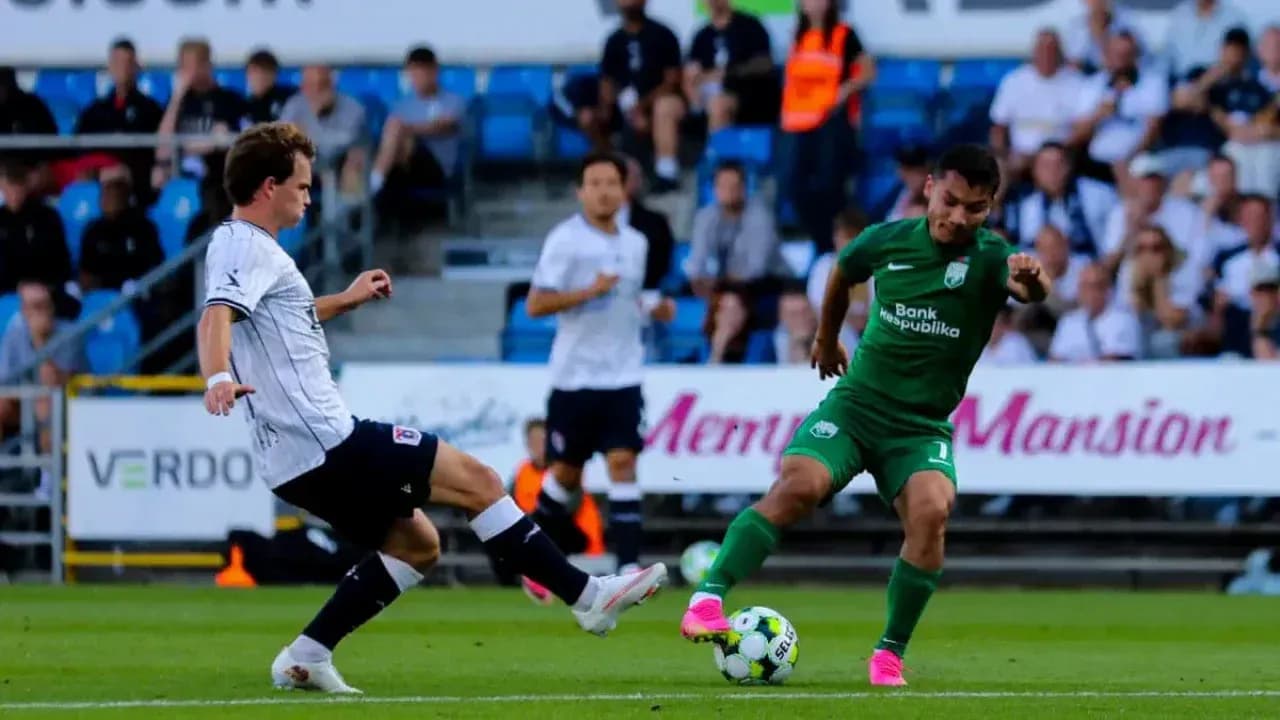
Aarhus' Tactical Masterclass in 2-1 Victory Over Sabah FA
Aarhus’ 2-1 win over Sabah FA at Cepheus Park Randers was a textbook example of how structure and vertical threat can outweigh territorial dominance. In a 3-4-3, Jakob Poulsen’s side accepted a possession deficit (44% to 56%) but controlled the most dangerous spaces, striking twice through the movement of J. Bogere while limiting Sabah FA to one reply in a game that became increasingly stretched after the hour.
Sabah FA, in their 4-2-3-1, tried to impose a higher-tempo, pass-heavy game (439 passes at 85% accuracy versus Aarhus’ 351 at 80%). They generated more total shots (15 to 10) and more efforts from distance (10 shots outside the box), but their territorial control rarely translated into clean central breakthroughs until V. Simic’s second-half goal gave them a foothold.
Structurally, Aarhus’ back three of E. Kahl, F. Tingager and C. Rosler underpinned the game plan. With wing-backs embedded in the “4” line of the 3-4-3, Aarhus were compact without the ball, funnelling Sabah FA’s possession into wider and deeper zones. The shot profile reflects that: Sabah FA took 10 of their 15 shots from outside the box and had only one shot blocked, indicating they were often forced to shoot early rather than work the ball into crowded central areas.
In possession, Aarhus were far more direct and purpose-driven. The front trio of T. Bech, J. Bogere and K. Arnstad looked to attack the channels behind Sabah FA’s full-backs, especially once the first line of pressure was broken by the central midfield pair of M. Knudsen and J. Jonsson. Aarhus’ 4 shots inside the box out of 10 total underline how they focused on creating fewer but higher-quality situations, rather than volume from range.
Key Tactical Shifts
The first key tactical shift came as early as the 29th minute, when J. Andersen (IN) came on for F. Tingager (OUT). Rather than changing shape, this swap refreshed the right side of the back three, keeping the defensive line mobile enough to step out and engage Sabah FA’s advanced midfielders. That stability allowed Aarhus to spring forward quickly, leading to J. Bogere’s opener at 31', born from Aarhus’ willingness to attack directly once they recovered the ball.
At half-time, leading 1-0, Aarhus doubled down on midfield energy. At 46', R. Carstensen (IN) replaced J. Jonsson (OUT), adding fresh legs to the central band of the 3-4-3. This was crucial for sustaining counter-presses and limiting Sabah FA’s ability to accelerate through the middle as they chased the game. The reward came at 63', when Bogere again exploited space, this time finishing after a contribution from Knudsen, whose positioning between the lines became more influential as Sabah FA pushed their full-backs higher.
Sabah FA’s response was to re-balance their attacking structure. At 65', O. Mbina (IN) came on for K. Parris (OUT), effectively adding a more direct presence in the forward line. Almost immediately, at 66', Sabah FA finally pierced Aarhus centrally, with Simic finishing after U. Rakhmonaliyev’s involvement. This sequence highlighted the one moment where Aarhus’ back three were drawn too deep and the double pivot of Knudsen and Carstensen could not screen the edge of the box effectively.
From that point, the game’s rhythm changed. Aarhus used their bench to restore control of the flanks and protect the lead. At 71', G. Links (IN) replaced F. Emmery (OUT), adding ball-carrying and defensive work on the wing. Later, at 81', two key defensive and structural substitutions arrived: C. Storch (IN) for C. Rosler (OUT) and J. Serra (IN) for M. Anderson (OUT). These moves kept the 3-4-3 shell intact but injected fresh legs into both the back line and the press from the front, helping Aarhus manage Sabah FA’s late pressure.
Sabah FA also turned to their bench in the closing stages to chase parity. At 79', X. Severina (IN) came on for A. Isayev (OUT), adding creativity between the lines. In added time, they made two more attacking substitutions: at 90+3', Y. Lachaab (IN) for J. Mickels (OUT) and A. Khaybulaev (IN) for V. Simic (OUT). These late changes aimed to sustain intensity around the box, but by then Aarhus had sunk into a compact low block, using their three centre-backs plus hard-working wing-backs to defend crosses and second balls.
The disciplinary pattern also fed into the tactical picture. Sabah FA’s first-half yellow cards to Veljko Simić and Joy Lance Mickels for “Foul” reflected their attempts to disrupt Aarhus’ transitions once the home side broke through midfield. In the second half, the yellows to Gift Links and Magnus Knudsen, both also for “Foul”, showed how Aarhus were willing to take tactical infringements to slow Sabah FA’s counters once they were protecting a lead.
In goal, M. Hedenstad (Aarhus) made 3 saves, a figure consistent with Aarhus’ strategy of allowing some controlled efforts from less dangerous zones while protecting the central channels. At the other end, S. Pokatilov (Sabah FA) faced fewer on-target efforts but still conceded twice, with only 1 save registered. That imbalance underlines the efficiency of Aarhus’ shot selection: 3 shots on goal producing 2 goals, versus Sabah FA’s 4 on target yielding just 1.
Statistically, Sabah FA’s 56% possession and superior passing volume suggest control, but the territorial dominance did not translate into a clear attacking edge. Aarhus matched them for corners (6 to 5) and were only slightly behind in total shots (10 to 15), despite spending more time without the ball. The 4 blocked shots by Aarhus’ defence, compared to just 1 for Sabah FA, further illustrate how the Danish side defended their box with greater aggression and compactness.
Ultimately, the match was decided by the contrast between volume and value. Sabah FA circulated the ball well and reached shooting positions, particularly from distance, but Aarhus’ 3-4-3 gave them superior verticality and protection of the central lane. Bogere’s brace was the natural outcome of a plan built on quick, well-timed incursions into space, while the late-game substitutions and disciplined defensive structure ensured that Sabah FA’s late push never fully destabilised the Aarhus block at Cepheus Park Randers.
Related News
Luis Díaz Confident Bayern Munich Can Win Champions League
Insights from AFC Champions League Matchday One: K League Clubs’ Strategies

Vincent Kompany's Bayern Munich Future Not Tied Solely to Champions League Outcome
Barcelona's Camp Nou Chosen for 2029 Champions League Final, Munich Set for 2028
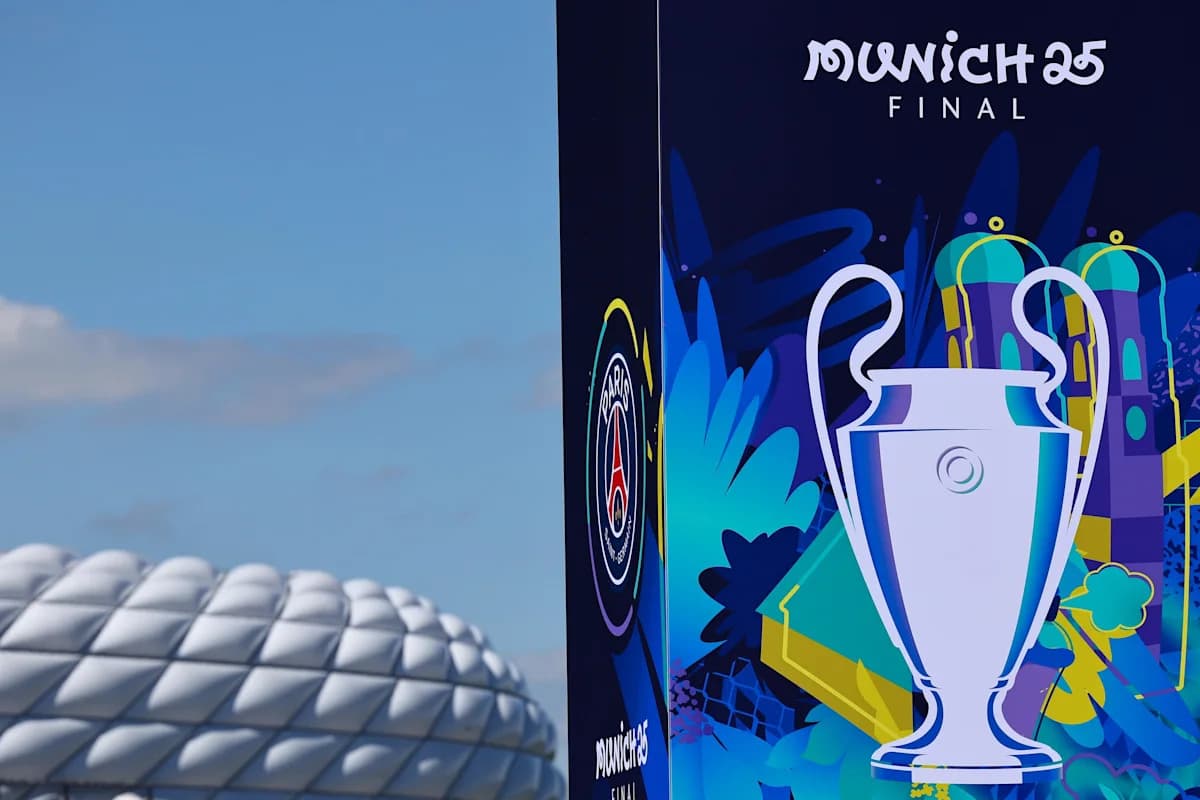
Allianz Arena to Host 2028 UEFA Champions League Final

Allianz Arena to Host 2028 Champions League Final for Third Time