
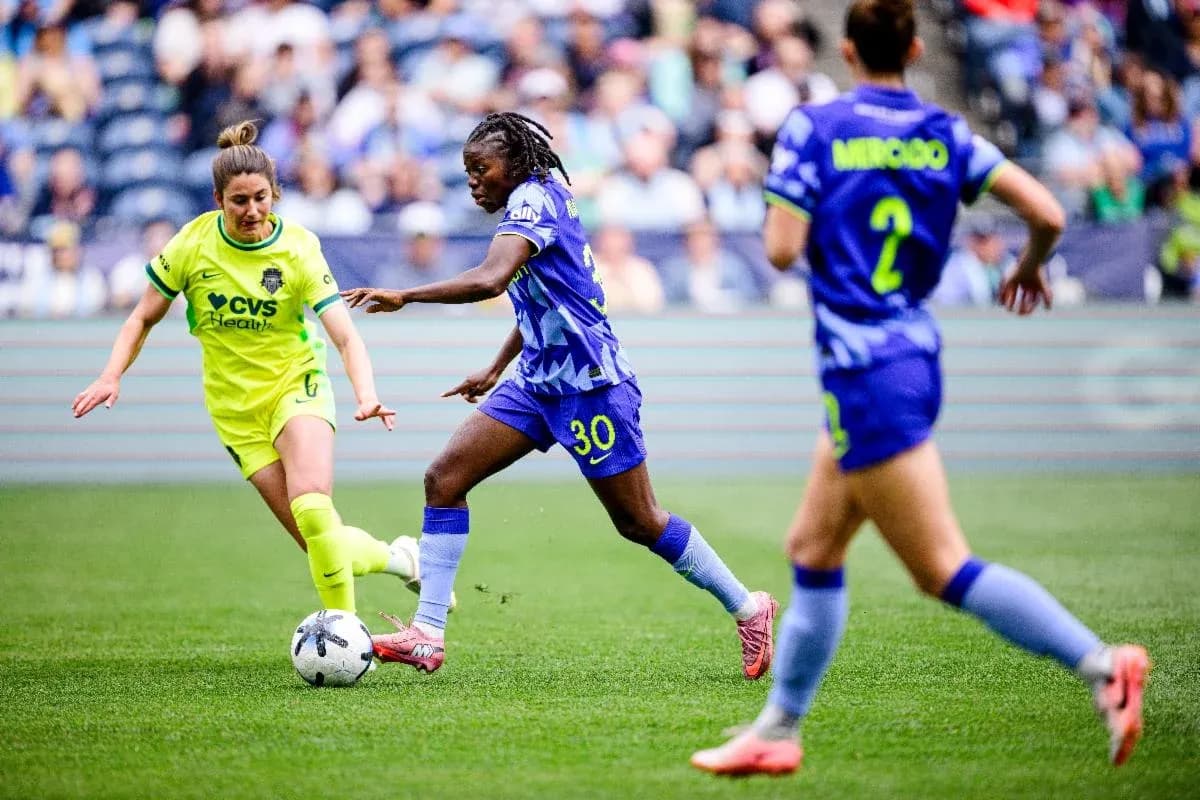
Washington Spirit vs Seattle Reign FC: A Measuring Stick Match
Audi Field under the lights, a Washington crowd humming, and a table split in two directions: this was a Group Stage meeting that felt more like a measuring stick than a routine league date. Washington Spirit W, sitting 4th with 21 points and a goal difference of 9, came in as one of the league’s form sides. Seattle Reign FC W, 10th on 14 points and carrying a goal difference of -3, arrived searching for traction rather than momentum. The 2–1 full‑time scoreline to Washington ultimately mirrored the broader seasonal arcs already written in the numbers.
Heading into this game, Washington’s season had a clear identity: control, balance, and a quietly ruthless edge in both boxes. Overall they had 6 wins from 11, with 18 goals scored and only 9 conceded; that is an overall average of 1.6 goals for and 0.8 against per match. At home they had been even more assured: 3 wins from 5, 8 goals scored and just 3 conceded, an average of 1.6 scored and 0.6 conceded at Audi Field. The defensive platform is not an accident; it is baked into Adrian Gonzalez’s consistent 4‑2‑3‑1, used in all 11 league fixtures.
Seattle’s campaign, by contrast, has been defined by thin margins and a misfiring attack. Overall they had 4 wins, 2 draws, 5 defeats, with only 10 goals scored and 13 conceded. That translates to an overall average of 0.9 goals for and 1.2 against per match. On their travels, they had been competitive but rarely dominant: 2 wins, 1 draw, 2 defeats, 5 goals scored and 6 conceded, averaging 1.0 scored and 1.2 conceded away. They, too, favour a 4‑2‑3‑1 – eight of their 11 outings in that shape – but the same structure has produced far less cutting edge.
On the night, both coaches doubled down on their identities. Washington’s back four of Gabrielle Carle, Elisabeth Tse, Tara McKeown and Lucia Di Guglielmo set up in front of Sandy MacIver, with Hal Hershfelt and Rebeca Bernal anchoring midfield. Ahead of them, a fluid band of three – Rosemonde Kouassi, Leicy Santos and Trinity Rodman – buzzed around central striker Sofia Cantore. It is a spine built to compress the middle third and then spring into space, and it leans heavily on Santos and Rodman as dual threats between the lines.
Seattle mirrored the shape: Claudia Dickey behind a back four of Sofia Huerta, Phoebe McClernon, Jordyn Bugg and Madison Curry; a double pivot of Angharad James‑Turner and Ainsley McCammon; then Holly Ward, Sally Marie Menti and Maddie Dahlien supporting Maddie Mercado. On paper it was symmetry; in practice it was a clash between a settled, confident version of 4‑2‑3‑1 and a still‑forming one.
The tactical voids, intriguingly, came not from absences – there were no listed suspensions or injuries in the data – but from discipline and game management profiles carried into the fixture. Washington’s yellow card distribution is remarkably even, but with clear spikes: 22.22% of their cautions arrive between 0–15 minutes, another 22.22% between 46–60, and a further 22.22% from 76–90. This is a side that plays on the front foot in the opening and closing phases of each half and is willing to take tactical fouls to sustain pressure or kill transitions.
Seattle’s disciplinary pattern is more chaotic and, crucially, more back‑loaded. Only 7.14% of their yellows come in the opening 15 minutes, but they spike to 21.43% in the 46–60 window, 21.43% in 76–90, and another 21.43% in 91–105. That late‑game surge in cards hints at a team often chasing the game, over‑stretching, and forced into desperate interventions as legs tire and distances grow.
Overlay those trends and the story of this 2–1 feels almost pre‑written. Washington, with a strong first‑half profile and a home average of 1.6 goals scored, were always likely to impose themselves early – and they did, taking a 1–1 scoreline into half‑time after trading punches. Seattle, whose attack averages only 0.8 goals at home and 1.0 away, were never built to win a shoot‑out; they needed a low‑event contest, which Washington’s creative axis refused to grant them.
The “Hunter vs Shield” duel centred on Washington’s scorers against Seattle’s leaky defence. Santos entered the match with 4 goals and 2 assists overall, a midfielder with 16 shots drawn into 10 on target and a rating of 7.2. Rodman added 3 goals and 3 assists overall, with 26 shots, 13 on target. Between them they had 7 of Washington’s 18 goals overall – 38.89% of the team’s total output. Against a Reign back line conceding an overall average of 1.2 per match, and 1.2 away, the probability of at least one decisive intervention from that duo was always high.
On the other side, Seattle’s “Shield” had to be collective. McClernon and Bugg were tasked with compressing the central channel against Cantore’s movement, while James‑Turner and McCammon tried to screen passing lanes into Santos. Yet Washington’s season‑long defensive record – only 9 goals conceded overall, with 3 at home – meant that even if Seattle found a moment through Mercado or the wide midfielders, breaking them down twice was statistically unlikely.
In the “Engine Room”, the battle between creators and enforcers tilted Washington’s way. Kouassi, with 3 assists overall and 23 key passes, is the team’s dribble‑first conduit, attempting 43 dribbles with 18 successful. Her duel volume – 136 duels overall, 67 won – underlines her willingness to engage physically. Opposite her, James‑Turner and McCammon had to decide whether to step out and confront or sit and protect the back four. Each time Seattle’s double pivot jumped, Santos drifted into the half‑spaces, linking with Rodman and Cantore; each time they held, Kouassi carried the ball into the final third. It is in that constant recalibration that Washington slowly bent the game to their tempo.
Statistically, Washington’s defensive solidity provided the frame for the final act. Overall, they keep clean sheets in 5 of 11 matches and fail to score only twice. Seattle, by contrast, fail to score in 6 of 11, including 2 on their travels. Even without explicit xG values in the data, the expected goals landscape is clear: Washington’s volume and variety of attacking contributors, combined with their home scoring average and the creative profiles of Santos, Rodman and Kouassi, point to a higher xG footprint. Seattle, reliant on a modest overall scoring rate and a more conservative attacking cast, are structurally more likely to produce a lower xG tally, especially away to one of the league’s stingiest defences.
Following this result, the 2–1 scoreline feels less like a surprise and more like a confirmation. Washington’s 4‑2‑3‑1 continues to look like a playoff‑calibre machine – balanced, repeatable, and anchored by a midfield trio capable of deciding games. Seattle’s mirror shape still lacks the same clarity of roles and punch in the final third. In a league where the margins are thin and the numbers unforgiving, this night in Washington simply underlined which project is further along.
Related News
Orlando Pride W vs Portland Thorns W: Playoff Showdown

San Diego Wave W vs Kansas City W Predicted Lineups: Team News for NWSL Women
Orlando Pride W vs Portland Thorns W Prediction: Key Stats and Betting Tips

San Diego Wave W vs Kansas City W: Key NWSL Clash Preview
San Diego Wave W vs Kansas City W Prediction: Key Stats and Betting Tips
Portland Thorns and Chicago Red Stars Draw in NWSL Showdown