
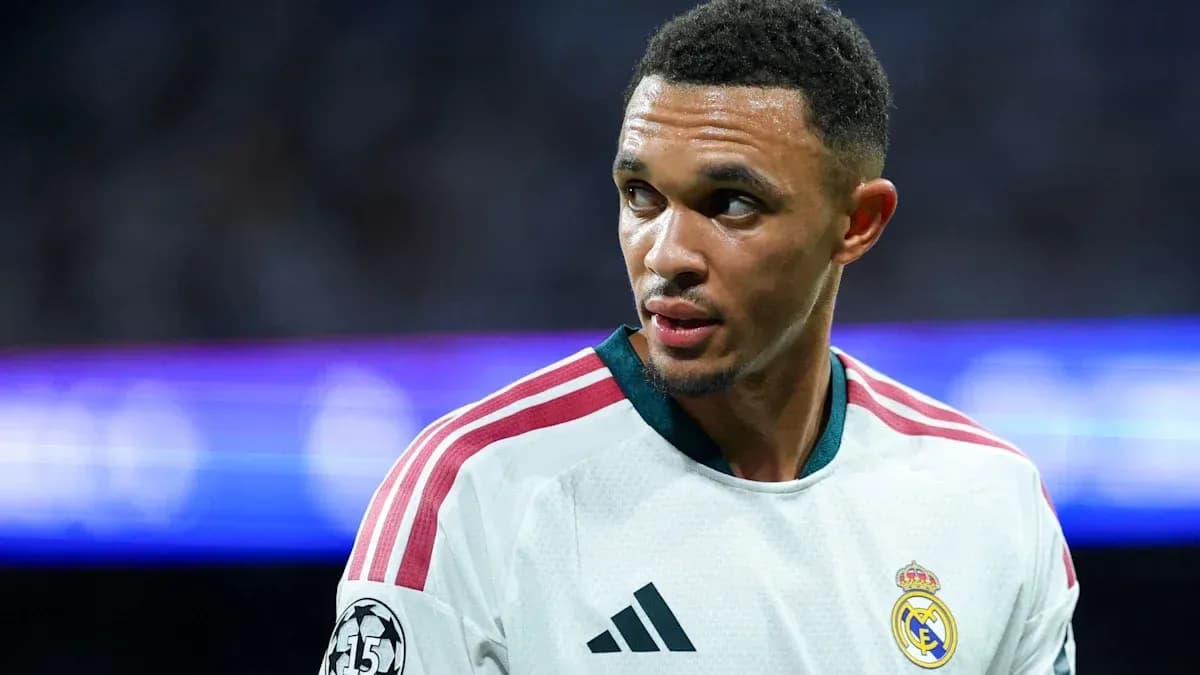
Trent Alexander-Arnold: Right-Back or Midfielder?
The question refuses to die: can Trent Alexander-Arnold really live as a midfielder?
Gareth Southgate tried it at Euro 2024, then walked away after two group games. Jurgen Klopp built a whole Liverpool system around his ability to step infield and dictate, but always from a right-back starting point. Now it is Jose Mourinho’s turn to experiment, dropping the 27-year-old into the centre for Real Madrid’s edgy 2-1 Champions League win over Inter Milan on Tuesday night.
A new chapter? Not quite.
Mourinho’s midfield gamble
With suspensions stripping Real of Eduardo Camavinga, Arda Guler and Bernardo Silva, Mourinho was short of bodies. Circumstance, more than revolution, opened the door for Alexander-Arnold to start in midfield alongside Federico Valverde.
He had the kind of night that fuels both sides of the debate.
Alexander-Arnold created two chances and slung in more crosses than any of his team-mates. His passing accuracy, though, dipped to 83.3%, and he did not win a single tackle. The numbers underlined what the eyes suggested: plenty of ambition on the ball, some looseness without it.
When Inter pulled one back on 77 minutes, Mourinho turned to his bench. Alexander-Arnold’s number went up. Whistles rolled around the Bernabeu, a low rumble of irritation. It felt aimed more at Real’s anxious display than at one player, but the timing made him the face of that frustration as he trudged off.
Mourinho was having none of the idea that this was a glimpse of a permanent reinvention.
“He has played midfield with England and Liverpool... but he is not a midfielder,” the Portuguese said afterwards. “He has played very well. He has interpreted what he needed to really well, tactically. Both him and Valverde have worked very well at this level.”
Gratitude, yes. A manifesto, no.
A right-back without a home
This was the first competitive match in which Alexander-Arnold and fellow right-back Denzel Dumfries had started together. Mourinho had tried the pairing in pre-season against Fiorentina, with Alexander-Arnold at right-back and Dumfries ahead of him on the same flank.
That tells its own story. Mourinho still has no fixed answer at right-back.
Last season, Alexander-Arnold had to wrestle with Dani Carvajal for the role. This season, the fight is with Dumfries. The England international has not yet nailed down the position he was signed for, which makes his deployment in midfield feel less like a grand design and more like a tactical sticking plaster.
Yet inside the club, his stock remains high. Mourinho, it is understood, has been impressed by his professionalism, his influence in the dressing room and, crucially, his flexibility. He sees a different profile to the classic full-back: someone who can drift into central zones and help construct attacks from inside the pitch rather than just hugging the touchline.
The strengths are unchanged from his Liverpool days. Passing range. Whipped crosses. Threaded through balls. Dead-ball quality. Those weapons translate anywhere on the pitch.
What remains in question is whether he can handle the constant churn of midfield traffic at the very top level.
England’s great ‘what if’
Southgate tried to answer that question in his own way. At Euro 2024, he pushed Alexander-Arnold into a central role, hoping to tap into that playmaking range from deeper, more crowded areas. It lasted two group games before the experiment was shelved and he was dropped from the starting XI.
The idea had not come out of nowhere. In June 2023, Alexander-Arnold wore England’s number 10 shirt in a 4-0 win over Malta in Euro qualifying and scored from midfield. That night, he spoke with the confidence of someone who could see a different future.
“I haven't played it too much, but it feels comfortable,” he told Channel 4. “It feels natural, I will say that. It's somewhere I can see myself playing.”
Southgate kept flirting with the concept over the next year. The turning point came in a laboured 1-1 draw with Denmark, where Alexander-Arnold was withdrawn before the hour. The bold plan quietly died there.
Mourinho’s version is a softer echo of that same dilemma. After the win over Inter, he admitted the role still bites.
“He has lost some balls because it is not the same to play in this position compared to at right-back,” he said. “The intensity of physical work is quite difficult. He has a different engine. He has given 100%. He left the pitch with nothing left to give.”
No questioning the effort. The question is about fit.
A talent caught between lines
Alexander-Arnold remains one of the most gifted passers of his generation, a full-back who thinks like a playmaker and hits the ball like a quarterback. Managers keep trying to move him closer to the heart of the game. Each time, reality drags the idea back towards the flank.
Real Madrid’s win over Inter did not settle the argument. It simply added another layer.
For now, Mourinho sees him as a right-back who can step inside, not a central midfielder who occasionally drifts wide. A specialist with licence, not a full-time convert.
The debate will roll on. Because with a player this unique, how long will any coach resist the temptation to try again?
Related News
Anthony Martial's Potential Return to LaLiga with Málaga

Manchester United Faces Drama in Carabao Cup Tie Against Brighton
Trabzonspor in Talks with Thomas Reis to Replace Fatih Tekke
Pablo Felipe Scores First Goal for West Ham in Cup Tie
Max Dowman Shines in EFL Cup, JJ Gabriel Seeks Exit from Manchester United
Hibernian Sack Coach David Gray Amidst Poor Performance