
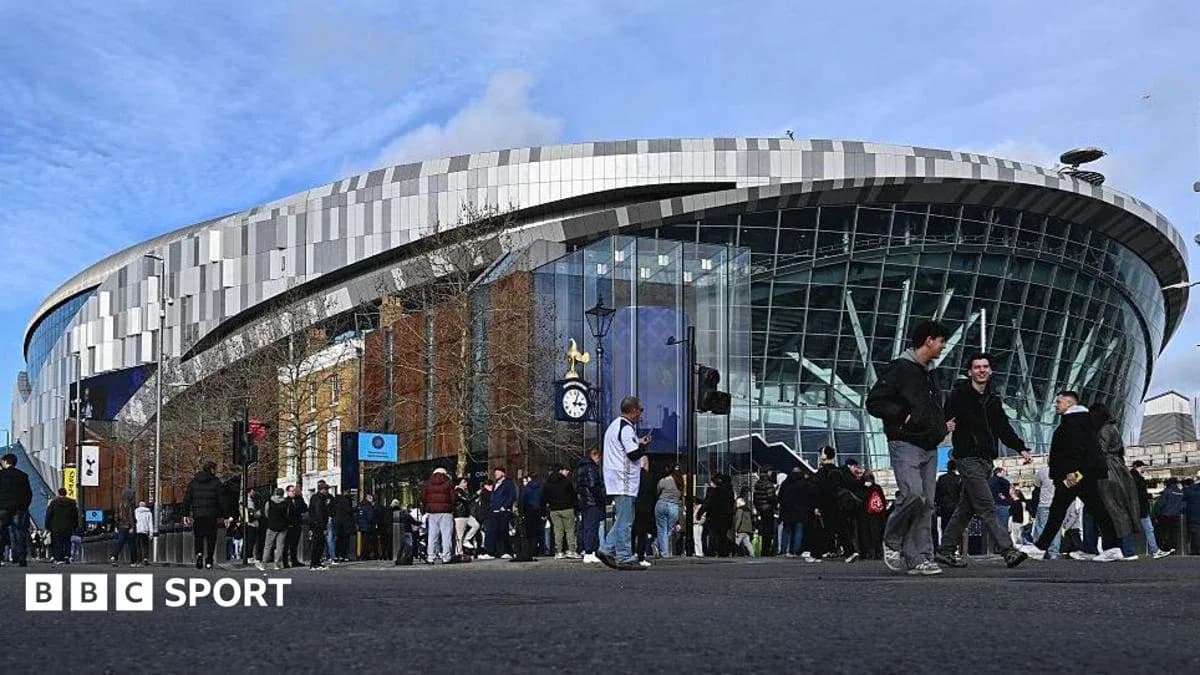
Tottenham's Financial Transformation Amidst Relegation Struggles
Tottenham’s season on the pitch was a grim watch. Again.
Another manager gone. Another campaign shredded by injuries. Another final day spent glancing over shoulders rather than up the table as one of the richest clubs in world football flirted with the drop before scrambling clear. Seventeenth place, for the second year running, is not a blip. It is a warning.
Yet step outside the dressing room and into the concourses of their gleaming new home and you find a very different club.
A relegation scrap with Champions League finances
Tottenham’s football has stalled. Their finances have not.
The move from White Hart Lane to their new stadium has transformed the balance sheet. Matchday income has rocketed from £45m in 2016-17, their final season at the old ground, to £126m in 2024-25. Less than double the capacity, two-and-a-half times the money.
“Spurs’ matchday income has increased from £45m in 2016-17… to £126m in 2024-25,” says football finance expert Kieran Maguire. The numbers are stark. The strategy behind them is simple.
They have built somewhere people want to linger.
Fans arrive earlier and stay longer. That extra 40 to 50 minutes inside the stadium is not just dead time. It is food, drink, merchandise. It is cash.
And it does not stop with football. The stadium can host up to 30 non-football events a year at full capacity. That changes everything.
Major concerts. NFL games. Boxing world title fights, including Anthony Joshua’s heavyweight showdown with Oleksandr Usyk in 2021. Since 2023 it has staged rugby union’s London derby, with Saracens “hosting” Harlequins under the lights.
Every date in the calendar feeds the bottom line. Commercial revenue has exploded from £73m in 2016-17 to £277m in 2024-25. That is not a marginal gain. It is a new financial tier.
And with it comes a different transfer market. Tottenham can now stretch to deals like Sandro Tonali’s, a club-record signing whose fee could climb to £100m. A team that has been playing like relegation fodder is spending like a Champions League regular.
The rulebook that rewards concrete and steel
All of this lands just as the Premier League tears up its old financial regulations.
Profitability and sustainability rules (PSR) are being replaced this summer by a new framework built around squad-cost ratio (SCR) and sustainability and systemic resilience (SSR).
Strip away the jargon and SCR is brutal in its clarity: it caps what a club can spend on its playing squad as a percentage of its overall revenue. Wages, transfer amortisation – the way transfer fees are spread across the length of contracts – and agent fees are all swept into the calculation.
One thing is not.
Stadium infrastructure costs sit outside the SCR. They do not count.
“In the case of Spurs, their infrastructure costs are around £70m a year – but those are excluded,” Maguire explains. “Any money that you invest in stadiums is completely ring-fenced and excluded from your ability to invest in players.”
So Tottenham can pour tens of millions into their ground without it squeezing what they are allowed to spend on the squad under the new rules. The stadium is both a revenue machine and a regulatory loophole.
There is a catch, of course. Stadiums are expensive. But Spurs timed their borrowing well, going to the banks when interest rates were “spectacularly cheap”, as Maguire puts it. The debt is heavy, but manageable.
For them, the equation is clear. The upside dwarfs the risk.
“In order to be competitive, you need to have a significant increase in matchday income,” Maguire says. You can either hike prices – and alienate your fanbase – or increase capacity and change the mix of tickets, pushing a greater share towards non-season-ticket supporters and corporate clients.
Tottenham chose the latter. Others are now weighing up whether to follow.
Everton, West Ham, and the uneasy leap
Everton and West Ham have already taken the plunge, leaving historic homes for new builds that promise long-term financial muscle but have not always won hearts.
The dilemma is familiar across the division. Stay or go?
Renovation looks cheaper at first glance, but it throws up a basic, awkward question: where do you play if your ground becomes a building site? A partial rebuild can drag on for years, with capacity reduced and matchday income throttled just when clubs need it most.
A new stadium avoids that, but the bill is vast and the emotional cost higher still. Generations of memory, ritual and identity are tied to old grounds. Fans fear that a move strips something essential away.
Yet the direction of travel is obvious. Owners and executives look at Tottenham’s numbers and see a blueprint.
Ratcliffe’s Old Trafford statement
At Manchester United, Sir Jim Ratcliffe has made his intentions plain. He wants a new stadium to mark his era.
The concept is bold: a 100,000-capacity arena with a heavy emphasis on corporate areas. The financial logic is ruthless. A ground of that size, with that level of hospitality, would generate far more matchday income than United currently pull from Old Trafford. More money means more room to manoeuvre under SCR, and more firepower for the senior squad.
The early plans, unveiled in March 2025, included a vast canopy. It looks dramatic. It will also cost a fortune. The overhang and everything beneath it would sit within United’s footprint, making the club responsible for its upkeep and safety. Is the architectural statement worth the ongoing expense?
Club officials suggest parts of the structure could be built off site and then shipped in, trimming costs compared with doing everything in situ. The proposed location – just down the road from Old Trafford – solves another thorny issue.
If the new ground rises alongside the old, United can play on at Old Trafford until the day they move. No exile. No temporary tenancy.
Because the alternatives are grim. Manchester City, Liverpool and Everton all have smaller grounds than Old Trafford. None is ideal from a security standpoint. All would be expensive to hire, even if they were willing.
United’s current vision avoids that. One stadium to another. A clean handover.
Newcastle’s crunch point
If Tottenham represent the upside of the stadium revolution, Newcastle show the cost of standing still.
This summer, they have effectively had to cash in on some of their best players to stay within financial rules. At the same time, their matchday income lags miles behind their rivals.
“For the 2024-25 season Newcastle’s matchday income was £52m. Manchester United’s was £160m, Arsenal’s £154m, Spurs’ was £126m,” Maguire notes.
That £100m gap is not a rounding error. It is a structural disadvantage.
“If you’re £100m behind your competitors, the only way to address that is either to be super smart or to charge more money for the product.”
Newcastle can only squeeze so much more from ticket prices before they collide with the realities of their support. The Gallowgate hardcore will not quietly accept being priced out. To close the gap, the club needs to change what it can offer.
“How can Newcastle increase the yield per fan and still be loyal to the Gallowgate hardcore? You need to be able to offer a different product and St James’ Park wasn’t built for a corporate audience.”
That is the crux. St James’ Park is iconic, but it is not a modern corporate machine. A purpose-built stadium could be. On paper, the argument to move is compelling.
Hearts versus spreadsheets on Tyneside
Newcastle supporter Charlotte Robson captures the split.
“I think we can host gigs at St James’ Park but probably not on the scale of Spurs or West Ham’s London Stadium,” she says.
“I don’t think it would be stupid to move from the ground but I think there is so much identity for Newcastle fans who are attached to St James’ Park that it would break a lot of hearts to move the ground in any significant way.”
That tension runs through every club considering a move. The accountants see revenue streams, naming rights, hospitality tiers. Supporters see the hill they climbed as kids, the first roar under the floodlights, the walk home after a derby win.
Yet the financial tide is strong. Clubs know that matchday revenue is only half the story. A new stadium also offers a platform for broader commercial growth: events, partnerships, global branding. Tottenham’s London location and global fanbase give them a clear advantage. Not every club can copy that.
“Spurs have got the advantage that they’re in London – a huge tourist trap. They are also a club with a global fanbase, so it works there,” Maguire warns.
“Is that going to work elsewhere in the country where you’ve got a more localised fanbase and where there is resistance to putting up prices for tickets? Then it becomes more challenging.”
Construction costs have surged. Materials, labour, regulation – everything is more expensive than when Tottenham broke ground. Yet the appetite has not gone away. If anything, the new financial rules make the stadium arms race more urgent.
Owners now know that every extra pound of revenue they can generate from bricks and mortar gives them more room to manoeuvre with their squads without falling foul of SCR.
So the question hangs over boardrooms from Manchester to Newcastle, Liverpool to London.
In an era where the balance sheet shapes the league table, can any ambitious club really afford not to build a new home?
Related News

Raphinha’s Hat-Trick Powers Barcelona to 7-2 Victory Over Racing Santander
Carabao Cup Fourth Round Draw: Liverpool Set to Clash with Chelsea, Arsenal to Face Fleetwood Town
Key Football Matches to Watch in Azerbaijan This Autumn

Raphinha's Hat-Trick Drives Barcelona to 7-2 Triumph Over Racing Santander

Hansi Flick Leads Barcelona to Record-Breaking Seven Wins in a Row

Gavi Reflects on Injury Return as Barcelona Dominate Racing Santander 7-2