
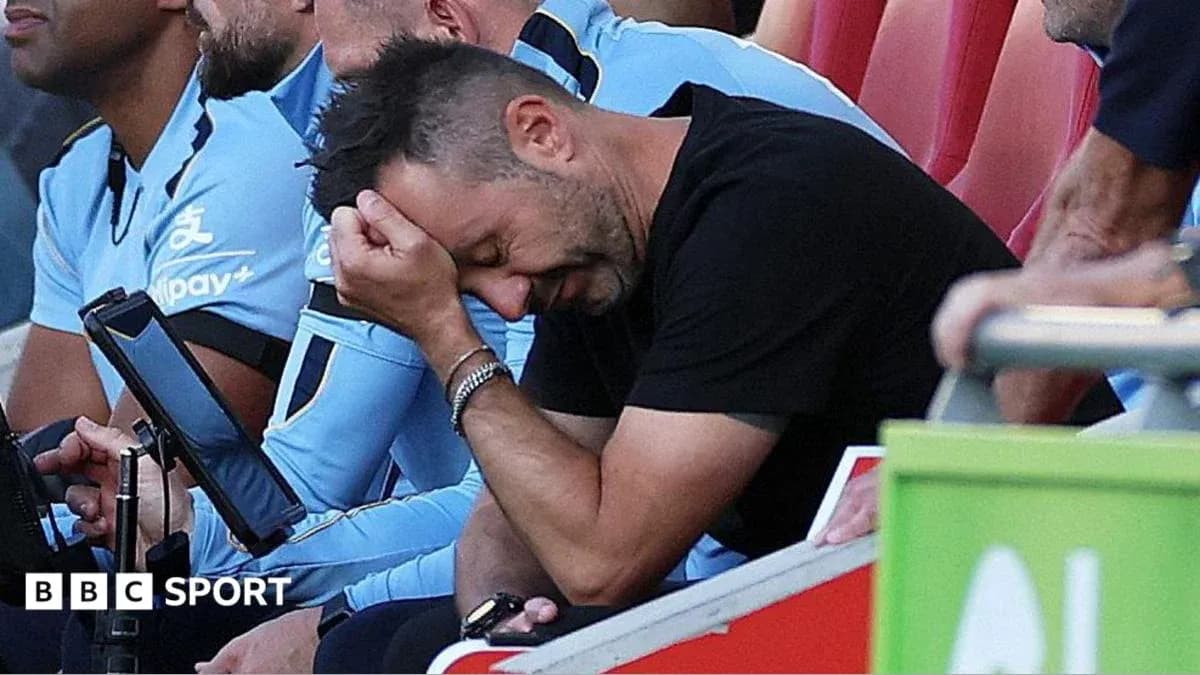
Roberto De Zerbi's Tottenham Hotspur Rebuild Faces Early Setbacks
Roberto De Zerbi will soon be nudging the £400m mark on his Tottenham Hotspur rebuild. On this evidence, he might need a different currency entirely.
Money cannot buy a backbone. Not yet, anyway.
A new era, same old collapse
This was supposed to be the reset. A full pre-season, a raft of expensive signings, the scars of last year stitched over by a manager who had already pulled off one escape act in north London.
De Zerbi arrived in March as the fireman, handed seven games and a simple brief: keep Spurs up. He did it, just, clinging on with a final-day win over Everton. That earned him time, trust and a vast transfer budget to ensure the club never flirted with the trapdoor again.
And then came Brentford away.
Under a hot west London sun, the new Spurs looked alarmingly like the old Spurs – brittle, uncertain, and visibly shrinking the moment the temperature rose on the pitch.
Brentford did not just beat them 3-0 at The Gtech Community Stadium. They exposed them. Ripped away the gloss of a lavish summer and showed the same old wiring underneath.
De Zerbi did not hide behind the result when he spoke to BBC Sport's Match of the Day.
“Bad game. We lost and suffered the difference in the duels. It was the key of this game. We didn't fight in the right way,” he said. “Our physical condition was not in the right level for all players... But we have to analyse this game better because we can't play this way in this type of game.”
The manager leaned on conditioning as context – late returns from the World Cup, new faces still bedding in – but even he knew it did not explain a lack of basics, a shortage of resilience, and the gulf in intensity.
From roar to resignation in 49 minutes
The day began with noise and belief. In one corner of The Gtech, Spurs fans roared in their new recruits, convinced this was the start of something different. Fresh faces, fresh energy, fresh standards.
By the 49th minute, many of those same supporters were already on the concourse or halfway home, heading for the exits just after Michael Kayode thumped in Brentford’s third to make it 3-0. When the final whistle went, Spurs’ players applauded rows of empty plastic, the optimism of the opening whistle reduced to a memory.
It might have been even more brutal. Igor Thiago, normally reliable from the spot, smacked a penalty against the post. A let-off on the scoreboard, but no comfort at all for De Zerbi. The damage was psychological, not numerical.
In the stands, rock star Jon Bon Jovi watched on. Spurs handed him enough material for a whole back catalogue of sad power ballads. They started poorly and then simply disintegrated.
Big names, big fees, no impact
De Zerbi threw in four of his new signings from the start: Andrew Robertson, Marcos Senesi, Jan Paul van Hecke and Sandro Tonali. Between them, a sizeable slice of that near-£400m rebuild. On this showing, the only positive is that they cannot sink much lower.
None of the debutants imposed themselves. To be fair, neither did anyone else in a Spurs shirt.
Tonali, the headline £100m arrival from Newcastle United, endured a particularly bruising afternoon. Brought in to dictate and dominate, he was instead overrun by Brentford’s record signing Mamadou Sangare, who bossed midfield and emerged as the outstanding player on the pitch.
Tonali’s most notable moment came when he lashed a first-half effort high into the sky, greeted gleefully by Brentford supporters with the predictable chant that Spurs had wasted their money.
Matheus Fernandes, signed for £85m from West Ham United, entered from the bench. Savinho and possibly Omar Marmoush will join the mix in the coming weeks. Talent is not the problem. What was missing here was something harder to quantify: heart, defiance, that refusal to fold.
From the first minute, Brentford sensed fragility. They pressed with purpose, snapped into duels, and hunted Spurs down. The visitors cracked almost immediately.
Brentford smell blood
Brentford should have been ahead before Keane Lewis-Potter finally pierced the flimsy resistance after 12 minutes. By the time Vitaly Janelt swept in the second before the interval, the contest felt done.
Spurs were not just behind. They were beaten in their heads.
On the touchline, De Zerbi raged and gestured, trying to inject life into a side that looked drained of belief. On the pitch, challenges were lost, shoulders slumped, and panic took over. There was no sense of a comeback brewing, no hint of a team ready to respond.
Conor Gallagher and Lucas Bergvall did not reappear after half-time, sacrificed at the break. They could argue, with some justification, that they had plenty of company in underperforming.
De Zerbi’s task now goes beyond shape, pressing triggers or tactical tweaks. He has to get inside this squad’s mentality again, just as he did in that short, frantic spell last season. The chequebook cannot do that work for him.
A pattern Spurs cannot ignore
One game does not define a season. Many ambitious sides have stumbled out of the blocks on opening day and recovered.
This, though, did not feel like a one-off. It looked like a continuation.
Spurs have finished 17th in each of the last two Premier League campaigns. The cloud hanging over the club predates De Zerbi, stretching back through Ange Postecoglou – who at least delivered a Europa League title – to Thomas Frank’s ill-fated stint and the blink-and-you-missed-it reign of Igor Tudor.
The names change. The league position, the mood, the collapses under pressure? Those have stayed stubbornly familiar.
De Zerbi admitted he was “surprised for the result and performance,” and repeated that he knew his players were not at full physical tilt. But he did not reach for excuses.
“We can't find an excuse. I am sorry for the result and performance. We are starting a new project and we couldn't find the principle,” he said. “Marcos Senesi, Jan Paul van Hecke and Sandro Tonali are not in the best physical condition. We knew that before the game. We have to improve on that and many other things like organisation and pressing.”
More arrivals are expected before the window shuts. More money will go out. Yet De Zerbi was clear on one point.
“I don't want the excuse that the first XI was not enough to compete and get a result. Brentford's spirit on the pitch was great, it has to be the right example for us.”
Culture, not just recruitment
That line cut to the heart of it. Brentford’s spirit versus Spurs’ spending.
New faces alone will not fix this. Sunday’s defeat underlined that Tottenham’s issues run deeper than any squad list or balance sheet. This is about habits, about a culture shaped by two seasons littered with losses and late-season scrambles.
De Zerbi has the backing, the budget and, for now, the belief of those above him. What he does not have yet is a team that reflects his demands when the pressure bites.
He can shuffle his squad. He can adjust his system. What he truly has to change is a mindset in which days like this have become routine.
And that transformation will define whether this lavish rebuild becomes a turning point for Tottenham – or just another expensive chapter in the same old story.
Related News
Transfer Rumors: Haaland’s Two Options; Real Madrid Targets $100 Million Premier League Star
Manchester United Targets Premier League Forward to Strengthen Attack

Liverpool Eyes 17-Year-Old Mexican Midfielder Gilberto Mora for Summer Transfer
Summer 2026 Transfer Window: Manchester United and Tottenham Struggle with New Signings
Liverpool Maintain Interest in Real Madrid Midfielder Amid Transfer Challenges
Transfer Insider Warns Tottenham About Costly Sale of Will Lankshear