
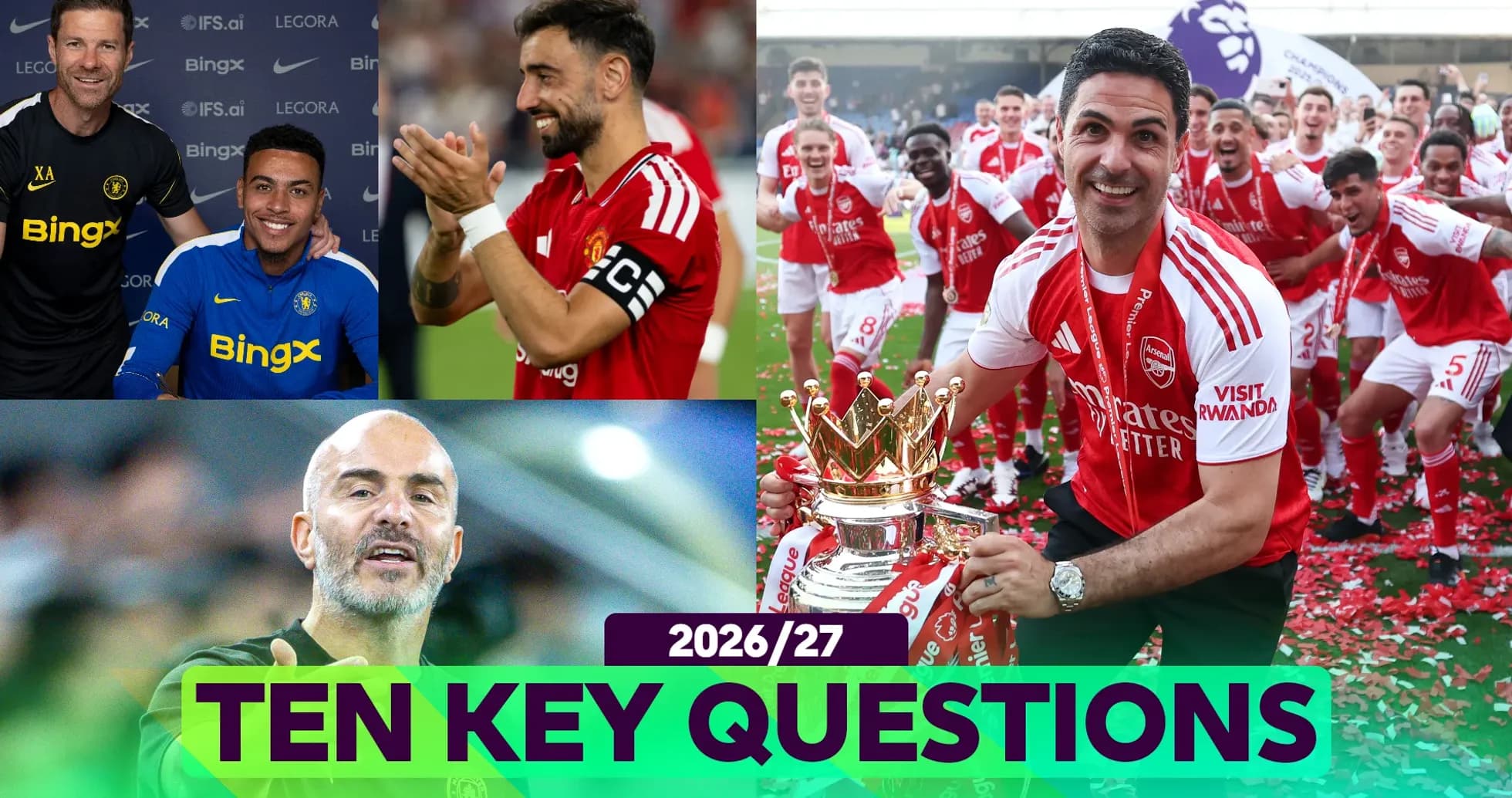
Premier League 2026/27: A New Era of Uncertainty and Opportunity
The Premier League is back. Not just with a new season, but with a reset button smashed across half the division.
Five of the so‑called "Big Six" are embarking on fresh projects. Nine clubs start with new managers. Pep Guardiola is gone. Jurgen Klopp is gone. The old order has fractured.
Right in the middle of the chaos, Arsenal stand still – and that might be their greatest weapon.
Arteta, experience and a rare shot at dominance
Only three managers have ever retained the Premier League title: Pep Guardiola, Sir Alex Ferguson, Jose Mourinho. Three names that define eras, not just seasons.
Mikel Arteta now has a chance to join them.
Arsenal enter 2026/27 as something they haven’t been for two decades: established champions with continuity everywhere you look. The squad is settled. The tactical framework is embedded. The scars of near-misses have been replaced by the calm of a team that finally got over the line after five years of climbing.
Around them? Turbulence.
Michael Carrick begins his first full season at Manchester United. Roberto De Zerbi does the same at Tottenham. Liverpool, Chelsea and Manchester City all start again under new head coaches.
In a league that usually punishes complacency, Arsenal’s stability suddenly looks like a competitive edge. Guardiola’s exit in particular leaves a vacuum at the top. Arteta is now the only title-winning manager in the division. The door is open for Arsenal to move from champions to something more daunting: a team that dominates an era.
Whether they walk through it will define the next few years.
Life after Pep: Maresca and the weight of a dynasty
Manchester City are used to chasing history. This season, they’re trying to outrun it.
Enzo Maresca inherits not just a squad, but a monument. Guardiola’s City broke records, reshaped English football and collected titles with a relentlessness that bent the league around them. Replacing that is not a normal job.
The path ahead looks brutally simple. Either Maresca does what Arne Slot managed at Liverpool – deliver immediate continuity after a legendary reign – or City risk falling into the post‑dynasty traps that swallowed Unai Emery at Arsenal and David Moyes at Manchester United.
City have at least tried to avoid repeating those mistakes. Rather than rip up the Guardiola blueprint, they’ve doubled down on it. Maresca is a Guardiola disciple, steeped in possession football and positional play. His tactical ideas sit as close as you can get to his former mentor’s without being a tribute act.
But the dressing room has changed. Bernardo Silva and John Stones have gone, taking with them experience, leadership and a deep understanding of Guardiola’s system. The question is brutal and unavoidable: does Maresca extend the magic, or does this mark the start of a quieter, more fallow period for the eight-time champions?
For the first time in years, City feel less like a certainty and more like a storyline.
Alonso at Chelsea: the Premier League’s next great coach?
If there is one appointment that crackles with intrigue, it is Xabi Alonso at Chelsea.
He arrives as one of the hottest coaching properties in world football, off the back of an extraordinary invincible season with Bayer Leverkusen in 2023/24. The timing is perfect for the Premier League. With Klopp and Guardiola gone, the stage is clear for a new managerial heavyweight to emerge. Alonso looks ready-made for that role.
The conditions are there for an explosive debut campaign. Chelsea have no European football, a luxury that helped Antonio Conte drill his title-winning side in 2016/17. Only six managers have ever won the Premier League in their first season; three of them – Conte, Jose Mourinho, Carlo Ancelotti – did it at Chelsea. Alonso stepping into that club within a club is not far-fetched.
He will have free midweeks to refine his ideas, to hard-wire his patterns of play into an already talented squad. Crucially, Chelsea have finally added experience to their youthful core. Danny Welbeck and Jordan Henderson are the first over‑30 signings of the BlueCo era, a symbolic shift towards balance and know‑how.
It feels like more than just another rebuild. It feels like a reset of the club’s entire strategy, with Alonso at the centre of it. If he gets it right quickly, Chelsea will not just be fun – they will be dangerous.
The return of chaos football?
Last season, some supporters looked at the numbers and winced. Goals per game dipped slightly from 2.40 to 2.36, but the bigger story lay in the open‑play Expected Goals. After a wild 2023/24, when open‑play xG per match peaked at 2.28, the figure slumped to 1.82 in 2025/26.
Set‑pieces surged. Chaos receded.
The dugouts suggest that might be about to change.
De Zerbi now has the time and authority at Spurs to unleash his full vision: high pressing, aggressive build‑up, waves of attacking movement. He couldn’t fully impose it at the end of last season. That changes this summer.
At Liverpool, Andoni Iraola brings back the "heavy‑metal" feel many fans craved. His Bournemouth side played with ferocity, pressing and attacking with a relentlessness that lit up the league. Now he has a bigger stage, a deeper squad and a fanbase that thrives on intensity.
Alonso’s Leverkusen and Real Madrid teams both scored freely. Bournemouth’s new head coach Marco Rose comes from the RB Leipzig/Borussia Dortmund school of vertical, aggressive football. Crystal Palace’s Pierre Sage favours fast transitions and hard pressing.
Put it together and the direction of travel is clear. The tactical influx points towards a Premier League that looks more like 2023/24 – frantic, open, end‑to‑end – than the more controlled, set‑piece heavy version we saw last year.
Can Carrick really drag United back into a title race?
Manchester United have been here before: hope, hype, a new man in the dugout. This time, though, the numbers are hard to ignore.
Michael Carrick stepped in as caretaker on 14 January. Three days later, United beat Manchester City 2-0. That win sparked a five‑month run so strong it earned him the job permanently – and, suddenly, reopened the conversation about United as title contenders.
Look at the table since Carrick took charge. Over 17 games – almost half a season – United were top.
Man Utd: 17 played, 12 wins, 3 draws, 2 defeats. Thirty‑nine points. Arsenal three points back on 36. Man City on 35. Bournemouth, Liverpool and the rest trailing behind.
Repeat that form over a full campaign and United win the Premier League for the first time since 2013. Football rarely follows straight lines, and no one inside Old Trafford will pretend it’s that simple. But the evidence of the last five months is enough to justify genuine optimism. For the first time in years, United’s belief is not based on nostalgia. It’s based on results.
A season made for comeback stars
New managers mean new eyes on old names. Add in a wave of players returning from injury, and 2026/27 has the feel of a comeback season.
Phil Foden and Cole Palmer both endured disappointing campaigns and missed out on England’s World Cup squad. Their talent hasn’t gone anywhere. Their motivation will be sky‑high.
At Manchester United, Marcus Rashford and Mason Mount are fighting for relevance and for minutes under Carrick. Both could yet become central pieces in his project.
Harvey Elliott, Omar Marmoush and Andy Robertson all saw their game time squeezed last season. Each now has a realistic path back to prominence. Yoane Wissa will hope a change in the dugout unlocks a better run of form.
Then there are the long‑term absentees. Levi Colwill and Alexander Isak stand out as players whose quality was almost forgotten while they were sidelined. In a league that loves a redemption arc, there is no shortage of candidates.
Villa, Newcastle and the end of continuity
Twelve months ago, Aston Villa and Newcastle United were tipped as Champions League dark horses precisely because nothing much had changed. Stability was their advantage.
That’s gone.
At Newcastle, the scale of upheaval is huge. Eddie Howe has resigned, Matthias Jaissle has arrived, and the new man must do without three of the club’s biggest stars: Bruno Guimaraes, Anthony Gordon and Sandro Tonali. All gone.
In their place: Lukas Hornicek, Bazoumana Toure, Aladji Bamba, Sean Steur and Ewen Jaouen. All signed for significant fees. All with strong reputations. It feels like a hard reset, not a tweak.
Villa’s shift is less dramatic but no less significant. Unai Emery stays, but the squad around him is being reshaped. Youri Tielemans, Morgan Rogers and Lucas Digne have departed. The new arrivals – Alejandro Garnacho, Johan Manzambi and Joao Gomes – bring a different profile, a different energy.
Both clubs are trying to evolve while staying competitive in a league that punishes missteps. Their ability to manage that transition will decide whether last season was a peak or just a staging post.
Europe: springboard or trapdoor?
Nine Premier League clubs qualified for Europe last season. For some, it’s familiar territory. For others, it’s a thrilling but dangerous new world.
The recent evidence is mixed. Aston Villa won the Europa League and still finished fourth. Crystal Palace happily traded a 15th‑place domestic finish for a UEFA Conference League triumph that transformed the club’s mood and profile.
On the flip side, Nottingham Forest, Spurs and Newcastle all slid into the bottom half while juggling European commitments.
This year brings fresh experiments. Brighton & Hove Albion enter the Conference League for the first time and only their second European campaign ever. They will look at Palace’s journey and see a template: embrace the adventure, manage the load, and use it to grow.
Palace themselves now step up to the Europa League, armed with that experience. Bournemouth and Sunderland, both in the Europa League, face a harsher reality. Their squads are thinner. The Thursday‑Sunday grind is unforgiving. Supporters will be torn between dreaming of big nights and fearing the impact on league form.
Then there are the clubs watching from the outside. Leeds United, strengthened by a smart summer, might quietly fancy their chances of sneaking into the top nine while rivals juggle Europe. Brentford, who narrowly missed out last season, again have blank midweeks to absorb Keith Andrews’ meticulous coaching.
If the Premier League’s "middle class" is going to yo‑yo in and out of European spots over the next few years, this could be the start of that cycle.
Mid-table muscle and a league with no soft spots
Leeds and Brentford are not alone in thinking bigger.
Fulham have handed the reins to former Real Madrid man Alvaro Arbeloa, who has already brought in two signings from Real. That alone is enough to fuel belief that he can build on Marco Silva’s work. Fulham finished just a point off the European places last season. The leap is not huge.
Nottingham Forest now have Oliver Glasner, fresh from winning the Conference League and FA Cup with Crystal Palace. Even after selling Elliot Anderson to Manchester City, Forest will look at their seventh‑place finish two years ago and see a benchmark they can realistically hit again.
Everton, meanwhile, quietly look stronger and more settled. They are bedding into their new stadium and, crucially, have something most of the league lacks: continuity in David Moyes. Add Hayden Hackney, Christian Norgaard and Brennan Johnson, and the squad clearly looks upgraded.
Put it all together and the picture is stark. There are almost no obvious weak links. For the big clubs, there are fewer "easy" weekends than ever.
Promoted trio face a harsher top flight
Coventry City, Ipswich Town and Hull City have not tiptoed into the Premier League. They have thrown themselves at it.
After Sunderland’s bold spending last summer propelled them not just to safety but into Europe – alongside Leeds – the message was clear: come up swinging or risk going straight back down. The new arrivals have listened.
All three have spent heavily and, interestingly, have largely targeted established internationals from mainland Europe rather than stacking up on Premier League experience. Ipswich have added Issa Diop and Sasa Lukic. Hull have brought in Matt Targett and Jack Butland. Coventry have focused on reinforcing a squad that cruised to the Championship title.
Frank Lampard gives Coventry an experienced figure on the touchline. Ipswich, back in the big time after a shorter absence, have turned to Gary O’Neil, who has already kept Bournemouth and Wolverhampton Wanderers up. Both clubs can point to the bench and feel reassured.
Hull’s position is trickier. Opta’s "Expected Points" table had them 23rd out of 24 in the Championship last season when xG for and against were taken into account. By that metric, they overperformed heavily. Now they step into a division with no hiding places.
Even so, this is Hull’s first Premier League campaign since 2017. They, like Coventry and Ipswich, will start the season with genuine optimism. The recent history of Sunderland and Leeds is a reminder that assumptions about promoted teams can age badly.
And that might be the defining feature of this season: in a league with more quality, more depth and more tactical variety than ever, who really dares to predict how it all ends?
Related News
Transfer Rumors: Haaland’s Two Options; Real Madrid Targets $100 Million Premier League Star
Manchester United Targets Premier League Forward to Strengthen Attack
Liverpool Eyes 17-Year-Old Mexican Midfielder Gilberto Mora for Summer Transfer
Summer 2026 Transfer Window: Manchester United and Tottenham Struggle with New Signings
Liverpool Maintain Interest in Real Madrid Midfielder Amid Transfer Challenges
Transfer Insider Warns Tottenham About Costly Sale of Will Lankshear