
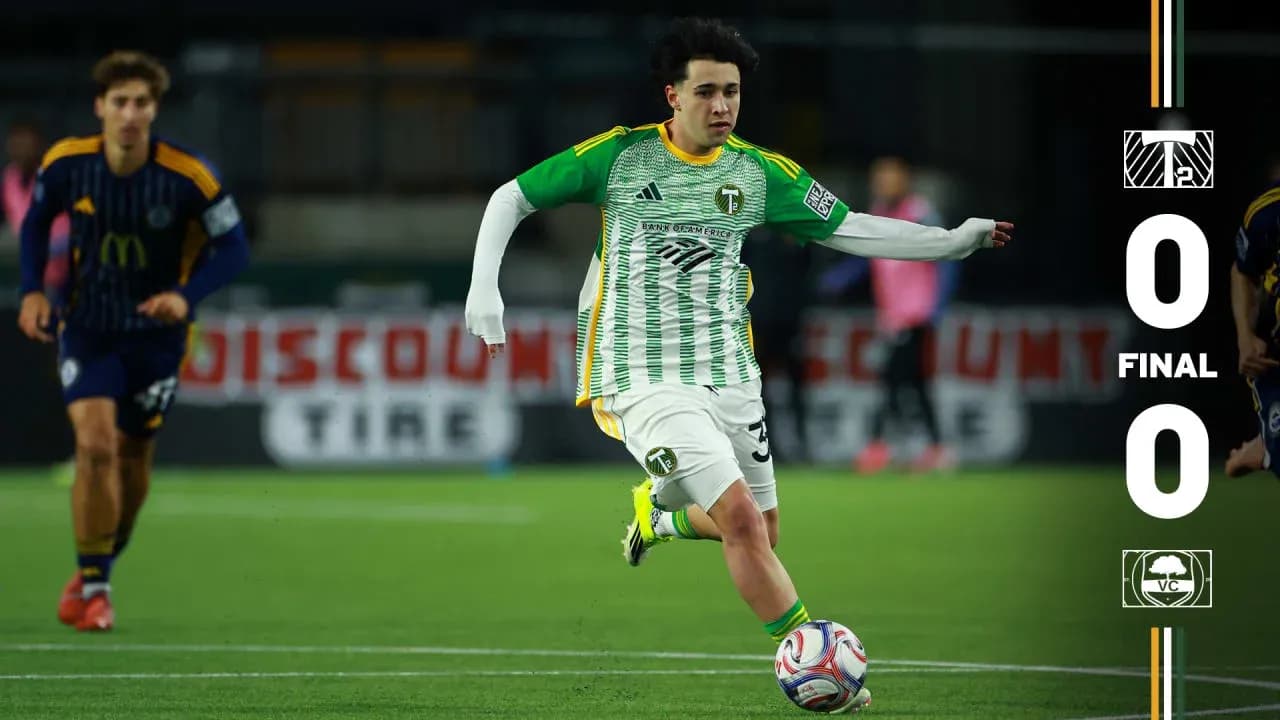
Portland Timbers II vs Ventura County: A Thrilling 120-Minute Showdown
Providence Park under the lights, a 120‑minute drama and a penalty shootout that went to the wire: Portland Timbers II and Ventura County turned a Group Stage fixture into something that felt every bit like a knockout tie. The scoreboard read 3–3 after normal time, and Ventura County edged the shootout 7–6, but the story of the night runs much deeper than the final kick.
I. The Big Picture – contrasting seasonal DNA
Heading into this game, the two sides brought very different profiles into MLS Next Pro 2026.
Portland Timbers II sat 4th in the Pacific Division on 14 points, with a goal difference of 0, the purest expression of their season: 11 goals for and 11 against overall in league play. Their campaign has been streaky and volatile, built on narrow margins. At home they had played 5 league matches, winning 2, drawing 1 and losing 2, scoring 8 and conceding 8. An average of 1.6 goals scored and 1.6 conceded at home underlined the sense that Providence Park is a venue of chaos rather than control.
Ventura County arrived as Pacific Division leaders, 1st with 19 points and a goal difference of 3 (19 scored, 16 conceded overall). Their identity has been far more assertive. On their travels they had played 6, winning 5 and losing just 1, with 9 goals scored and 7 conceded away from home. An away average of 2.0 goals for and 1.2 against framed them as one of the league’s most ruthless road teams, a side comfortable in hostile environments and happy to lean into high‑tempo, high‑risk football.
The 3–3 scoreline after 90 minutes felt like a collision of those two identities: Portland’s volatility and Ventura’s attacking certainty meeting in a match that refused to settle.
II. Tactical Voids and discipline – who bent, who broke
Injury and suspension data offered no hard absences, so both coaches effectively had full decks to shuffle. Jack Cassidy sent Portland out with a young, energetic core: H. Sulte in goal behind a defensive group featuring C. Ferguson, A. Bamford and N. Lund, with the physically imposing C. Ondo and the industrious E. Izoita offering presence in deeper lanes. Ahead of them, L. Fernandez‑Kim, V. Enriquez, D. Cervantes and N. Santos provided the connective tissue, while Colin Griffith led the line.
Griffith’s presence is significant beyond this single match. He appears across the league leaderboards for goals, assists and even disciplinary metrics, a statistical quirk that underlines his centrality to Portland’s game model. He is the reference point: the one they look to for penetration, link play and pressing triggers.
Ventura County, by contrast, spread their threat more evenly. B. Scott anchored them from the back, with a spine that ran through M. Vanney and E. Martinez, and a midfield built around the craft of A. Vilamitjana and the mobility of B. Phan. In the final third, V. Garcia, D. Vanney, E. Preston and J. Placias offered a rotating cast of runners and receivers, capable of stretching a back line that has not always been comfortable when exposed.
Discipline has been a quiet but important theme in both teams’ seasons. Portland’s yellow‑card distribution reveals a side that increasingly lives on the edge as games wear on: 26.32% of their cautions arrive between 61–75 minutes, and another 21.05% in the 76–90 window. Across 91–105 minutes they add a further 10.53%. That late‑game spike suggests a team that often defends deeper and reacts more than it anticipates, especially as legs tire.
Ventura’s bookings cluster differently but point to a similar pattern: 31.25% of their yellows come between 46–60 minutes, 31.25% between 61–75 and another 31.25% from 76–90. The second half is where their aggression spikes, usually as they push to protect or overturn a result. In a tie that went to 120 minutes and penalties, that shared tendency toward late‑game fouls added an undercurrent of jeopardy to every transition.
III. Key Matchups – Hunter vs Shield, and the engine room
The “Hunter vs Shield” narrative in this fixture revolved around Portland’s need to unlock Ventura’s away resilience. Portland’s attack at home has produced 1.6 goals on average, but their overall profile is almost perfectly balanced: 12 goals for and 13 against in total this campaign, with 1.5 scored and 1.6 conceded per match overall. They do not overwhelm opponents; they edge them.
Ventura, however, travel with a different posture. On their travels they score 2.0 goals per match and concede 1.2, and they have yet to draw a game this season: 5 away wins, 1 away defeat, 0 away draws. That binary record speaks to a side that plays on the front foot, trusting their forward line to outscore whatever their defence might allow.
Griffith’s duel with Ventura’s defensive core, marshalled by Scott and the Vanney–Martinez axis, was therefore pivotal. For Portland to live with Ventura’s offensive volume, Griffith needed to occupy centre‑backs, pin full‑backs and create pockets for Cervantes, Santos and Enriquez to attack. The 3 goals Portland produced in regulation were a testament to that collective movement, even if the raw stats do not yet capture the individual xG contributions.
In the “Engine Room”, the confrontation between Portland’s midfield trio and Ventura’s central unit defined the tempo. Portland’s season‑long numbers tell us they are not a clean‑sheet machine – just 3 in total, 1 at home and 2 away – and they have failed to score in 2 matches overall. Ventura, by contrast, have yet to fail to score in any of their 11 fixtures and have kept 4 clean sheets, 3 of them away. That contrast put huge onus on Portland’s midfield to slow Ventura’s transitions, deny early passes into Garcia and Preston, and protect Sulte from the volume of shots Ventura usually generate.
IV. Statistical prognosis and the penalty edge
From a pure numbers perspective, Ventura County entered as slight favourites. They score 2.0 goals per match overall, concede 1.5, and carry a positive goal difference of 5 in all competitions reflected by their 22 goals for and 17 against. Portland’s overall goal difference of –1 in the statistical block (12 for, 13 against) hints at a side that tends to be out‑chanced over larger samples, even if their divisional table line shows a neutral 0 in league‑only play.
Set‑piece and penalty data added another layer. Portland have been awarded 9 penalties this campaign, scoring 8 and missing 1; that 11.11% miss rate mattered when the match went to a shootout. Ventura, by contrast, have a perfect record from the spot in regulation – 1 penalty taken, 1 scored, 100.00% conversion and no misses. When margins shrink to a single kick from 12 yards, that historical edge in execution and psychology often tilts the scales.
Following this result, Ventura’s identity as road specialists hardened further. They survived a wild night, matched Portland blow for blow in open play, and then leaned on their penalty poise to escape with a 7–6 shootout win. For Portland, the performance reaffirmed both their promise and their fragility: they can trade punches with the best in the Pacific Division, but until their defensive structure and late‑game discipline tighten, they will continue to live on the knife‑edge that defined this extraordinary evening at Providence Park.
Related News

MLS Winners and Losers: Rising USMNT Star Cavan Sullivan, St. Louis City's Smart Moves, and Chicago Fire's Struggles Without Hugo Cuypers

MLS Highlights: Portland Timbers End Drought, Josh Sargent Shines, Cavan Sullivan Impresses
Tacoma Defiance vs Colorado Rapids II Stats: Head-to-Head Record

St. Louis City II vs Vancouver Whitecaps II: Head-to-Head Stats and Match Preview

Atlanta United II vs New York City II Stats: Head-to-Head Record
Houston Dynamo FC II vs Austin II Stats: Head-to-head Record