
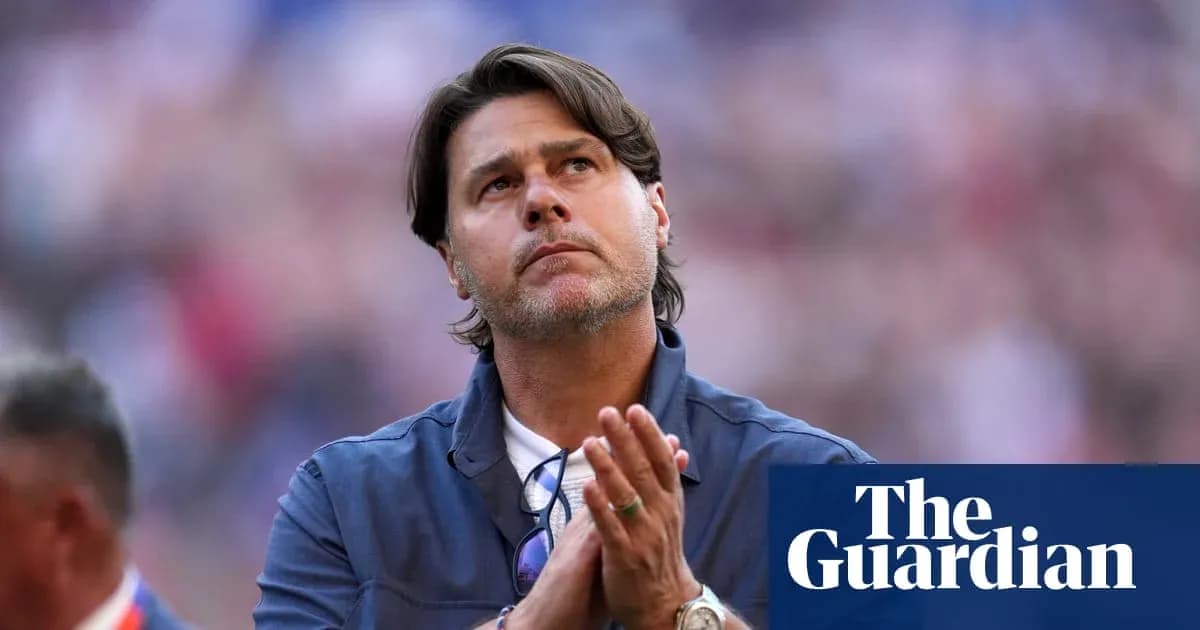
Pochettino's Vision for US Soccer: Building a Lasting Legacy
Mauricio Pochettino is back on the training pitch, but the air around him feels very different.
Two months have passed since the US men’s national team limped out of their home World Cup, a campaign that was supposed to be a launchpad and instead became a reckoning. Many expected Pochettino to walk away once the dust settled. Instead, he doubled down.
The former Tottenham and PSG manager, initially viewed as a short-term specialist brought in to ride the wave of a home tournament in 2026, has signed on for another World Cup cycle. The extension, finalized in August, shifts his job from “tournament coach” to something closer to architect.
And he seems to relish that.
From touchline boss to program builder
Pochettino has framed his decision to stay in almost missionary terms: a chance, as he’s put it, to “have a lasting impact on the sport in the country that has welcomed us so warmly – and for that impact to extend beyond results on the field.”
US Soccer backed that up with structure, not slogans. When they announced his new deal, they also confirmed that the Argentinian will take a far broader role than any USMNT coach before him. He will help steer youth development and coaching education, advise on collaboration with the professional leagues, and weigh in on several key strategic areas.
In most major football nations, the national-team coach has some influence over the wider setup. In the US, no one has ever been handed this much.
He will not be working in a vacuum. The federation is in the middle of a sweeping restructuring, building out two new director roles to oversee the men’s and women’s senior and youth programs. Pochettino has already told US Soccer he’s willing to help shape those hires – with one clear caveat.
“It can’t [just] be my guy,” he said with a laugh on Monday, speaking to a small group of reporters.
The tone changed when he talked about what’s at stake.
“This is the future of the USA,” he said. “We want to try to perform in the World Cup and to create something special with the fans. And now it’s about being a part of the legacy that the federation wants to create – becoming one of the most powerful countries in soccer. That is a dream, no? It’s amazing. If we can be part of that, we are so excited and so happy.”
The immediate calendar looks modest: four friendlies in late September and early October against Peru, Chile, Mexico and Canada. The real assignment is far heavier. Pochettino must guide the US through qualification for the 2030 World Cup and help prepare a team that will also represent the country at the Los Angeles Olympics in 2028, with a Copa América appearance that same summer widely reported as likely.
Results still matter. But his contract now runs straight through the heart of a decade in which US Soccer wants to change what the sport looks like in the country.
Balogun’s deadline day collapse
The summer transfer window underlined how fragile that project can feel at player level.
For most USMNT regulars, it was a quiet market. Gio Reyna moved to Strasbourg, Sebastian Berhalter joined Middlesbrough, and teenage forward Zavier Gozo jumped from MLS to Crystal Palace. Many others stayed exactly where they were.
Folarin Balogun expected a different story. After a breakout World Cup, the Monaco striker looked set for a major move, with Everton pushing to bring him to the Premier League. Then, on deadline day, the deal fell apart. Everton cited a potential fitness issue. Monaco disputed it. So did Balogun.
The move died anyway.
Balogun is hardly the first player to see a big switch vanish in the final hours, but the timing and the manner of it stung. Pochettino made it clear he intends to step in, at least on a personal level.
“Yes, it’s difficult because you cannot influence that decision,” he said. “You need to support what they are doing with the people making the decisions. In some special cases, like Flo’s, I will call in the next few days. I wanted to give him a little bit of space after that situation in Everton. I want to know from him what happened.”
Then he underlined Balogun’s importance to the national team picture.
“We are always offering our support, and that’s it. I think he’s an important player for us, he was an important player in the World Cup and I hope that he can find being in Monaco, or in another place, his best place to perform in the best way.”
For a program that needs its attacking talents playing and thriving at the highest level, how Balogun responds to that setback will be watched closely.
The tug-of-war for dual nationals
If Pochettino’s job is to build a deeper, more competitive US player pool, the battle for dual nationals sits right at the center of it.
He offered almost nothing concrete about the 26-man roster he’ll call into camp later this month. One absence, though, is already confirmed: Augsburg center-back Noahkai Banks will not be involved.
The 19-year-old, who holds both German and American eligibility, remains undecided about his international future. He has said publicly he wants to choose by “the next international break, or at the latest by the international break after next.” In Germany, reports have suggested that newly appointed national team coach Jürgen Klopp has already scouted him in person.
US Soccer cannot afford to ignore that kind of competition, and Pochettino stressed that the federation is staying close.
“We are in contact with all the potential dual nationals,” he said. “I think it’s important for us, of course, because that is the human connection that is so important.”
He used Banks as a live example.
“Even if they, like in that case, Noki, didn’t change his mind and is waiting still, no decision, and of course we cannot consider him for the next camp … But the organization is working with all the dual nationals and players with the possibility to make a decision.”
For Pochettino, this is about more than a sales pitch.
“That human connection is important because if one day they feel that they can defend and they want to fight and to be part of our national team … Of course, if they deserve it, and we consider that they deserve to be involved, of course we are going to call [them up].”
The message is clear: the door stays open, but the standard stays high.
All roads lead to Los Angeles
The next few weeks will bring friendlies, roster debates and the usual tactical tinkering. The next few years will bring World Cup qualifying, a likely Copa América and the glare of a home Olympics in Los Angeles in 2028.
Pochettino has chosen to stand at the center of all of it, not just as a coach chasing wins, but as a figure trying to shape what US soccer will look like when that Olympic flame is lit in LA.
By then, the question won’t be whether the US can host major tournaments.
It will be whether the foundations he is helping lay now have turned them into the kind of football power he keeps talking about.
Related News
Owen Elding's Long-Awaited Call-Up to Ireland's Squad

Nick Woltemade Shines in Juventus Victory Over NEC Nijmegen
Todd Boehly's Chelsea Tenure: From Showman to Footnote

Manchester City vs Sunderland: Maresca’s Winning Streak Continues

Bournemouth vs Liverpool: Goals and Tension on the South Coast
Alexander Isak's Journey at Liverpool: From Injury to Optimism