
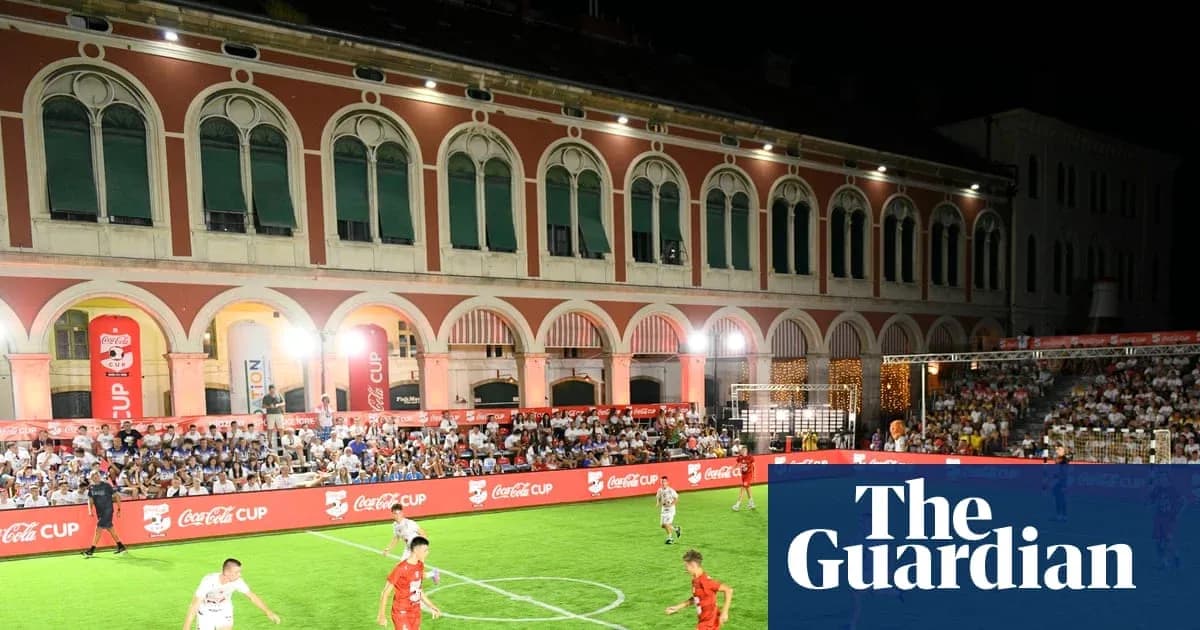
Plazma Youth Sport Games: The Davos of Sport
On a raised platform above the Adriatic, 20 children sit in a circle, eyes narrowed over chessboards. They are not playing each other. They are playing Nigel Short.
The grandmaster shuffles around the ring, one move at a time, edging past chairs and legs, glancing at clocks, leaning into positions. These are not beginners; they are some of the best young talents from across the Balkans. Yet they have something no ordinary junior tournament can offer: celebrity coaches whispering in their ears.
So you get the surreal sight of a former French Open champion, Ana Ivanovic, peering at a knight fork. Sean Dyche, ex‑Burnley manager, crouches to talk through a position like it’s a low block at Turf Moor. And, eyebrow‑raisingly, Peter Thiel – rightwing tech billionaire, PayPal and Palantir founder – stands among them, offering advice on rooks and pawns rather than returns on investment.
This is the Plazma Youth Sport Games, and this year Split is its stage.
The “Davos of sport” on the Dalmatian coast
The YSG is marking its 30th anniversary in the Croatian city, and the description that keeps being thrown around is striking: “the Davos of sport”. Big names from politics and sport drift through the Dalmatian heat each summer, but the real scale of the project lies elsewhere.
It is the largest amateur sports event for children in Europe.
Just under half a million young people from Croatia, Bosnia and Herzegovina, Serbia, Slovenia and North Macedonia entered qualifying this year. Ten sports make it to the finals in Split – from chess and 3v3 basketball to mini‑football – played out over one dense, noisy week.
The Games sell themselves as more than a medal hunt. Kids are pushed towards teamwork, collaboration, and the unfamiliar act of putting their phones away. Organisers talk about Plazma as both a sporting event and a “social project”, and the branding is not just for show.
The message has worked. Ambassadors queue up: Zlatan Ibrahimovic, Alastair Campbell and a rotating cast of sporting and political heavyweights. Many leave sounding converted.
Dyche is one of them. He calls the Games “a brilliant, brilliant initiative”, but it is the girls’ mini‑football final that really grabs him. “It was terrific, they were playing good football; getting properly stuck into each other, properly playing,” he says. “You could feel that they felt free and were being supported in that environment.”
He loves the freedom of it. He doubts he would see the same thing born in England.
“It seems to me that every time you try and get an initiative off in England, there’s a million rules and regulations that make it difficult,” he says. “I know how hard it can be to get funding too and times are tough for people.”
Born from crisis, not from nostalgia
The Plazma Games themselves grew out of a far harsher landscape.
They were founded by Zdravko Maric in the wreckage of the breakup of Yugoslavia and the Bosnian war. His aim was not lofty peacebuilding. It was simpler and more urgent: to tackle the drug problems ravaging Croatian youth at the time.
“It’s a lifetime project and we live with it every day,” says his brother, Slaven Maric, who has worked on the Games since day one. “But when Zladko started it we didn’t have an idea that it would develop into this. It’s not about sport or the results, it’s about social life, it’s about being together. There were many issues with drug abuse [then], now it’s about bringing the kids to spend sometime together in real life.”
That last phrase – “real life” – is doing more and more work. Getting children off their phones is a central message for the 2026 edition. Esports brands have tried to climb aboard. They have been turned away.
Split: a small city with a giant sporting shadow
By planting the Games in Split, the Maric family tapped into a city that already breathes sport.
With a population of around 160,000, Split should be too small to dominate any global medal table. It does not care. Goran Ivanisevic, Bernard Vukas – once hailed as Croatia’s greatest footballer before Luka Modric – are only the start. Across generations, the city has produced champions in almost every direction you look.
- Branko Cikatic, one of kickboxing’s greats.
- Toni Kukoc, three‑time NBA champion with the Chicago Bulls.
- Stipe Bozic, the mountaineer who carried the city’s name to the highest peaks.
Split even has its own Olympic “walk of fame”, Hollywood style, celebrating 73 medal winners.
It has its own sport, too. Picigin: a loose, acrobatic, hand‑played cousin of hackysack, played in the shallows of the Adriatic with a devotion that borders on the religious.
In that context, the connection between Split and the YSG feels natural. The pride among locals is obvious.
Slaven Bilic, another son of the city and now a YSG ambassador, does not pretend to be neutral. “I’m not objective because I’ve known Zdravko for more than 30 years but it’s great that at a time when there’s a lot of negativity in the world that this can exist,” he says. “Especially in this part of the world that is supposed to be unstable.”
Money, power and the next step
The Games are 30 years old. The question now is where they go next.
One ambition stands out: expansion. North Macedonia joined for the first time this year. Ukrainian teams arrived as invited guests. Talks have already been held with six more countries about coming on board.
The commercial side is growing at the same time. Coca‑Cola is a partner, as are Topps and the Croatian telecoms company Telemach. Around the edges, another number catches the eye: there are now 11 billionaires associated with the Games, several of whom have put money into them.
Among those investors, one is understood to be Peter Thiel, the PayPal and Palantir founder and mentor to US vice‑president JD Vance. Asked in Split why he chose to back the Games, Thiel offered nothing. He simply moved down the riviera behind a security detail, leaving the question hanging.
Aleksander Ceferin, the Uefa president, is far more willing to talk about the concept. Uefa provides funding to the YSG, and Ceferin sees them as a rare example of elite sport using its money well.
“I think that top sport, and the money that you get with top competition, should be used for the development of sport and this is the development of sport,” he says. His words invite the obvious comparison with Gianni Infantino and Fifa’s attempts to sell a stake in the World Cup to private investors, even as Ceferin ducks questions about that ongoing battle.
A Soccer Aid‑style finale
The week in Split closes with its own take on Soccer Aid. A YSG select side walks out to face 11 all‑stars. On paper, it looks absurdly one‑sided.
Claude Makélélé. Pavel Nedved. Zlatan Ibrahimovic. The names in the all‑star XI feel like they have been plucked from a sticker album.
The local players have something else. On their touchline, Sean Dyche barks instructions and encouragement, the Premier League manager turned kids’ coach for one night.
The result matters less than the scene: bridges built between generations and nations, memories stamped into young minds, tackles flying in with no hint of deference. Properly stuck in, as Dyche would put it.
As 30th birthdays go, it is not a bad way for the Games to blow out their candles – and to hint at how much bigger this “social project” might yet become.
Related News
Transfer Rumors: Haaland’s Two Options; Real Madrid Targets $100 Million Premier League Star
Manchester United Targets Premier League Forward to Strengthen Attack
Liverpool Eyes 17-Year-Old Mexican Midfielder Gilberto Mora for Summer Transfer
Summer 2026 Transfer Window: Manchester United and Tottenham Struggle with New Signings
Liverpool Maintain Interest in Real Madrid Midfielder Amid Transfer Challenges
Transfer Insider Warns Tottenham About Costly Sale of Will Lankshear