
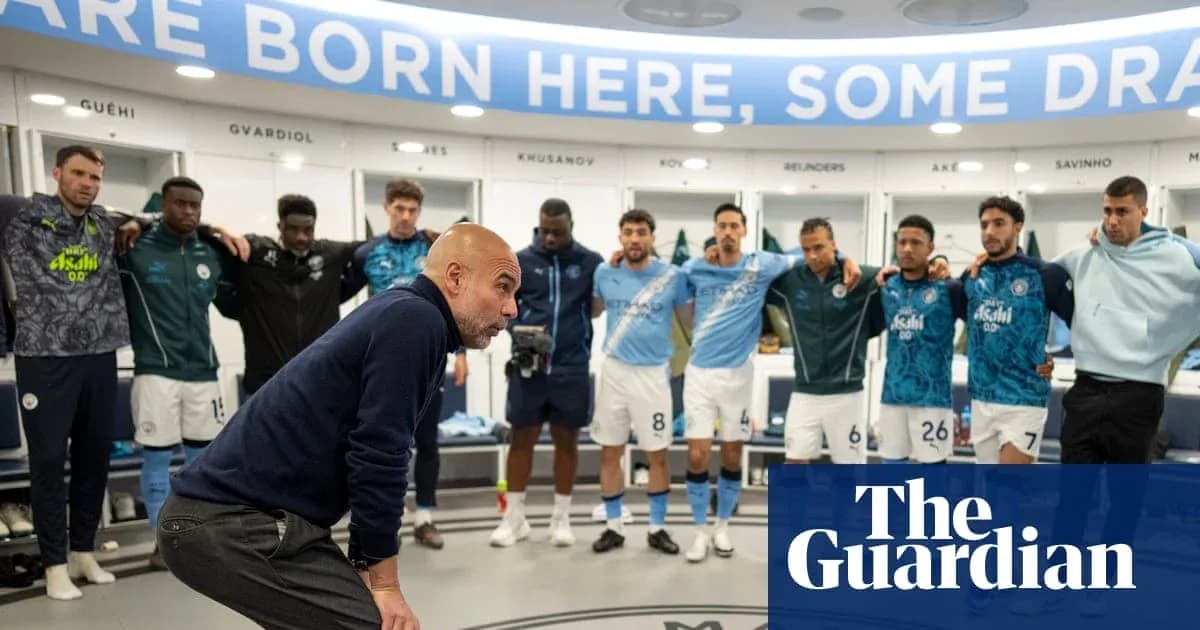
Pep Guardiola: A Beautiful Obsession Revealed
Pep Guardiola has spent most of his Manchester City reign controlling the narrative. On the pitch, in the dressing room, at the lectern. So the jolt in Amazon’s new four-part documentary, A Beautiful Obsession, is how much control he surrenders.
This is not the polished, title-laden Guardiola of the highlight reels. It is the Guardiola of the winter collapse, of nine defeats and a single win in 13 games, of a “machine built for winning” suddenly coughing and spluttering through the bleakest stretch of his City tenure.
And City, who filmed and produced the series themselves, have chosen not to hide from it.
A season laid bare
From Wednesday on Prime, viewers are dropped into the chaos of the 2024-25 campaign as the wheels come off in real time. The story is not smoothed over. There is no attempt to turn Guardiola into a saint, no soft lighting around the club’s most painful decisions.
Kevin De Bruyne’s exit, the cold-blooded call to let go of the greatest player in City’s modern history, is handled with the same unflinching lens. So is the fury of Khaldoon al-Mubarak after Guardiola’s baffling decision to change 10 players for a Champions League home tie against Bayer Leverkusen, a 2-0 defeat that left the chair incandescent. None of it is tidied away in the edit.
Instead, the camera moves closer. Sometimes uncomfortably close.
Guardiola is shown groping for answers he cannot find. His private life, long kept at arm’s length from his football, suddenly becomes part of the story he is telling his players.
After a 2-0 defeat by Juventus in the Champions League on 11 December 2024 – City’s seventh loss in 10 games – he tries to shock his squad out of their torpor. He lays out his own pain.
“I’m fucking divorced from the most beautiful woman on your planet,” he says in the dressing room. “I love her unbelievably, but we lost the passion. How do you play football, because you are paid? Or because of something inside? Where is the passion?”
It is raw. It is also a striking choice of motivational tool, a deliberate crossing of the line between the personal and the professional. Guardiola has every right to speak about his private life, but the series forces the viewer to ask whether this sort of disclosure risks making him look diminished in front of his players – as if the usual managerial levers no longer work.
Later, he spells out his own definition of a true No 1. “You have to convince your players [that they would] go to the penthouse, the roof and jump down [for you].” The question lingers: is this speech about his divorce the act of a man still capable of inspiring that kind of loyalty, or of one reaching for something that is no longer there?
A year on, after those 10 changes against Leverkusen, the theme returns. Guardiola, again, lays his life at the squad’s feet. “I leave my life, my divorce and my family is away, and everything for all of you. And what do you give back?” he asks.
The human behind the manager
The second episode, The Rebuild, only deepens the sense of a man straining for new ways to connect. Manuel Estiarte, Guardiola’s close friend and City’s director of first-team operations, reveals that he took it upon himself to tell the players about the divorce.
He wanted them to understand why “Pep is anxious, sad, different”.
“I said to the team: ‘Please, you have to understand, you’re not playing with a coach who can be a bit impulsive, intense, sometimes a bit up and down. You’re seeing a human being. He’s getting a divorce,’” Estiarte explains. For him, it was “necessary for the team not only to visualise Pep as a manager but for the first time as a human being.”
The admission raises more questions. Why did Guardiola not deliver this himself if the aim was a deeper emotional connection? And behind closed doors, did Khaldoon and Ferran Soriano, City’s CEO, ever sit and ask whether their manager’s private turmoil was starting to bleed into his work?
The documentary cuts sharply from this to a different Guardiola. He appears lighter, almost breezy.
“In my life I made a lot of changes – I got divorced and I have to settle a bit. But no complaints at all honestly,” he says, before drawing a line between his personal state and his professional contentment. “In my job, yeah,” he adds when asked if he is happy.
Relationships – how they are built, how they fray, how they are used – run through the series. Episode three is titled Love and Hugs for a reason.
Walker, the armband and a breaking point
In The Desert, the opening episode, that theme hits hardest. Guardiola is close to tears as he addresses the squad after Kyle Walker’s decision to leave in January 2025, right when City’s season is teetering.
Walker, the captain they chose, walks away at the moment of maximum strain. Guardiola does not hide his disappointment. He tells the group their leader did not behave like one. Then he turns the spotlight on them. If they voted for him, why did they not demand more loyalty? Why did nobody pin him to the wall and tell him to stay?
The confrontation that triggers Walker’s exit is one of the most striking scenes. In the Anfield dressing room, after Walker’s mistake leads to Luis Díaz winning a penalty that Mohamed Salah converts in a 2-0 defeat, Guardiola calls out the error. Walker snaps back that he is being singled out “every meeting”.
The row ends with Guardiola in tears, delivering a monologue that lays bare his own commitment. Only 11 days earlier, in the middle of that disastrous run, he had signed a new contract. He tells them he did it because he wanted to fight.
The camera catches him in the foreground, emotional, while Walker sits behind him, silent, absorbing every word. Guardiola turns to the hierarchy of the dressing room.
“If captains first, then the other ones, for example [feel] that there’s a problem, tell me. It’s not going to change the love I have for all of you. I’m sorry,” he says.
The regret hangs in the air.
De Bruyne and the cold edge of the machine
Episode two opens with another wound. Kevin De Bruyne is not offered a new contract. Soriano, speaking to Khaldoon, insists the Belgian “gets the respect he deserves as the greatest player in the modern history of City”.
Guardiola reveals that “Super Kev” broke down in his office when he learned the decision. The manager also makes clear that, sentiment aside, there had to be a ruthless edge to the call. City’s machine must keep moving.
The cameras then find De Bruyne as he is asked what he will miss most. The answer is not a trophy, not a stadium. It is home.
“My kids don’t want to go,” he says, tears in his eyes.
The sequence underlines a truth often buried beneath the noise of elite sport: the people at the heart of it feel everything. Passion is not just a buzzword for team talks; it is the fuel. The relationships – between manager and player, club and legend, parent and child – bring joy and they cut deep.
When the board bites back
The series is at its most bracing when the internal criticism points upwards. Guardiola’s decision to rotate almost his entire outfield for that Leverkusen tie does not get smoothed over by the boardroom.
“Our attitude with Pep Guardiola should not be too negative. But it shouldn’t be too kind or accommodating either. This is his mistake this time,” Soriano says. There is no attempt to disguise the verdict.
Khaldoon goes further. “To pick an entire new [outfield] team in a game this important is probably one of the lowest points we’ve had. I can’t speak to him – I’m so angry.”
For a club often accused of operating behind a wall, the candour is jarring. The manager is not just questioned; he is openly blamed.
Nothing is eternal
By the end of part four, Nothing Is Eternal, the storm has eased. Not completely, but enough.
City do not implode. They regroup. The Carabao Cup and FA Cup are added to Guardiola’s haul, pushing his tally to 20 trophies in a decade, including three Community Shields. The league campaign ends with City in second place, the rebuild at least structurally complete.
Guardiola gets the send-off his work demands. Not as the untouchable genius of the early years, but as a man who has been through the grinder and come out the other side, marked but still standing.
“Life should not just be about football. It’s too much to be honest,” he says near the end, looking towards whatever comes next.
For once, the obsession that defined his time in Manchester is framed not as a virtue, but as a weight he is finally ready to put down.
Related News
Transfer Rumors: Haaland’s Two Options; Real Madrid Targets $100 Million Premier League Star
Manchester United Targets Premier League Forward to Strengthen Attack
Liverpool Eyes 17-Year-Old Mexican Midfielder Gilberto Mora for Summer Transfer
Summer 2026 Transfer Window: Manchester United and Tottenham Struggle with New Signings
Liverpool Maintain Interest in Real Madrid Midfielder Amid Transfer Challenges
Transfer Insider Warns Tottenham About Costly Sale of Will Lankshear