
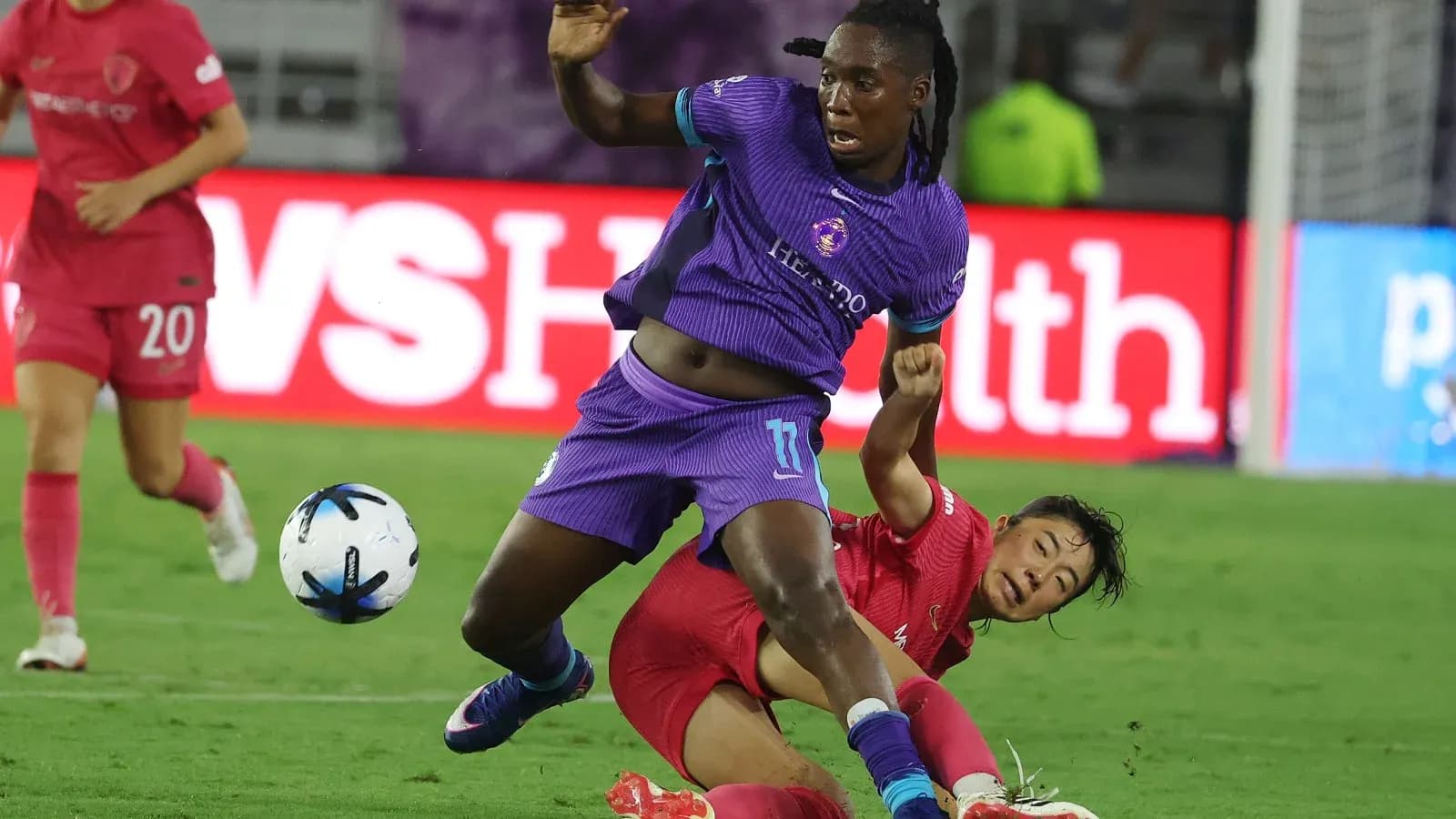
Orlando Pride W Defeats North Carolina Courage W 1–0 in NWSL Clash
Orlando Pride W edged a tight NWSL Women group-stage contest 1–0 over North Carolina Courage W at Inter&Co Stadium, Orlando, relying on late quality in both boxes more than territorial control. Despite trailing 44%–56% in possession and facing 12 shots to their own 9, Seb Hines’ side converted their one clear late opening through Barbra Banda in the 87th minute and then managed the closing stages with controlled aggression. Mak Lind’s Courage built longer spells of circulation and a higher passing volume, but their 12-shot output translated into just one effort on target, leaving the visitors punished for inefficiency and a lack of penalty-area clarity.
Disciplinary Events
Disciplinary and scoring events followed a clear, escalating pattern. The first flashpoint came at 21', when Summer Yates (Orlando Pride W) received a yellow card — Foul — reflecting Orlando’s willingness to disrupt Courage’s early rhythm between the lines. Just before the interval, the game’s emotional temperature spiked: at 45+3', Oihane Hernández (Orlando Pride W) was booked — Unsportsmanlike conduct — and at 45+5', Ally Lemos (Orlando Pride W) followed with a yellow — Foul — as Orlando leaned on tactical infringements to survive extended Courage possession.
North Carolina’s only booking arrived at 50', when Dani Weatherholt (North Carolina Courage W) was shown yellow — Foul — a sign of the visitors’ increasing urgency to prevent Orlando’s transition outlets, particularly Banda, from turning long balls into clean breaks. The decisive attacking moment came at 87': Barbra Banda (Orlando Pride W) finished a Normal Goal, assisted by Rafaelle Souza, breaking a deadlock that had been defined more by structure than clear chances. Deep into stoppage time, at 90+7', Rafaelle Souza (Orlando Pride W) collected a yellow card — Foul — as Orlando protected their narrow lead with assertive game management rather than passive retreat.
In total, Orlando Pride W accumulated 4 yellow cards, North Carolina Courage W 1, for a match total of 5 bookings. That disciplinary asymmetry underlined Orlando’s more reactive, combative defensive posture compared with Courage’s ball-dominant but less confrontational style.
Tactical Overview
Structurally, Orlando set up in a 4-2-3-1 that functioned as a compact mid-block. Anna Moorhouse in goal, with a back four of Hailie Mace, Coriana Dyke, Rafaelle Souza, and Oihane Hernández, stayed relatively narrow, ceding wide spaces but aggressively contesting central entries. The double pivot of Ally Lemos and Haley Hanson focused on screening Shinomi Koyama and Manaka Matsukubo, accepting a possession deficit (328 passes at 80% accuracy versus Courage’s 425 at 82%) in exchange for vertical access to Banda. Ahead of them, Solai Washington, Angelina Alonso Costantino, and Summer Yates were tasked with jumping out to press Courage’s first line selectively, then springing forward once Orlando regained the ball.
North Carolina Courage W’s 4-3-3 was more circulation-oriented. Kailen Sheridan acted as a first passer behind a back four of Ryan Williams, Uno Shiragaki, Natalia Staude, and Dani Weatherholt. The midfield trio of Riley Jackson, Shinomi Koyama, and Manaka Matsukubo tried to overload the central lane, with Lauryn Thompson and Ashley Sanchez tucking in from the flanks around Evelyn Ijeh. Their 56% possession and higher pass count reflected sustained control, but the shot profile betrayed a lack of incision: 12 total shots yielded only 1 on target, split evenly between 6 attempts inside and 6 outside the box, suggesting Orlando largely forced Courage into lower-quality looks.
Goalkeeper Performance
Goalkeeper usage reinforced the tactical story. Moorhouse made 1 save from Courage’s single shot on target, but more importantly, her defensive unit limited clear sights at goal despite conceding territory. At the other end, Sheridan faced just 2 shots on goal, also saving 1; Orlando’s efficiency came from making one of their few accurate efforts count, with Banda’s late strike the culmination of a more direct, transition-oriented plan rather than volume shooting.
Personnel Changes
Personnel changes were tightly linked to tactical adjustments. At 55', Hines refreshed his attacking midfield band: Marta (IN) came on for Summer Yates (OUT), adding composure between the lines, while Seven Castain (IN) replaced Solai Washington (OUT), injecting fresh legs and vertical running. At 64', Julie Doyle (IN) for Ally Lemos (OUT) slightly rebalanced the midfield, trading a holding profile for more ball-carrying and pressure resistance as Orlando anticipated chasing longer Courage phases.
Mak Lind’s response came at 69', when Allyson Schlegel (IN) replaced Evelyn Ijeh (OUT) and Chioma Okafor (IN) came on for Lauryn Thompson (OUT), effectively retooling the front line for more direct penetration and penalty-box presence. At 77', Carly Wickenheiser (IN) for Riley Jackson (OUT) aimed to add different midfield dynamics, possibly more forward thrust. Hines’ late move at 84' — Luana Bertolucci (IN) for Angelina (OUT) — added defensive reliability and ball security in central zones before the decisive goal. Lind’s final attacking tweak at 85' saw Ivy Garner (IN) for Ashley Sanchez (OUT), pushing for a late equalizer but ultimately unable to alter the shot quality problem.
Match Statistics
The match’s statistical profile supports the view of a controlled Courage performance undone by Orlando’s sharper moments. Courage’s 56% possession, higher pass volume (425 vs 328), and slightly better pass accuracy (82% vs 80%) underscore their dominance of the ball. They also led in total shots (12 vs 9) and shots off target (10 vs 4), but the crucial metric — shots on goal — favored Orlando 2–1, aligning with the 1–0 scoreline. Both sides committed 15 fouls, yet Orlando’s 4–1 yellow card deficit shows their fouls were more often deemed card-worthy, consistent with a more disruptive defensive strategy.
Without explicit xG values, the closest proxy is shot location and accuracy: Orlando’s 5 shots inside the box versus Courage’s 6, combined with Orlando’s higher on-target rate, suggests the hosts carved out marginally better-quality openings from fewer attacks. Defensively, both keepers recorded 1 save, but Orlando’s Defensive Index — inferred from limiting Courage to a single accurate effort despite their territorial control — was superior. In overall form terms, Orlando demonstrated an ability to win without statistical dominance, leaning on structure, targeted aggression, and late-game execution, while Courage’s underlying numbers highlight a team with solid possession mechanics but an urgent need to translate control into genuine threat.
Related News
Orlando Pride W vs Portland Thorns W: Playoff Showdown
San Diego Wave W vs Kansas City W Predicted Lineups: Team News for NWSL Women
Orlando Pride W vs Portland Thorns W Prediction: Key Stats and Betting Tips
San Diego Wave W vs Kansas City W: Key NWSL Clash Preview
San Diego Wave W vs Kansas City W Prediction: Key Stats and Betting Tips
Portland Thorns and Chicago Red Stars Draw in NWSL Showdown