
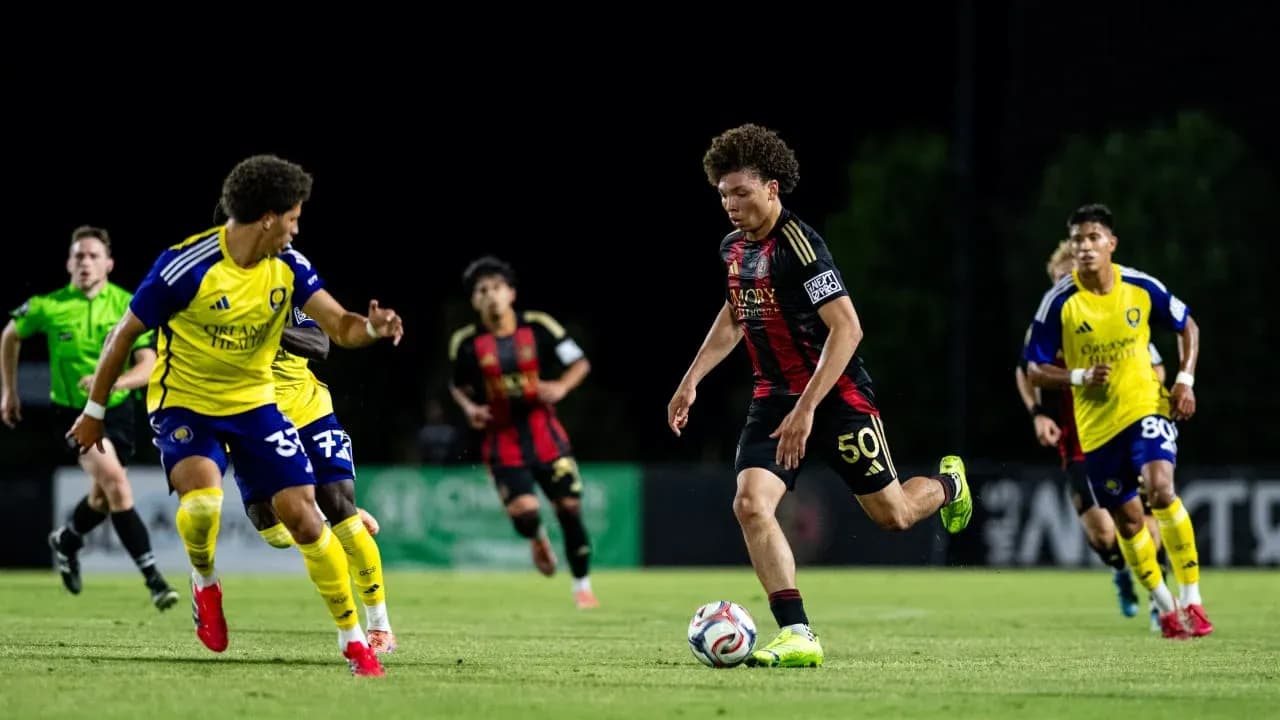
Orlando City II Dominates Atlanta United II in MLS Next Pro Clash
Under the lights at Fifth Third Stadium, this MLS Next Pro meeting between Atlanta United II and Orlando City II ended with a clear, clinical verdict. Following this result, the scoreboard read 0–2, a scoreline that distilled the broader seasonal identities of both sides: Atlanta, high-variance and aggressive but fragile; Orlando, chaotic yet ruthless in the final third.
I. The Big Picture – Two Playoff Chasers, One Statement Win
Both teams arrived in strong Eastern Conference positions. Heading into this game, Atlanta United II sat on 16 points from 9 matches, ranked 4th in the conference table snapshot, with a goal difference of 3 (14 goals for and 11 against overall). Their season to that point had been defined by extremes: 5 wins, 4 losses, and no draws, both in total and split between home and away. At home, they had been productive, scoring 6 goals in 3 matches, an average of 2.0 goals per game, but conceding 4 at a rate of 1.3.
Orlando City II mirrored the points tally but with a very different scoring profile. Heading into this game, they also had 16 points from 9 matches in the Eastern Conference, ranked 5th, but with a goal difference of 0, built from 19 goals scored and 19 conceded overall. Their attack had been one of the most explosive in the division: 22 goals in total across home and away league play, at 2.4 goals per match overall. On their travels, Orlando were averaging 2.3 goals for and conceding 1.8, a high-event side that rarely leaves a neutral unsatisfied.
This fixture, though labeled as Group Stage in the competition format, had the feel of a playoff dress rehearsal. Both sides carried “Promotion – MLS Next Pro (Play Offs: 1/8-finals)” in their conference descriptions, and the match played out like a test of who could better impose their identity under pressure.
II. Tactical Voids and Discipline – Edges at the Margins
There were no listed injuries or absences in the data, so both coaches effectively had full squads to choose from. Atlanta’s starting group of J. Hibbert, D. Chica, M. Senanou, M. Cisset, D. Chong-Qui, A. Gill, A. Torres, E. Dovlo, I. Suarez, C. Dunbar and A. Kovac suggested a youthful, dynamic side, with the bench options of J. Donaldson, M. Tablante, P. Weah, L. Butts, D. Sibrian, I. Ettinger, A. Jardines and A. Henry offering fresh legs but not much veteran ballast.
Orlando’s XI of L. Maxim, P. Amoo-Mensah, C. Guske, T. Reid-Brown, B. Rhein, D. Judelson, I. Gomez, G. Caraballo, I. Haruna, H. Sarajian and Pedro Leao looked more balanced between structure and flair, backed by substitutes M. Murillo, M. Belgodere, C. Archange, S. Titus Jr, J. Ramirez, J. Yearwood and L. Tsopanoglou.
From a disciplinary perspective, heading into this game, Atlanta had been walking a fine line. Their yellow-card distribution showed a clear late-game spike: 23.81% of their bookings came between 76-90 minutes, with additional clusters from 46-60 (19.05%) and a spread across earlier ranges. Red cards were also spread across the second half, with 33.33% each in the 46-60, 61-75 and 76-90 windows. This is a team that tends to fray as matches stretch and emotions rise.
Orlando’s yellow-card pattern, by contrast, was front-loaded. A combined 52.64% of their yellows came between 16-45 minutes (26.32% in 16-30 and 26.32% in 31-45), then tapering off towards the final quarter-hour (10.53% from 76-90). They start combative, then manage the game more cleanly as it wears on. With no red cards at all in the distribution, their aggression has generally stayed just inside the lines.
III. Key Matchups – Hunter vs Shield, Engine Room vs Chaos
The “Hunter vs Shield” narrative here was less about individual top scorers (no specific player scoring data is provided) and more about unit-versus-unit confrontation. Orlando’s attack, heading into this game, had been relentless: 13 home goals and 9 away, with their biggest away win a 0-2 and a ceiling of 3 goals on their travels. They had also failed to score in 0 matches overall, a remarkable consistency.
Atlanta’s defensive record, by contrast, was solid but not impermeable. They had conceded 12 goals overall in the statistics snapshot (4 at home, 8 away), at 1.3 per match both at home and on their travels. The clean-sheet record told the story: 0 at home, 2 away, 2 in total. At Fifth Third Stadium, they tended to concede at least once.
In midfield, the “Engine Room” battle was about how Atlanta’s technical core could cope with Orlando’s tempo. Players like A. Gill and A. Torres were tasked with knitting together Atlanta’s possession and transitions, while E. Dovlo and I. Suarez offered running power and vertical threat. On the other side, B. Rhein and D. Judelson formed the structural spine for Orlando, with I. Gomez, G. Caraballo and I. Haruna providing the connective tissue to Pedro Leao up front.
Without explicit positional labels, the patterns still emerge: Atlanta’s profile suggests a side that wants to attack in waves, supported by an average of 2.0 home goals for and willing to accept risk. Orlando, with 2.3 away goals for and 1.8 against, lean into volatility but trust their forward line to outgun opponents.
IV. Statistical Prognosis and Tactical Verdict
Following this result, the 0–2 scoreline fits the statistical trend lines more snugly on Orlando’s side. Their season-long numbers heading into the game painted them as a team that almost always scores and often scores multiple times. The defensive side of their ledger is messy, but against an Atlanta team that had already failed to score in 3 matches overall (1 at home, 2 away), the possibility of a shutout was quietly present.
Atlanta’s overall average of 1.6 goals for per match and 1.3 against suggested a team that usually finds the net but lives in narrow margins. Their lack of home clean sheets, combined with Orlando’s refusal to blank, tilted the probabilistic edge towards the visitors. Add in Orlando’s perfect penalty record (2 penalties taken, 2 scored, 100.00% conversion, 0 missed) versus Atlanta’s lack of spot-kick threat (0 penalties taken, 0 scored, 0 missed), and the set-piece micro-margins also leaned purple.
Defensively, the absence of minute-by-minute goal distributions limits precise time-window matchups, but the card data offers a proxy. Atlanta’s tendency to pick up yellows and even reds late on, particularly from 76-90, overlaps dangerously with Orlando’s habit of staying aggressive in attack across 90 minutes. A fatigued, card-risk Atlanta back line against a relentless Orlando front unit is a recipe for late concessions, even if the goals in this match came earlier.
In tactical terms, Orlando City II imposed their season-long identity with clarity: high tempo, multiple threats, and enough defensive resilience to ride out Atlanta’s surges. Atlanta United II, for all their attacking averages and home promise, ran into a side perfectly calibrated to exploit their structural vulnerabilities.
The 0–2 at Fifth Third Stadium does more than settle a single night’s contest. It sharpens the contours of both teams’ playoff profiles: Orlando as the dangerous, free-scoring hunter nobody wants in a two-legged tie; Atlanta as a volatile contender who can beat anyone on their day, but must solve their late-game discipline and home defensive frailties if they are to turn numbers into knockout success.
Related News

MLS Winners and Losers: Rising USMNT Star Cavan Sullivan, St. Louis City's Smart Moves, and Chicago Fire's Struggles Without Hugo Cuypers

MLS Highlights: Portland Timbers End Drought, Josh Sargent Shines, Cavan Sullivan Impresses
Tacoma Defiance vs Colorado Rapids II Stats: Head-to-Head Record

St. Louis City II vs Vancouver Whitecaps II: Head-to-Head Stats and Match Preview
Atlanta United II vs New York City II Stats: Head-to-Head Record
Houston Dynamo FC II vs Austin II Stats: Head-to-head Record