
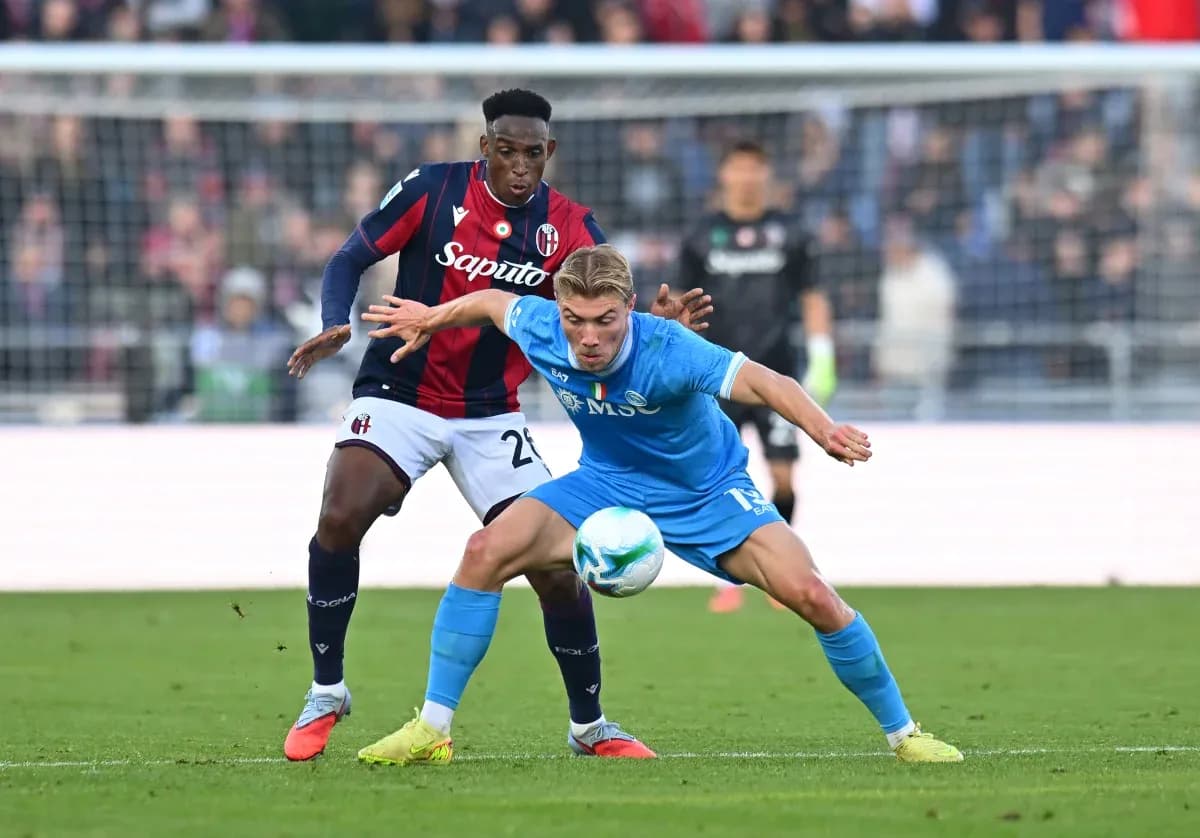
Napoli vs Bologna: A Chaotic Serie A Clash Ends 2–3
Under the lights of Stadio Diego Armando Maradona, a high‑stakes Serie A clash between second‑placed Napoli and eighth‑placed Bologna ended 2–3, a result that reshapes the narrative of both seasons as the regular season ticks into its final stretch.
I. The Big Picture – Two Identities, One Chaotic Night
Following this result, Napoli remain a side defined by attacking volume and structural boldness. Overall this campaign they have scored 54 goals and conceded 36 across 36 matches, a goal difference of +18 that underlines why they sit on 70 points. At home they have been formidable: 12 wins from 18, with 32 goals for and 18 against, averaging 1.8 goals scored and 1.0 conceded at Stadio Maradona.
Yet against Bologna, Antonio Conte doubled down on aggression with a 3‑4‑2‑1, trusting the system that has been his most‑used shape (21 league matches). V. Milinkovic-Savic was shielded by a back three of G. Di Lorenzo, A. Rrahmani and A. Buongiorno, with a fluid midfield line of M. Politano, S. Lobotka, S. McTominay and M. Gutierrez behind the attacking trio Giovane, Alisson Santos and focal point R. Hojlund.
Bologna arrived as one of Serie A’s most dangerous away sides. On their travels they have 9 wins from 18, scoring 29 and conceding 23, an away average of 1.6 goals for and 1.3 against. Vincenzo Italiano leaned into that identity with an assertive 4‑3‑3: M. Pessina in goal, a back four of Joao Mario, E. Fauske Helland, J. Lucumi and J. Miranda, a midfield trio of T. Pobega, R. Freuler and L. Ferguson, and a front line of R. Orsolini, S. Castro and F. Bernardeschi.
The half‑time score of 1–2 to Bologna set the tone: Napoli’s home firepower was present, but the visitors’ away ruthlessness – a season‑long trait – was decisive.
II. Tactical Voids – Missing Stars and the Card Landscape
This fixture was shaped as much by absences as by those on the pitch. Napoli were without three headline names: David Neres (ankle injury), K. De Bruyne (eye injury) and R. Lukaku (hip injury), all listed as “Missing Fixture”. The tactical void was obvious. Without De Bruyne’s passing range and Lukaku’s penalty‑box gravity, Conte’s 3‑4‑2‑1 leaned heavily on McTominay’s late runs and Hojlund’s channel work rather than classic between‑the‑lines creativity and back‑to‑goal dominance.
On Bologna’s side, K. Bonifazi (inactive), N. Cambiaghi (muscle injury), N. Casale (calf injury) and M. Vitik (ankle injury) were all absent. The most intriguing omission in tactical terms is Cambiaghi: his season has been defined by relentless duels and aggression, culminating in 1 red card and 3 yellows in Serie A. His ability to tilt games emotionally and territorially was missing, forcing Italiano to find intensity through Pobega and Ferguson instead.
Across the season, Napoli’s disciplinary profile has been spiky but controlled. Their yellow cards peak in the 61–75 minute window at 31.91%, with a notable late‑game red‑card spike: 100.00% of their reds arrive between 76–90 minutes. Bologna, by contrast, spread their aggression more evenly but with a heavy lean to the second half: 27.27% of their yellows come between 61–75 minutes and 25.76% between 76–90, while their reds are scattered across key phases (including 16.67% in both 16–30 and 46–60, and 33.33% in 61–75).
In a match that stayed 11‑v‑11, those patterns still mattered. Napoli’s tendency to accumulate cards after the break often forces Conte to temper his press or rotate his back line; Bologna’s late‑phase aggression, even without Cambiaghi, suits a side that thrives on away‑day transitions and tactical fouls.
III. Key Matchups – Hunter vs Shield, Engine Room vs Enforcer
The headline duel was always going to be R. Hojlund against Bologna’s defensive block. Overall this campaign, Hojlund has 10 league goals and 4 assists, from 42 shots (22 on target). He is not just a finisher; 30 key passes and 4 assists underline his capacity to combine and create. Against a Bologna defence that has conceded 43 overall (20 at home, 23 away), his role as “Hunter” was clear: attack the space behind Joao Mario and J. Miranda, and destabilise the central pairing of E. Fauske Helland and J. Lucumi.
Italiano’s “Shield” was built on structure rather than star power. Lucumi’s positioning and Helland’s reading of the game had to absorb Hojlund’s physicality while tracking the under‑the‑radar movements of Giovane and Alisson Santos. Every time Hojlund drifted wide, it asked a question of Bologna’s full‑backs; every time he stayed central, it became a test of their centre‑backs’ duels.
In midfield, the “Engine Room” was a compelling clash. For Napoli, S. McTominay has been one of Serie A’s most influential two‑way midfielders this season: 9 goals and 3 assists, with 69 shots (33 on target), 1202 passes at 88% accuracy, and 28 tackles plus 13 blocked shots. He is both late‑runner and enforcer, equally willing to arrive in the box or drop into the defensive line.
Opposite him, R. Freuler and L. Ferguson formed Bologna’s central axis. Freuler, the metronome, is tasked with resisting Napoli’s press and protecting the back four; Ferguson, more vertical, must break lines and support the front three. Their job was to suffocate McTominay’s surges and disrupt S. Lobotka’s rhythm. If they could deny Napoli easy central progressions, Bologna’s 4‑3‑3 could spring quickly into transitions for Orsolini and Bernardeschi.
On the flanks, M. Politano’s presence as Napoli’s top assister (5 assists and 2 goals overall, with 36 key passes) gave Conte a creative outlet. Politano’s duel with J. Miranda and the covering Ferguson was central to Napoli’s attempts to unpick Bologna’s right‑side block, especially when Hojlund drifted towards that channel to overload.
For Bologna, R. Orsolini carried the “Hunter” mantle. With 9 goals and 1 assist overall, 64 shots (30 on target) and 26 key passes, he is both finisher and creator. His four penalties scored, offset by two missed, show a player unafraid of responsibility but not infallible from the spot. In open play, his duel with Buongiorno and the wide centre‑back zones of Napoli’s back three was a constant tactical hinge: if Orsolini could isolate Buongiorno or drag Rrahmani wide, Bologna’s central lanes would open for Castro.
IV. Statistical Prognosis – xG Shadows and Defensive Truths
There is no explicit xG data in the snapshot, but the season’s numbers sketch a clear underlying picture. Heading into this game, Napoli’s overall average of 1.5 goals scored and 1.0 conceded per match suggested a side that typically controls territory and chance quality, especially at home where they average 1.8 scored. Bologna’s overall averages – 1.3 goals for and 1.2 against – and their stronger away output (1.6 scored) hinted at a team built to punish open contests.
In that context, a 2–3 scoreline fits the statistical tension: Napoli’s attacking volume met a Bologna side whose away attacking metrics are those of a top‑six contender, not a mid‑table one. Defensively, Napoli’s record of 13 clean sheets overall and only 18 goals conceded at home shows a usually tight unit; conceding three here underscores how exposed a back three can become when the wing‑backs and advanced midfielders are pushed high and the press is half a step late.
For Bologna, shipping two away from home is almost exactly in line with their away average of 1.3 goals conceded; scoring three is an overperformance that reflects both their tactical bravery and Napoli’s structural risk.
Following this result, the statistical prognosis for both sides sharpens. Napoli remain a Champions League‑calibre machine, but one whose 3‑4‑2‑1 can be stretched by aggressive 4‑3‑3s that attack wide and early. Bologna, meanwhile, consolidate their reputation as one of Serie A’s most dangerous travellers: a team whose away attacking output and midfield intensity make them capable of unsettling even the league’s elite when the game opens into a shoot‑out.
Related News
Frosinone vs Como Prediction: Key Stats and Betting Tips

Fiorentina vs Napoli Prediction: Key Stats and Betting Tips
AS Roma vs Inter: Serie A Showdown on 19 September 2026

Inter’s Dominance in 5–3 Win Over Udinese
AS Roma vs Inter Prediction: Key Stats and Betting Tips
Lazio and AC Milan Battle to a 2–2 Draw: Early Serie A Insights