
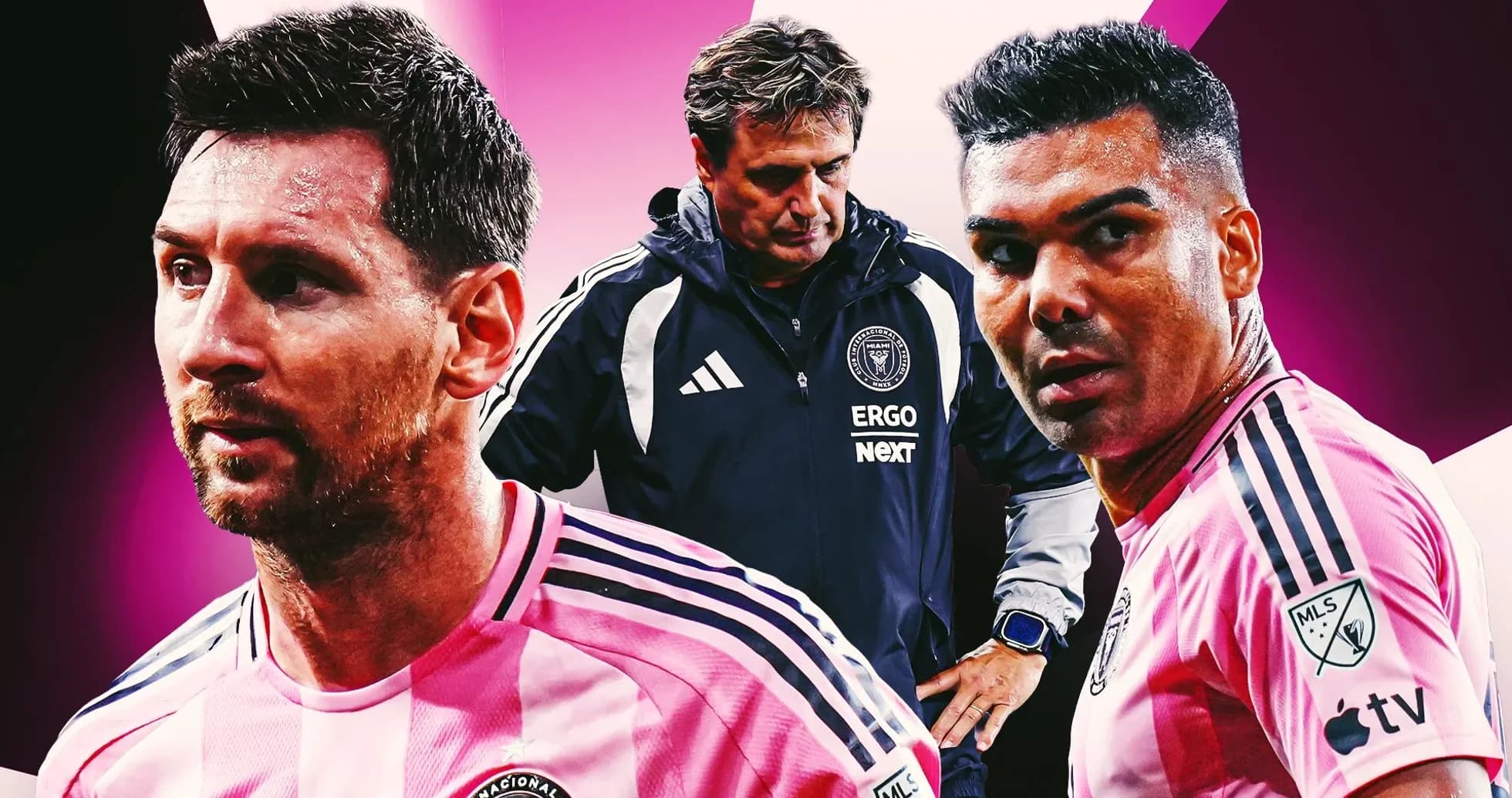
Miami's Struggles Exposed by Nashville: A Tactical Breakdown
Miami’s problem is no longer subtle. It’s not a blip, not a bad night, not something that can be explained away by travel or injuries or “fine margins.”
Their 4-1 hammering in Nashville stripped the veneer clean off.
Miami had the ball, but Nashville had the plan. The Herons dominated possession and still looked permanently on the verge of collapse, ripped open again and again in transition. Hany Mukhtar, who has carved up plenty of good MLS teams, turned Miami into a training exercise. He scored twice. Sam Surridge added another. Andy Najar stormed forward from right back to pile on, arriving in acres of space as Miami’s defensive shape simply disintegrated.
In midfield, it was even more damning. Eddi Tagseth and Matthew Corcoran didn’t just win the battle; they ran Miami into the ground. The gaps were huge, the reactions slow, the recovery runs half a beat late. It was a miserable night, but more than that, it was a clear tactical blueprint for how to beat them.
Shut down Lionel Messi — or even just limit him — and everything else starts to wobble.
Messi doesn’t defend. Luis Suarez, 39 and still fighting his body, simply can’t. Rodrigo De Paul covers ground on the right, but Casemiro, the marquee post-World Cup arrival, looks like he’s trudging through mud in the middle of the park. The drop-off from Jordi Alba to Sergio Reguilón, who hasn’t played regular football since 2022, is brutally obvious. You can’t scheme your way out of legs that aren’t there.
Right now, this is an average playoff team being dragged toward relevance by one extraordinary player.
Built for Messi, not built to last
On paper, the fixes seem obvious. Anyone with a whiteboard can see where the problems lie: Miami need energy up front and in central midfield. They need players who can run, press, and cover for the stars.
But the squad tells a different story — one shaped around a single man.
Elite central midfielders are hard to find and harder to convince to join MLS. Still, there was a world in which someone like N’Golo Kanté could have arrived instead of Casemiro. Miami also chose to spend around $15 million on German Berterame, a forward who doesn’t truly excel in any one area. That’s a luxury signing on a roster that can’t afford luxuries.
Then there’s Benjamin Cremaschi. A homegrown, energetic midfielder who openly admitted he felt misused under Javier Mascherano and could yet push for a move. Nurtured properly, he might have been the perfect piece to build a more dynamic midfield around. Instead, Miami have leaned on veterans, reputations and familiar faces.
That’s not an accident.
This all traces back to 2023, when Sergio Busquets and Alba were brought in with one clear purpose: help convince Messi to come. De Paul has admitted that the chance to play alongside Messi and stay sharp for the World Cup drove his decision to leave Atletico Madrid. He and Messi were reportedly putting in extra training sessions before Qatar; the bond is real and strong.
Even Casemiro, a former Barcelona enemy during his Real Madrid years, framed his move in those terms.
“For me, without a doubt, I am coming only to play with the best player of all time,” he said at his introductory press conference. “I want to enjoy, I want to help him to keep winning because he is a winner. Another player is joining who wants to win, who wants to compete.”
Whether Messi is personally making the calls or simply approving them almost doesn’t matter. The outcome is the same: this is a squad built to keep him content, not a roster engineered to win after he’s gone.
And that’s the looming problem.
A league about to change, a club stuck in one man’s orbit
MLS is on the verge of a structural shift. The league plans to move to a Fall-Spring calendar in 2027-28. Owners have already been briefed on potential changes to salary rules that would allow more spending, more ambition, more flexibility.
That’s when clubs with a plan can start to act like it.
Miami’s reality is more complicated. Messi is under contract through the end of the 2028 season. That covers next year’s shortened “sprint season” and the first full Fall-Spring campaign. On paper, that gives Miami an abbreviated season, one full season, and the rest of this one with their main attraction.
But if Messi decides he’s done earlier, the whole thing starts to look very bleak, very quickly.
They would be left with expensive Designated Players who don’t quite fit together. De Paul is tied down on DP money through 2029. Berterame is locked in on the same timeline. Casemiro doesn’t occupy a DP slot right now, but Miami have already shown with De Paul that they’re willing to start a player on smaller money before upgrading him later. That path remains open.
That’s the nightmare scenario: an aging, expensive spine, no Messi, and no clear successor.
What Miami truly need is not just another star, but a new face of the club — someone who can carry the sporting and commercial load. Julian Alvarez is the dream. He won’t replicate Messi’s global pull — no one will — but his age, quality, work rate, Argentine roots and marketability make him the closest thing to a genuine succession plan.
The problem? Reality.
Atletico Madrid paid an initial €75 million, plus up to €20m in add-ons, to sign him from Manchester City in 2024. This summer, they reportedly turned down a €150m offer from Real Madrid. For Miami to even enter that conversation, they’d need to put together a transfer package far beyond normal MLS parameters, and that’s before they even talk about his salary.
Right now, Alvarez is less Plan A and more fantasy.
If that proves impossible, the next logical route is an American star. Christian Pulisic and Weston McKennie are the only two who truly fit the bill. Pulisic is the most recognizable active American player. McKennie brings quality, charisma and a personality that would play well in the U.S. market.
Both could help define the next version of Inter Miami. Neither could replicate the gravitational pull of Messi.
The business of Messi
And that is where the bind tightens.
Miami are not just dependent on Messi the player. They are built on Messi the business. His presence drives sponsorships, ticket prices, shirt sales and global visibility. A stand at Nu Stadium carries his name. His compensation reportedly includes ownership shares.
This is not a normal DP. This is the foundation of the entire project.
Before Messi, Miami were one of the league’s worst teams. They had already tried the “big name” route with Blaise Matuidi and Gonzalo Higuain, but neither shifted the club’s trajectory. Attendance sat in the bottom third of MLS. By July 2023, when Messi finally arrived, Miami were effectively out of the playoff race, trophyless, with Phil Neville sacked and a roster full of holes.
Messi changed all of that overnight.
The danger is that when he leaves, Miami slide straight back into that old pattern: a club with ambition, but no identity, no anchor and no clear plan. The transition is coming. The timing, though, is in one man’s hands. Messi will decide when his Miami chapter ends. The club, for all its resources, is left to react.
There is still a scenario in which Messi summons one more Herculean season, drags this flawed team to another trophy and buys Miami time. But nights like the one in Nashville make that feel like an increasingly heavy burden to place on a 37-year-old.
For now, the image is the same after each setback: Messi disappearing down the tunnel, teammates trudging behind, questions hanging in the air.
The real test won’t be how long he can keep carrying them. It will be what, if anything, is left standing when he finally stops.
Related News
Transfer Rumors: Haaland’s Two Options; Real Madrid Targets $100 Million Premier League Star
Manchester United Targets Premier League Forward to Strengthen Attack
Liverpool Eyes 17-Year-Old Mexican Midfielder Gilberto Mora for Summer Transfer
Summer 2026 Transfer Window: Manchester United and Tottenham Struggle with New Signings
Liverpool Maintain Interest in Real Madrid Midfielder Amid Transfer Challenges
Transfer Insider Warns Tottenham About Costly Sale of Will Lankshear