
Manchester United's Struggles: Carrick and Wilcox Under Pressure
The boos came first. Then the silence.
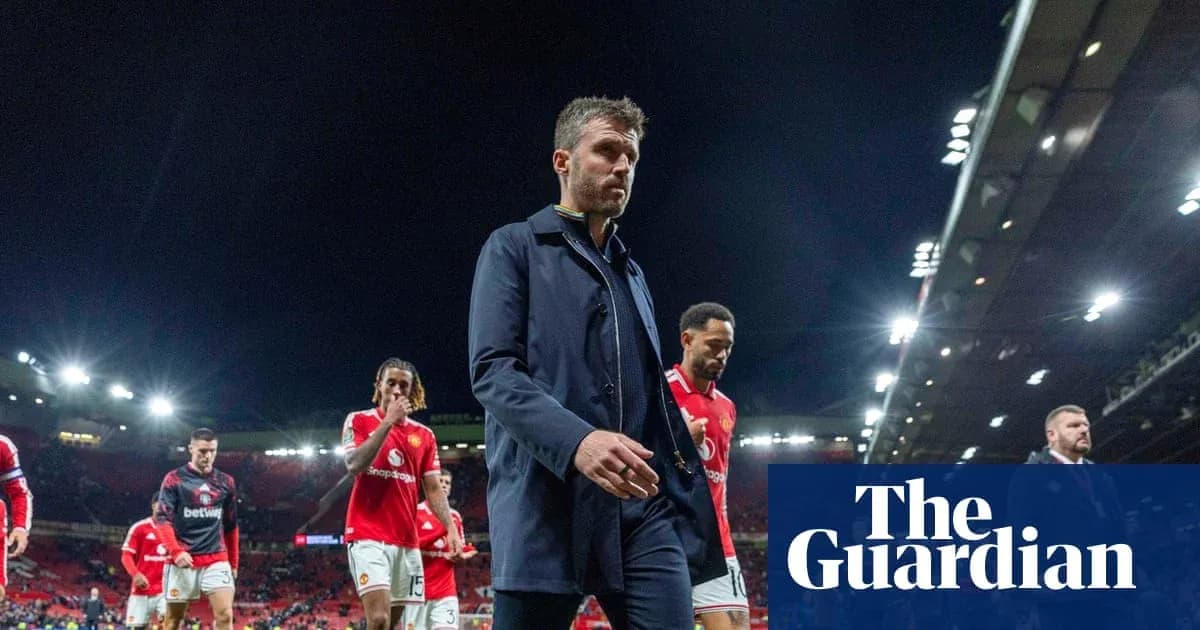
As Manchester United slid out of the Carabao Cup on Wednesday night, the soundtrack at Old Trafford was a blend of anger and indifference. Michael Carrick, expression fixed and sombre, walked towards the tunnel with his players as the jeers rained down. High above, in the directors’ box, Jason Wilcox did not bother to hide his displeasure. He will know, though, that the discontent is not his head coach’s burden alone.
This is how football works. Supporters judge in real time. They decide what is acceptable and what is not, and they deliver their verdict to those they believe they pay to represent them. Carrick and his squad are the public face of United, sent out to explain defeats and front up sponsors’ campaigns. They carry the visible weight. But they are not the only ones who built this.
Carrick only returned to United in January. The longer-term strategy, the structural calls, the squad-building framework – those belong to others, with the head coach slotted into a plan already in motion. That does not dilute the pressure on him. Lose at Fulham on Sunday and the temperature around him will spike again.
United’s supporters are not naïve. They know who runs their club. Protests against the Glazer family and Sir Jim Ratcliffe have become part of the backdrop. They understand that not every misplaced pass or tactical misstep is down to the man in the dugout or the players on the pitch. The boos are for nights like Brighton and this cup exit. The apathy is for everything else: the years of drift, the financial mismanagement, the sense of a giant shrinking.
It stings to see United back in the Champions League yet outspent in the summer by promoted sides. That is the cost of previous errors. Money now has to be used with care, not bravado.
The 3-2 defeat by Brighton told its own story. Two goals up inside 10 minutes, then barely present for the remaining 80 and deservedly beaten. A team that can race ahead and then vanish has deeper problems than form. Carrick knows that. Brighton, heavily rotated, still fielded a vibrant, cleverly assembled squad, stitched together from seven different countries this summer alone. Their recruitment has range and imagination. United’s did not.
Four signings from fellow Premier League clubs. No real sense of calculated risk. Little dynamism. For a club of United’s scale, that felt small. The irony is that the most effective arrival last summer, in terms of value and consistency, has been Senne Lammens from Royal Antwerp – exactly the kind of left-field move the club so rarely makes.
Carrick and Wilcox cannot be fully judged until Carlos Baleba, the priciest of the three summer recruits, is fit and available. On paper, his mobility should address one of the most glaring flaws in midfield. Targeting central midfielders after Casemiro’s departure and Manuel Ugarte’s struggles made sense. But it was never the only area that needed work.
Inside the club, there was an acceptance that the squad was short in several departments. The way they chose to strengthen, though, lacked variety and now looks painfully naive. Raiding other Premier League sides is almost always expensive and rarely efficient, even if it does shorten adaptation time. With a shortage at left-back and Joshua Zirkzee failing to convince, opting for a cheaper midfield option than the £50m Andrey Santos could have freed resources to address other weaknesses.
Instead, United spent £155m on three players in broadly the same position. Someone above Carrick should be explaining how that was considered the best route to rebuild the team. Outside the club, people are left to guess, while inside Carrick is tasked with conjuring a Plan B now that Luke Shaw, as many expected, is sidelined again.
Wilcox has spoken about the project before. On 30 October 2025, after three straight wins, he sat down with United’s in-house media and outlined the long-term vision. Two months later, Ruben Amorim was sacked and that plan was shredded. When results are positive, Wilcox is willing to talk. During downturns, beyond formal statements announcing sackings, he has gone quiet.
Across Europe, sporting directors routinely front up to the press. In the Premier League, that culture has barely taken hold. At United, with the team languishing in 13th, the silence feels louder by the week.
Wilcox’s path to this point matters. He arrived from Southampton in 2024 as technical director, then helped argue for Erik ten Hag to stay on after an eighth-placed finish. Ten Hag was eventually dismissed after starting the next season poorly. Amorim came in from Sporting, his preferred style misaligned with the squad and the budget nowhere near big enough to reshape it. United finished 15th and lost meekly to Tottenham in the Europa League final. After 14 months, Amorim was removed and Wilcox got another chance to reset.
Carrick cannot be shielded from criticism. This United side are underperforming. Heavy wins over promoted Ipswich and Azerbaijani side Sabah do not disguise the broader picture of a flat, uncertain start.
The defence has creaked, conceding seven times in four league games. Against Brighton, the central pairing of Leny Yoro and Ayden Heaven looked out of their depth, their partnership veering towards shambolic. Up front, the attack has lacked cohesion, movements rarely dovetailing, patterns breaking down before they form.
Wilcox’s reputation was forged at Manchester City, where he excelled as head of academy. Those who worked with him rated him highly and saw him as ideally suited to that level of development. At United, higher up the food chain, his decisions are dissected and criticised. The potential departure of JJ Gabriel will infuriate many on the outside, yet on this issue at least, Wilcox has pushed hard to keep the teenager, working through the player’s inner circle to try to persuade him.
At United, power carries weight, but it does not always carry accountability. Ten Hag paid for his failures. Amorim did too. Others have continued largely unchallenged. Right now, only Carrick is forced to stand in front of the cameras and absorb the blows.
Carrick and Wilcox are tied to the same results, the same league table, the same restless fanbase. If this slide continues, though, it feels inevitable that only one of them will truly be made to answer for it.
Related News
Max Dowman's Future at Arsenal: Mikel Arteta's Stance
Arsenal's Max Dowman: Loan Move for Development
Liverpool's Alexis Mac Allister: Contract Situation and Future Prospects
Manchester City Overcomes Liverpool 4-2 in Thrilling WSL Clash
Kylian Mbappé Leaves Nike for Landmark Deal with On Holding
Chelsea's Midfield Crisis Exposed in Brentford Defeat