
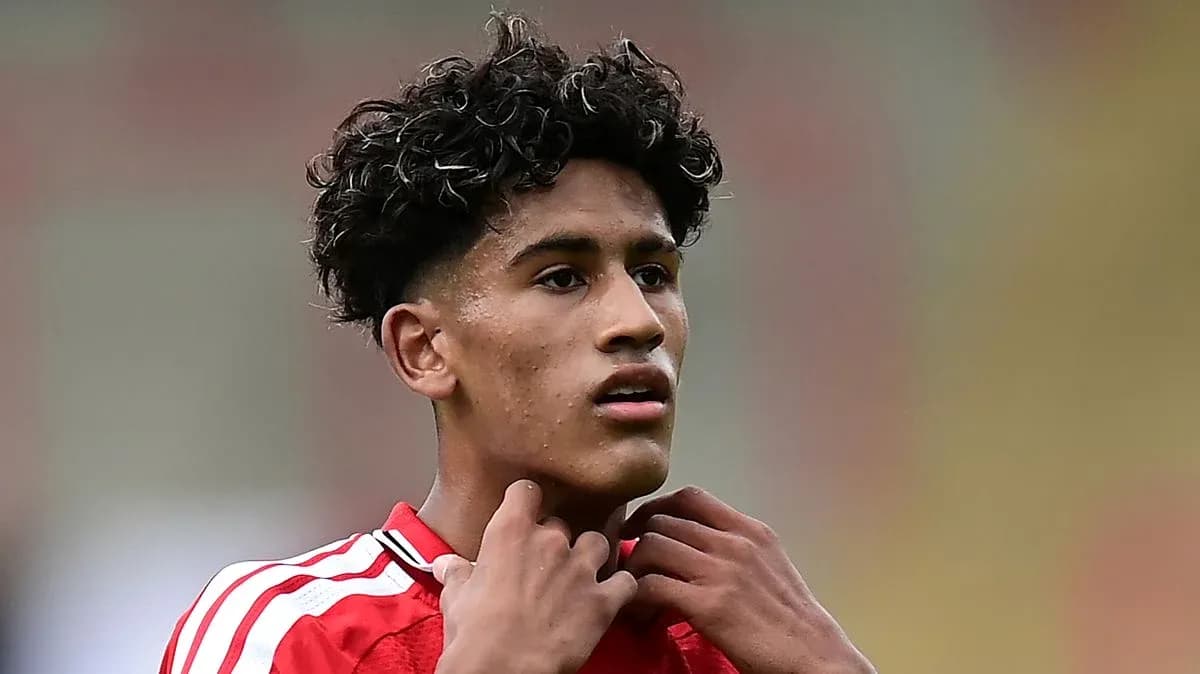
Manchester United's Academy Change Could Elevate JJ Gabriel
Manchester United have quietly made a structural change in their academy that could accelerate JJ Gabriel’s route to the first team – and reshape how their brightest youngsters step into Michael Carrick’s side.
Gabriel is only 15. You wouldn’t know it from the numbers.
Last season he tore through U18 defences, scoring 26 goals in 29 games and announcing himself as the next big hope coming out of Carrington. This term he has already jumped to U21 level and barely broken stride, with two goals and two assists in just two appearances.
He has trained with the seniors, featured in pre-season and is eligible to play in the Premier League this year. For a teenager still technically in schoolboy territory, the pathway has rarely looked this clear.
Mirroring Carrick’s blueprint
The key shift has come with U21 boss Adam Lawrence abandoning his 4-3-3 and moving to a 4-2-3-1 – a deliberate attempt to mirror Carrick’s first-team shape.
It sounds like a dry tactical note. It isn’t.
By aligning the academy with the senior structure, United want their top prospects to step into familiar roles, rather than relearn the game the moment they cross the line into the first-team environment. For Gabriel, that means growing into the role that defines Carrick’s attack: the No.10 position usually occupied by Bruno Fernandes.
According to the Daily Mail, the new system is already being used to school Gabriel in that central creative slot. He can play as a striker, he can drop deeper as an attacking midfielder, and now he is being asked to understand the full demands of the Fernandes role – pressing, linking, arriving in the box, and carrying the scoring burden.
False nine clues in the forward line
The mirroring doesn’t stop at No.10.
Carrick’s use of Matheus Cunha as a false nine has also been copied at U21 level, with Amir Ibragimov leading the line in a similar fashion. It is a clear tactical template: mobility over muscle, movement over a traditional target man.
The decisions around other young forwards point in the same direction. Chido Obi has been sent out on loan and Louie Bradbury has been allowed to join Stoke City. Taken together, those calls suggest a long-term strategy that leans away from orthodox No.9s and towards flexible, interchanging attackers.
That shift could open even more doors for Gabriel. His eye for goal at youth level is proven; if United increasingly build around false nines and fluid front lines, a player who can operate as both a No.10 and a central attacker suddenly becomes even more valuable.
Carrick watching closely
Carrick is not observing this from a distance. He has been a regular presence at U18 and U21 matches, and he saw Gabriel’s U21 debut first-hand last month.
The teenager responded by scoring once and setting up two more in a 5-0 win over Ipswich Town. It was the kind of performance that forces a manager to take notice, no matter the age of the player.
Carrick did not hold back in his assessment of the group that night, or of Gabriel’s trajectory.
"I thought the boys played ever so well, actually," he said. "Really good team, really strong team that we had, and you could see that the quality. I really enjoyed the game. Really pleased with the boys, the way they went about it. The quality, the attitude, everything about the game was really good. So, really encouraged by that.
"JJ is one of the boys. He's obviously got a really big talent. He's trained with us quite a bit. He's getting experience all the time. He's physically adapting to each step that he makes, and just continuing his development."
That last line matters. United are clearly determined not to rush him physically, even as his performances scream for promotion.
Where does Gabriel really fit?
As the hype builds, there is still debate about what Gabriel will ultimately become.
United forward Bryan Mbeumo has already floated a different idea for the youngster’s best position. Speaking to Zack En Roue Libre in March, he argued that Gabriel might be even more dangerous starting wider.
"He’s actually kind of a winger, he’s a dribbler and even in front of the box, I still think he’s good, honestly,” Mbeumo said. "He’s strong, the little guy is strong. Yeah, he’s strong, he’s really something, frankly... I think he’s 15.
“You feel that he’s bound to be a little kid but he trains quite a bit with us and actually you see, you can feel that the little guy has something special."
It is a reminder of the range United are dealing with. To some, Gabriel is a No.10 learning the Bruno role. To others, he is a winger waiting to stretch defences and attack full-backs. On the numbers alone, he already looks like a penalty-box threat.
For Carrick and his staff, that is a good problem to have. The club have put the framework in place – a shared formation, a defined style, and a manager willing to watch academy games himself. Now it comes down to how quickly a 15-year-old with “something special” can turn all of that into a competitive debut in front of a full Old Trafford.
Related News
James Rodríguez Retires from Colombia National Team: A Golden Era Ends
Liverpool Target Lamine Camara: A Rising Force in Ligue 1
Al-Taawoun Fined and Punished for Fan Chants Against Neves

Atlético Madrid's Bold Promise to Julián Álvarez
Liverpool Eyes Rayan as £130m Release Clause Approaches
Arsenal and Liverpool Battle for Bournemouth Starlet Rayan