
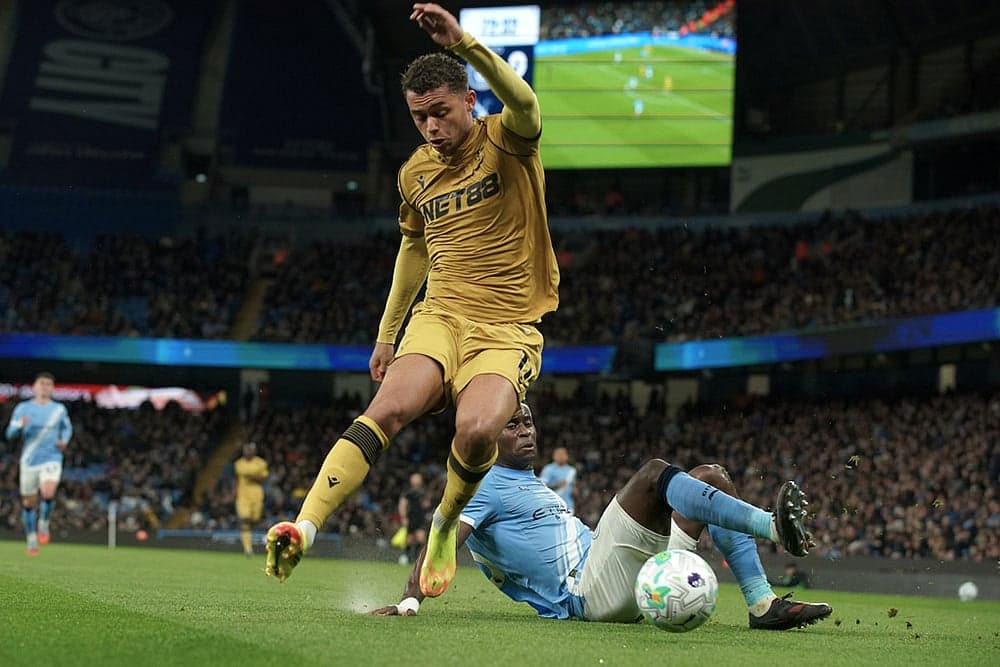
Manchester City Dismantles Crystal Palace 3-0 at Etihad
Manchester City’s 3-0 win over Crystal Palace at Etihad Stadium was a controlled, methodical dismantling built on structural dominance and high technical execution. Pep Guardiola’s 4-2-2-2 used the ball to pin Oliver Glasner’s 5-4-1 deep, converting 72% possession and 723 passes into a constant territorial siege. Palace’s compact block initially resisted, but once City broke the line for the opener, the tactical gulf widened and the game drifted into damage limitation for the visitors.
Executive Summary
City led 2-0 by half-time and never relinquished control, adding a third late on to reflect their superiority. The front pairing of A. Semenyo and O. Marmoush, supported by P. Foden and B. Silva between the lines, repeatedly overloaded Palace’s central trio. With Crystal Palace limited to 6 shots and just 0.68 xG, City’s defensive structure was as impressive as their attacking fluency. G. Donnarumma was rarely tested, while D. Henderson was exposed by the volume and quality of City’s entries into the box.
Scoring Sequence & Disciplinary Log
All three goals followed the same pattern: City drawing Palace’s block to one side, then exploiting the resulting gaps.
At 32', A. Semenyo (Manchester City) — assisted by P. Foden — opened the scoring. Foden received between the lines, turned under minimal pressure, and slipped a vertical pass into Semenyo’s inside-right channel run. The finish was clinical, low across Henderson, and rewarded City’s patient probing.
At 40', O. Marmoush (Manchester City) — again assisted by P. Foden — doubled the lead. This time City combined down the left, Foden drifting into the half-space to receive before threading a diagonal pass behind the back line. Marmoush’s movement across the near post unbalanced the central defenders, and he finished first time.
The second half discipline narrative was entirely Palace’s. Two yellow cards were shown:
- 52' Tyrick Mitchell (Crystal Palace) — Foul
- 81' Daichi Kamada (Crystal Palace) — Simulation
These were the only bookings of the match: Manchester City 0, Crystal Palace 2, Total: 2.
City’s third arrived on 84', Savinho (Manchester City) — assisted by R. Cherki — capping the performance. With Palace stretched after multiple substitutions, Cherki received between lines and fed Savinho on the right, whose direct dribble and finish inside the far post punished a tiring back five.
Substitutions followed the mandated pattern and reinforced City’s control. At 58', J. Doku (IN) came on for J. Gvardiol (OUT), and N. Ake (IN) came on for M. Nunes (OUT), subtly shifting the dynamic on the flanks. Palace responded on 60' with a triple change: I. Sarr (IN) for Y. Pino (OUT), J. S. Larsen (IN) for J. Mateta (OUT), and A. Wharton (IN) for W. Hughes (OUT), moving towards a more aggressive counter-attacking posture. On 75', D. Kamada (IN) replaced B. Johnson (OUT), and on 82' N. Clyne (IN) came on for D. Munoz (OUT). City’s late wave saw M. Kovacic (IN) for B. Silva (OUT) and R. Cherki (IN) for O. Marmoush (OUT) on 79', then J. Stones (IN) for P. Foden (OUT) on 82', closing the game with extra control and physicality.
Tactical Breakdown & Personnel
Guardiola’s 4-2-2-2 was asymmetric in practice. J. Gvardiol and M. Nunes started as nominal full-backs, but both stepped aggressively into midfield zones, turning the base into a back two of A. Khusanov and M. Guehi during settled possession. R. Ait-Nouri and Savinho operated high and wide as advanced midfielders, stretching Palace’s wing-backs and forcing the back five to constantly shuffle horizontally.
The double “10” structure of P. Foden and B. Silva was the game’s key tactical lever. With Palace’s 5-4-1, J. Lerma and W. Hughes were repeatedly outnumbered centrally. Foden and Silva positioned themselves between Palace’s midfield and defense, creating interior triangles with Semenyo and Marmoush. The first two goals both emerged from these pockets: City lured Palace’s midfield line out, then exploited the channel behind with timed runs.
Out of possession, City’s Defensive Index was strong. Despite committing numbers forward, they limited Palace to 6 total shots, only 2 on goal, and 0 shots from outside the box. The pressing structure saw Semenyo and Marmoush curve their runs to block passes into Lerma, forcing Palace long. A. Khusanov and M. Guehi were aggressive in stepping into duels with J. Mateta, preventing Palace from establishing any meaningful hold-up play.
G. Donnarumma’s reality was one of concentration rather than heroics: 2 saves, aligned with Palace’s 0.68 xG and City’s defensive control. His goals prevented figure of -0.78 indicates that, on the rare occasions Palace did create, the finishing underperformed the xG rather than Donnarumma significantly overperforming. Conversely, D. Henderson made 1 save against 1.56 xG and conceded three times, with a goals prevented of -0.78, reflecting that City’s finishing was efficient and the shot quality high.
The substitutions sharpened City’s threat rather than merely managing minutes. J. Doku’s introduction for J. Gvardiol pushed the left side into a more direct 1v1 mode, pinning back T. Mitchell and further limiting Palace’s counter-attacking outlet. N. Ake for M. Nunes provided a more conservative left-sided defender once the lead was secure. Later, M. Kovacic’s entry for B. Silva added ball security and tempo control, while R. Cherki’s cameo was decisive: his creative profile directly produced the 84' goal for Savinho. J. Stones for Foden in the closing stages underlined Guardiola’s shift to a more robust 3-2 rest-defense shape, ensuring Palace never built late momentum.
Glasner’s 5-4-1 was designed to congest central areas, but with only 28% possession and 278 passes (215 accurate, 77%), Palace rarely progressed beyond their own half. The wing-backs, D. Munoz and T. Mitchell, were pinned deep, and the single forward, J. Mateta, was isolated. The raft of second-half changes — introducing I. Sarr, J. S. Larsen, A. Wharton, D. Kamada and N. Clyne — aimed to inject pace and ball-carrying, yet by then City’s structure and rhythm were too entrenched.
The Statistical Verdict
The numbers underscore City’s superiority. They produced 15 total shots to Palace’s 6, with 10 inside the box, matching their 1.56 xG and translating it into 3 goals. Palace’s 0.68 xG and only 2 shots on target reflect a side largely restricted to low-quality moments, mostly in transition.
In possession, City’s 723 passes, 645 accurate (89%), against Palace’s 278 passes, 215 accurate (77%), illustrate the extent of their control. The 9-4 corner count further captures territorial dominance. Discipline-wise, the card balance — Manchester City 0, Crystal Palace 2, Total: 2 — aligns with the game’s flow: Palace chasing shadows and occasionally resorting to a Foul (Mitchell) or Simulation (Kamada) under pressure.
Taken together, the tactical plan, execution, and underlying metrics all point in the same direction: a commanding Manchester City performance in which structure and technique systematically dismantled Crystal Palace’s defensive game plan.
Related News
Bournemouth vs Liverpool Prediction: Key Stats and Betting Tips

Tottenham vs Aston Villa Predicted Lineups: Team News for Premier League Clash
Brighton vs Arsenal: Premier League Clash Preview

Manchester City vs Sunderland: Premier League Clash Preview
Tottenham vs Aston Villa: Early Relegation Battle

Brentford vs Chelsea Predicted Lineups: Team News and Match Insights