
Manchester City’s Defeat Exposes Glaring Structural Issues
Enzo Maresca walked into Wembley talking about “closing the gap” to Arsenal. Ninety minutes later, the gulf looked wider than ever.
Manchester City’s 3-0 defeat in the Community Shield was not just a bad day at the office. It was an X-ray of a side with glaring structural faults: holes through the middle, a midfield that vanished under pressure, and a leadership vacuum when the game began to tilt away from them.
With less than a week until the Premier League season starts, City look anything but ready.
A plan exposed
Maresca insisted afterwards that City “have it quite clear what we need to do” and promised movement before the transfer window shuts. Hours later, the club confirmed Rodri’s departure to Barcelona. That was not the kind of “something” he had in mind.
City’s hierarchy will not panic over a Community Shield loss. Their faith in Maresca runs deeper than one August setback. But this was the first serious stress test of his ideas against elite opposition, and Arsenal tore through them with uncomfortable ease.
All three goals came from open play. All three came from Arsenal slicing through a City side that never looked settled, either with or without the ball.
The numbers tell one story. The pattern of the match tells another.
City had more of the ball, far more. They played around 200 more passes in Arsenal’s half. They started with a front line and supporting cast full of creativity and goals. Yet they fashioned just one big chance, the one Erling Haaland failed to convert. Arsenal created four of those and buried three.
Possession without purpose. Territory without threat.
Disconnected and disorganised
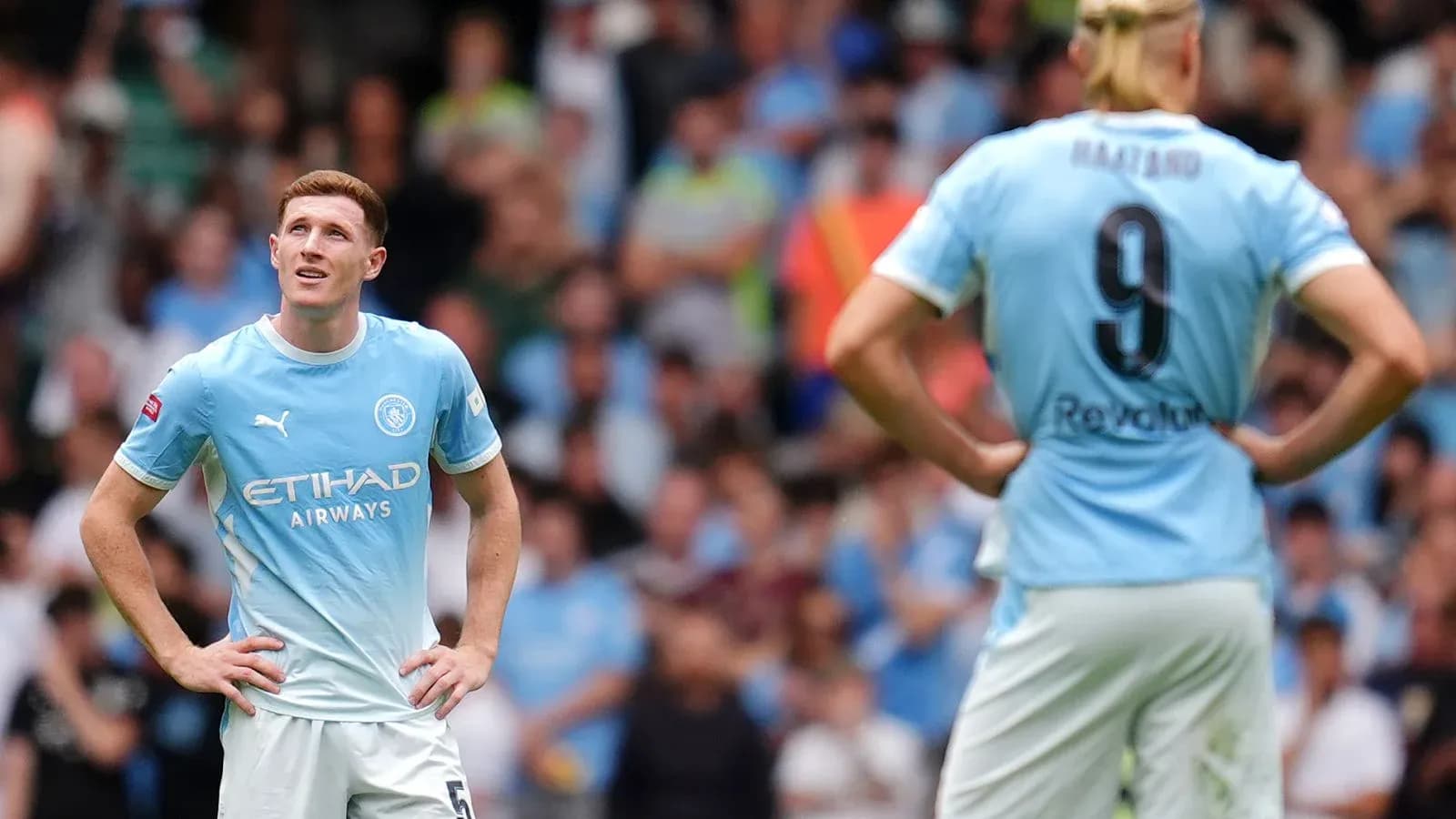
Some mitigation exists. Nico O’Reilly, Elliot Anderson and Haaland had only just returned from post-World Cup breaks. None of the trio looked sharp. None truly influenced the game. Their performances came with obvious caveats and will not top Maresca’s list of concerns.
The bigger issue lay in the way City’s units operated – or rather, didn’t.
The team looked stretched and disjointed, lines of play broken, players acting as individuals rather than as a coordinated machine. That played straight into Arsenal’s hands.
Maresca’s use of Mateo Kovacic as the central rotator failed to convince. O’Reilly’s movements into midfield, intended to help form the 3-2 build-up shape the Italian prefers, rarely brought control. Instead, they opened doors.
Every time O’Reilly stepped inside, he left acres of grass behind him. Noni Madueke repeatedly sprinted into that space, dragging the game into chaos. At one point, Ben White was effectively operating as a winger, such was the freedom Arsenal enjoyed down that flank.
O’Reilly is a gifted 21-year-old with the tools to become an effective de facto central midfielder. But on this stage, against Arsenal’s seasoned enforcers, he was overrun. This is not Bernardo Silva. This is not Rodri. Expecting him to replicate their influence at this stage of his development is fantasy.
High line, soft press, big trouble
The warning signs were not new. Maresca attracted criticism at Chelsea for a high defensive line married to a passive press. That combination is lethal in the worst way in the Premier League.
It surfaced again here.
When Arsenal committed numbers and attacked with intent, City’s defence stayed perilously high yet strangely unengaged. No one stepped out. No one snapped into a duel. They simply retreated in a straight line, inviting the inevitable.
Martin Odegaard did not need a second invitation. Gifted time and space, he picked his head up, measured his cross, and found Christos Tzolis, who cushioned the ball into the path of Kai Havertz. A simple finish, a simple goal. Child’s play at this level.
It was the kind of sequence that makes coaches wince in the video room. A defensive line begging to be exploited, a midfield that never arrived, a press that was more suggestion than reality.
Maresca cannot say he has not been warned by history.
A midfield stripped bare
The work ahead before the 1 September deadline is obvious. City’s midfield, once the most imposing in Europe, suddenly looks flimsy.
Enzo Fernandez remains a live target. He divides opinion – loudly. Sections of his own fans booed him at the weekend. He carries baggage. But he also carries qualities this City midfield sorely lacks: goals, guile, and fight.
Fernandez thrived under Maresca at Chelsea. The relationship works. He is combative, occasionally to his detriment, but City badly need some edge in the centre of the pitch. Against Arsenal, they were so light in there that Mikel Arteta’s side enjoyed near total control.
He is not a Rodri replacement. No one is. But he is a presence, and right now presence is exactly what City are missing.
The problem does not stop there. Tijjani Reijnders is set to move on, stripping out yet another option and loading responsibility onto young shoulders.
Elliot Anderson is only 23. Ayyoub Bouaddi, a key target, is just 18. Kovacic is 32 and the wrong side of his peak. Somewhere in that blend, the balance has gone missing.
Time, but not much of it
Some of this will ease with rhythm. It was game one. A glorified curtain-raiser, not a title decider.
Haaland will sharpen. Anderson will grow into the role of anchoring midfield with more minutes and guidance. The back four, which looked misshapen and uncertain, should tighten up with time on the training ground and a clearer grasp of pressing distances in Maresca’s structure.
And City will not face Arsenal every week.
But that is exactly the point gnawing at Maresca. Arsenal are the benchmark he talked about. On this evidence, the gap he wants to close is stretching.
The Italian now has three and a half months to ponder, tweak, and recruit before the sides meet again in late November. By then, City must look like a team that understands his demands, not one exposed by them.
There is a sliver of comfort in the timing. Better to have the brutal truths laid bare in August, with room to react, than in the thick of a title race. The performance was a jolt, but also a roadmap of what must change.
The window is open. The flaws are obvious. The clock is ticking.
Maresca asked to close the gap. Now he has to prove he knows how.
Related News
Transfer Rumors: Haaland’s Two Options; Real Madrid Targets $100 Million Premier League Star
Manchester United Targets Premier League Forward to Strengthen Attack

Liverpool Eyes 17-Year-Old Mexican Midfielder Gilberto Mora for Summer Transfer
Summer 2026 Transfer Window: Manchester United and Tottenham Struggle with New Signings
Liverpool Maintain Interest in Real Madrid Midfielder Amid Transfer Challenges

Transfer Insider Warns Tottenham About Costly Sale of Will Lankshear