
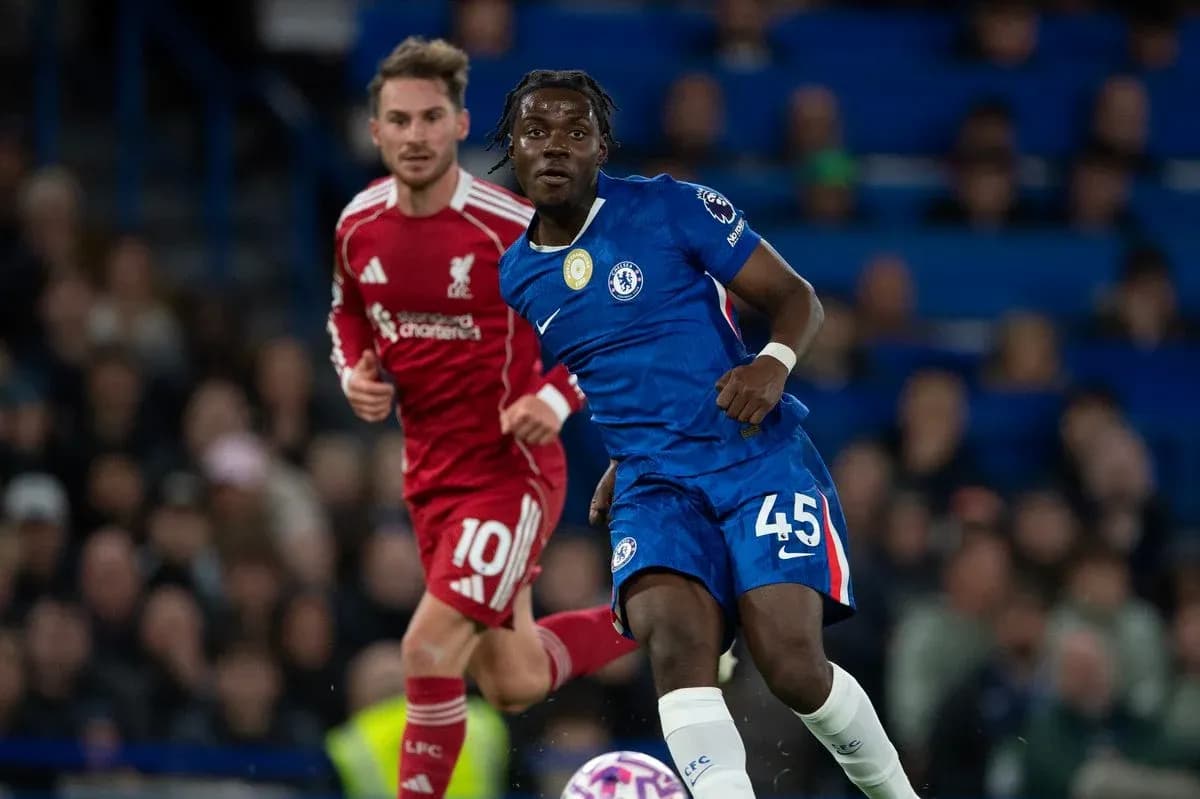
Liverpool and Chelsea Share Tactical Draw in Premier League
Liverpool and Chelsea shared a 1–1 draw at Anfield in Premier League Round 36, a match that quickly settled into a tactical arm-wrestle rather than a chance-laden shootout. Ryan Gravenberch’s sixth-minute opener, created by Rio Ngumoha, was balanced by Enzo Fernández’s equaliser on 35 minutes, and from there both sides largely neutralised each other. With Liverpool edging shots (8–6) but Chelsea shading possession (52–48), the contest became a test of structure, pressing triggers and in-game adjustments rather than individual brilliance, framed by a late spike in disciplinary tension.
Scoring Sequence
The scoring sequence was straightforward but tactically revealing. At 6', Liverpool exploited early verticality: Ryan Gravenberch arrived from midfield to finish after Rio Ngumoha’s involvement, signalling Arne Slot’s intent to push his central midfielders into advanced half-spaces. Chelsea responded by stabilising their double pivot and, on 35', Enzo Fernández struck to make it 1–1, punishing Liverpool’s inability to fully control central second balls despite their early lead.
Key Incidents
The key non-goal incident came at 50', when Cole Palmer had a strike cancelled by VAR for Chelsea. That moment encapsulated Chelsea’s improved attacking structure after the break, but also Liverpool’s narrow escape at a time when their block was being stretched.
From 63' onwards, the pattern was shaped by substitutions and discipline. At 63', Andrey Santos (OUT) was replaced as Reece James (IN) came on for Chelsea, adding width and crossing threat from right-back. At 67', Liverpool adjusted their front line as Rio Ngumoha (OUT) made way for Alexander Isak (IN), moving towards a more orthodox focal point.
Disciplinary Phase
The disciplinary phase then escalated:
- 67' Jorrel Hato (Chelsea) — Foul
- 73' Enzo Fernández (Chelsea) — Foul
- 83' Marc Cucurella (Chelsea) — Foul
- 88' Joe Gomez (Liverpool) — Argument
- 89' Moisés Caicedo (Chelsea) — Handball
- 90+4' Alexis Mac Allister (Liverpool) — Persistent fouling
Further Liverpool changes at 77' reshaped their defensive line: Cody Gakpo (OUT) was replaced as Federico Chiesa (IN) came on, and Ibrahima Konaté (OUT) was replaced as Joe Gomez (IN) entered, giving Liverpool fresh legs at centre-back and a more direct threat from Chiesa on the flank.
Goalkeeper Performances
In goal, both keepers had relatively controlled afternoons. Giorgi Mamardashvili made 2 saves for Liverpool; Filip Jørgensen matched him with 2 saves for Chelsea. With Liverpool’s expected goals at 0.56 and Chelsea’s at 0.50, the 1–1 scoreline actually slightly over-performed the underlying shot quality for both sides, underscoring how few truly high-value chances were created. Notably, both keepers show the same negative “goals prevented” value (-0.49), suggesting that each conceded slightly more than a model would expect from the shots faced, rather than producing standout shot-stopping heroics.
Team Structures
Structurally, Liverpool’s starting shape used Curtis Jones nominally as a defender but functionally as a flexible outlet, with Virgil van Dijk and Ibrahima Konaté as the core of the back line and Miloš Kerkez giving width on the left. Jeremie Frimpong’s listing as a midfielder reflected Slot’s preference for an aggressive wing-back/winger hybrid on the right, tasked with stretching Chelsea’s left side and pinning Marc Cucurella deeper.
In midfield, Alexis Mac Allister and Ryan Gravenberch formed the technical hub. Mac Allister’s late booking for “Persistent fouling” at 90+4' highlighted the workload he carried in counter-pressing and disruption as Liverpool tried to regain control in the closing stages. Gravenberch’s early goal underlined his licence to break beyond Dominik Szoboszlai, who operated between the lines, and ahead of a young, mobile link like Rio Ngumoha. Cody Gakpo led the line initially, but the introduction of Alexander Isak and Federico Chiesa in the 67'–77' window signalled a shift towards more direct running in behind and one-v-one threat, as Liverpool sought to tilt a marginal contest.
Chelsea, under Calum McFarlane, leaned into a more controlled possession game, reflected in their 52% of the ball and superior passing numbers (515 total passes, 446 accurate, 87% completion). The back four of Malo Gusto, Wesley Fofana, Levi Colwill and Jorrel Hato was built to circulate under pressure, with Hato’s yellow card for “Foul” at 67' coming as he was drawn into a duel after Liverpool tried to transition quickly.
The midfield triangle of Andrey Santos, Moisés Caicedo and Enzo Fernández was key. Caicedo’s late “Handball” yellow at 89' came as Chelsea pushed for territorial gains, while Fernández’s goal and subsequent “Foul” booking at 73' reflected his dual role as both creator and aggressive presser. Cole Palmer operated as the primary advanced playmaker, his disallowed goal at 50' emblematic of Chelsea’s second-half territorial improvement. Joao Pedro provided the forward reference point, with Cucurella listed as a midfielder, often tucking inside to help Chelsea overload central zones; his 83' yellow for “Foul” highlighted the strain of dealing with Liverpool’s right-sided rotations.
Statistics
Statistically, the game was remarkably even. Liverpool: 8 total shots, 3 on target, 5 corners, 48% possession, 473 passes at 84% accuracy, xG 0.56. Chelsea: 6 shots, 3 on target, 2 corners, 52% possession, 515 passes at 87% accuracy, xG 0.50. Both sides committed 17 fouls, but the card profile tilted towards Chelsea: 4 yellows to Liverpool’s 2. That asymmetry aligns with Chelsea’s slightly more aggressive defensive interventions as they tried to protect their point while still pushing for a winner.
Overall Analysis
Overall, Liverpool’s Overall Form in this match can be read as structurally sound but lacking final-third incision, while their Defensive Index remains stable, allowing just 6 shots and an xG of 0.50. Chelsea’s Overall Form shows a team comfortable in controlled possession with a marginally higher technical ceiling in build-up, but similarly short of cutting edge. Given the xG, shot volume and identical goalkeeper save counts, a 1–1 draw at Anfield is a statistically and tactically coherent outcome, with the late disciplinary flare-ups more a reflection of competitive tension than systemic breakdown.
Related News
Tottenham vs Aston Villa Predicted Lineups: Team News for Premier League Clash
Brighton vs Arsenal: Premier League Clash Preview
Manchester City vs Sunderland: Premier League Clash Preview
Tottenham vs Aston Villa: Early Relegation Battle
Brentford vs Chelsea Predicted Lineups: Team News and Match Insights
Brighton vs Arsenal Prediction: Key Stats and Betting Tips