
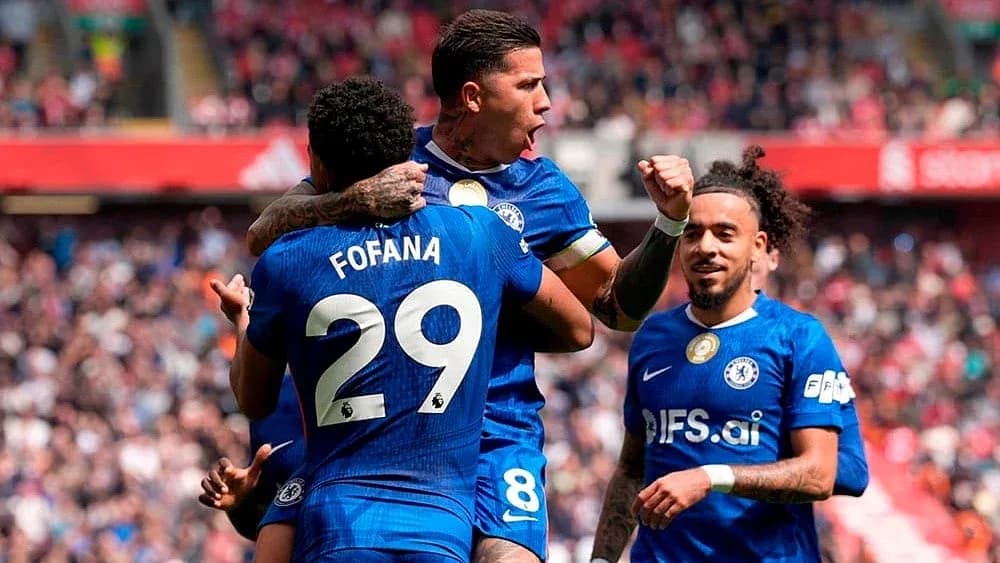
Liverpool and Chelsea Draw 1-1: Tactical Insights from Anfield
Anfield under grey Merseyside skies, Craig Pawson’s whistle cutting through the noise, and by the end of 90 minutes Liverpool and Chelsea were locked at 1-1. Following this result, the table tells its own story: Liverpool sit 4th with 59 points and a goal difference of 12 (60 scored, 48 conceded), Chelsea 9th with 49 points and a goal difference of 6 (55 scored, 49 conceded). It was a draw that felt less like a stalemate and more like a tactical arm wrestle between two evolving sides.
I. The Big Picture – Two Projects, One Stalemate
Liverpool came into the day with a clear home identity. At Anfield this season they have played 18 league games, winning 10, drawing 5 and losing just 3, with 33 goals for and 19 against. That translates to 1.8 goals scored at home on average and 1.1 conceded – the profile of a side that usually bends visitors to its will.
Chelsea, by contrast, have been a paradox on their travels: 18 away games, 7 wins, 5 draws, 6 defeats, scoring 31 and conceding 25. An away average of 1.7 goals scored and 1.4 conceded hints at volatility – capable of cutting loose, but rarely watertight.
The 1-1 at Anfield, then, was a meeting in the middle. Liverpool’s attacking edge at home was blunted, Chelsea’s habit of open, high-scoring away games was tempered. Tactically, it was a night where both coaches’ structures held just enough to avoid collapse, but not enough to claim supremacy.
II. Tactical Voids – Who Was Missing, and What That Meant
The team sheets told a story of absences that shaped the contest. For Liverpool, the spine of a previous era was stripped away. Alisson’s muscle injury meant Giorgi Mamardashvili started in goal, altering Liverpool’s build-up rhythm and long distribution patterns. Further upfield, the absence of Mohamed Salah (thigh injury) and Florian Wirtz (illness) robbed Arne Slot of his two most natural final-third problem-solvers – the league’s 7-assist wide talisman and a creative fulcrum who would normally live between the lines.
Also missing were Wataru Endo (foot injury) and Hugo Ekitike (Achilles tendon injury), the latter having scored 11 league goals overall this season. Without Ekitike, Liverpool’s central reference point in the box was gone, forcing Cody Gakpo to carry an even broader attacking load.
Chelsea’s list was equally disruptive. Robert Sánchez (concussion) was unavailable, so Filip Jørgensen took the gloves. Mykhailo Mudryk was suspended, removing one of Chelsea’s purest depth and chaos runners. J. Derry (concussion), J. Gittens (muscle injury), A. Garnacho and P. Neto (both inactive) further trimmed the attacking and rotation options. That left Calum McFarlane leaning heavily on João Pedro as both top scorer and creative outlet.
Disciplinary trends from the season framed the underlying risk. Liverpool’s yellow cards cluster late: 31.48% of their bookings come between 76-90 minutes, with another 16.67% in 91-105. Chelsea mirror that late-game edge, with 23.60% of their yellows in 76-90 and 14.61% in 91-105. Both sides, in other words, habitually walk the disciplinary tightrope in the closing stretch. This time, neither imploded, but the tempo of the final quarter was always likely to be spiky.
III. Key Matchups – Hunter vs Shield, and the Engine Room
Hunter vs Shield
The headline duel was João Pedro against Liverpool’s defensive structure. Across the campaign he has 15 goals and 5 assists, with 50 shots (28 on target) and 29 key passes. He is not just Chelsea’s finisher; he is their attacking axis.
He ran into a Liverpool back line anchored by Virgil van Dijk and Ibrahima Konaté, protecting a defence that, overall, concedes 1.3 goals per game and at home just 1.1. With Liverpool’s season-long shape often a 4-2-3-1 (used 32 times), Van Dijk and Konaté are asked to hold a relatively high line while full-backs and advanced midfielders push on.
João Pedro thrives when he can receive between lines and spin into the channels. Van Dijk’s positioning and Konaté’s recovery pace limited the truly clean looks he usually engineers, forcing him to play more with his back to goal and link rather than constantly attack space. The result was a muted version of Chelsea’s usual away cutting edge – the “hunter” contained, if not silenced.
At the other end, Gakpo – with 7 goals and 5 assists overall, plus 50 key passes – was Liverpool’s primary attacking reference in Salah and Ekitike’s absence. He faced a Chelsea defence that, on their travels, concedes 1.4 goals per game. Levi Colwill and Wesley Fofana had to hold a relatively aggressive line behind a midfield that is not shy about stepping up to press.
The Engine Room
In midfield, the duel that set the game’s rhythm was Dominik Szoboszlai and Alexis Mac Allister against Moisés Caicedo and Enzo Fernández.
Szoboszlai’s season numbers are those of a true conductor: 6 goals, 5 assists, 2,090 completed passes with 68 key passes, 52 tackles and 8 blocked shots. He has also walked the edge of discipline with 8 yellows and 1 red, and he has missed a penalty this season – a reminder that his high-impact role comes with risk.
Mac Allister’s presence alongside him offered control and progression, but they were up against one of the league’s most disruptive double pivots. Caicedo, with 87 tackles, 56 interceptions and 14 successful blocks, is a one-man pressing trap, albeit one who lives on the disciplinary line: 11 yellow cards and 1 red. Enzo adds 9 goals, 3 assists and 65 key passes, blending line-breaking passes with a willingness to step into advanced pockets.
For long spells, Caicedo and Enzo managed to compress Liverpool’s central lanes, forcing Slot’s side to funnel attacks through Jeremie Frimpong’s wide surges and Curtis Jones’ underlaps. But Chelsea’s aggression came at a cost: their season card profile shows consistent bookings across all phases, with notable spikes between 61-75 (21.35% of yellows) and 76-90 (23.60%). As fatigue set in, spaces began to appear around the edges of their block, allowing Szoboszlai to step into shooting positions and Gakpo to receive on the half-turn.
IV. Statistical Prognosis – A Draw that Fits the Numbers
From a season-long lens, the 1-1 feels statistically coherent. Liverpool’s overall attack produces 1.7 goals per game, Chelsea’s defence concedes 1.4 away. Chelsea’s away attack averages 1.7, Liverpool’s home defence 1.1. Overlay those profiles and you land in the territory of a tight, marginal game where both sides are more likely than not to score, but neither is likely to run away with it.
Liverpool’s clean-sheet record – 5 at home and 10 overall – speaks to a side that usually finds a way to shut the door at Anfield. Chelsea’s 4 away clean sheets and 9 overall show they can dig in, but not habitually. In that context, each side finding the net once, then leaning on their structures to see the game out, aligns with the underlying probabilities.
xG data is not provided in the raw feed, but if we project from season tendencies, a balanced xG share feels plausible: Liverpool’s home chance creation, shorn of Salah and Ekitike, versus Chelsea’s away threat concentrated heavily through João Pedro and Enzo. Both teams’ penalty records also hint at underlying discipline in the box: Liverpool have taken just 1 penalty overall, scoring it, while Chelsea have had 7, scoring all 7. Neither side is reckless in their own area, which again supports a narrative of chances coming more from open play combinations than from spot-kick chaos.
In the end, this was a match defined less by individual brilliance and more by the scaffolding around it. Liverpool, with their 4-2-3-1 DNA and fortress-like home record, met a Chelsea side whose away profile is that of a dangerous but imperfect traveller. The 1-1 at Anfield felt like a snapshot of where both projects stand: coherent, competitive, but still searching for the extra layer of ruthlessness that turns tight games into defining wins.
Related News
Bournemouth vs Liverpool Prediction: Key Stats and Betting Tips
Tottenham vs Aston Villa Predicted Lineups: Team News for Premier League Clash
Brighton vs Arsenal: Premier League Clash Preview
Manchester City vs Sunderland: Premier League Clash Preview
Tottenham vs Aston Villa: Early Relegation Battle

Brentford vs Chelsea Predicted Lineups: Team News and Match Insights