
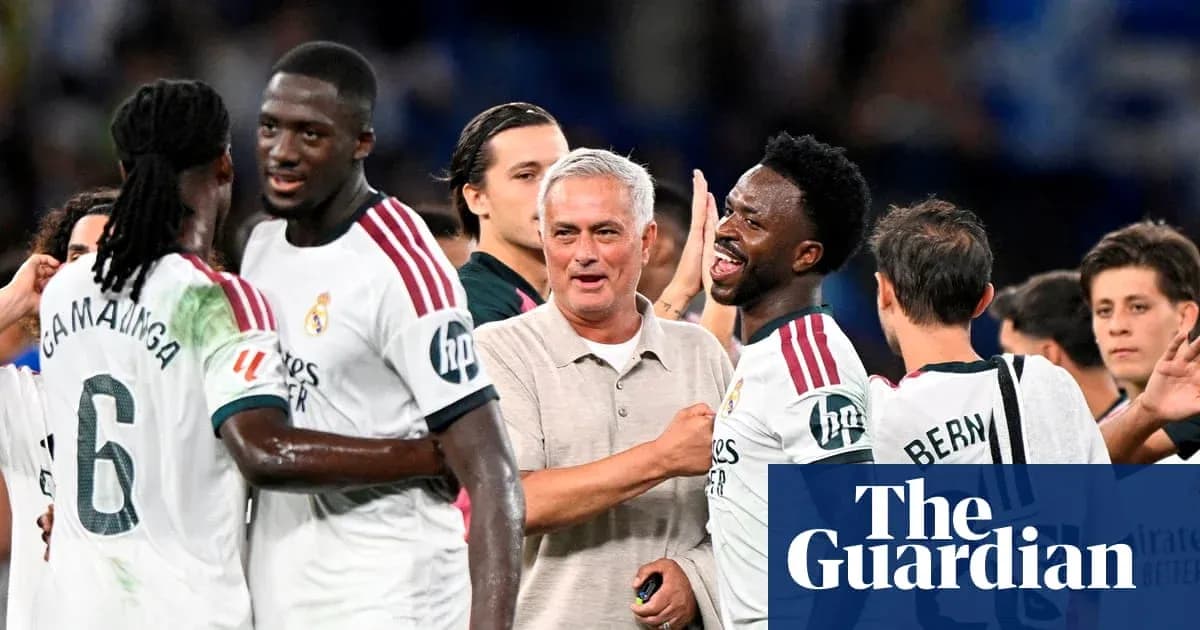
José Mourinho's Second Debut: A 2-1 Win at Espanyol
José Mourinho stayed put.
As the Real Madrid bench exploded past him, substitutes and staff sprinting towards the corner flag where Carlos Espí had just bundled in a 90th‑minute winner, the new coach did not join the charge. He rose slowly, fists clenched, and walked the touchline behind them, eyes fixed on the scrum of white shirts. On the way, he dragged his captain Fede Valverde over for a quick word. It might as well have been: “We got away with that.”
Four thousand three hundred and eighty days since his last league game in charge of Madrid, Mourinho’s second debut ended with a late, scruffy, desperately needed 2-1 win at Espanyol. For all the talk of galácticos, of how he would mesh Kylian Mbappé, Vinícius Júnior and Jude Bellingham, for all the money thrown at Yan Diomande, it was a 21-year-old signed quietly from Levante six months ago who decided it.
Carlos Espí was bought to be a throwback. An old-school No 9. Penalty-box weight. Chaos in crowded spaces. His goals had kept Levante up last season; now he is living at Valdebebas, sharing breakfast with Mourinho and trying to elbow his way into a squad of superstars. This was the assignment: different profile, different threat, something to throw at a packed defence when the patterns dry up.
And when a messy move broke down in the area, when Mbappé lost control and the ball squirmed loose, there Espí was – close enough, aggressive enough – to ram it over the line. A poacher’s finish. A big question too: is this just the Plan B, or is this a type of striker Madrid have been missing for years?
The night had started with the cameras on Mourinho, not his forwards. Photographers abandoned their usual spots behind the goals and swarmed around the visiting bench as he took his seat. His last league game for Madrid had been a 4-2 win over Osasuna in May 2013. This return began with the same noise, the same sense of theatre. It did not, though, bring instant perfection.
By the time he hugged Espanyol coach Manolo González, high‑fived the referee and ducked into the tunnel at full time, the reality of his task had been laid bare. Madrid had more chances, more of the ball, more names on the teamsheet – but Espanyol were organised, stubborn and dangerous. Mourinho had warned they were a good side. At times, they looked better than that.
There were familiar flaws. The lapses in intensity. The vulnerability when the press drops half a yard. The moments when the front three tread on each other’s toes. It is the first match, yes, but the doubts that haunted last season have not vanished overnight. They were simply pushed back 90 minutes by Espí’s finish and the sense that, for now, the story would be written as a late escape, not an early crisis.
Mourinho arrived framing his return against his own past. When Madrid met Benfica in the spring, he described his previous spell here as “three hard, intense, sometimes violent years”. Time has sanded down the edges. The fights, the fractures, the daily battles with everything and everyone recede; the trophies and the defiance remain.
He insists he is “not the kind of man who misses anything”, that he is not driven by regret. Others, though, had missed him. Florentino Pérez more than anyone. In the president’s worldview, coaches tend to be disposable, a necessary evil between signings. Mourinho is the exception, the one manager he truly embraced.
There is a part of Pérez that never stopped believing Madrid’s avalanche of silver – six Champions Leagues in 11 years after Mourinho’s departure – still had his fingerprints on it. That he had set the standards, changed the culture, shown the way. Mourinho told a story before this game: after every trophy, Pérez would call him. He always replied that it was nothing to do with him. Which, of course, was a neat way of saying it was a little bit to do with him.
It took 13 years for Pérez to act on that instinct and bring him back. The logic is simple enough. The last men to return – Zinedine Zidane and Carlo Ancelotti – delivered. The others didn’t. Madrid have gone two seasons without a major title. Barcelona have stepped ahead. The diagnosis, inside the club at least, is not just tactical. It is cultural.
Mourinho went straight to that point. “We have to try not to negotiate things that are non-negotiable,” he said. “Commitment can’t be missing.” Effort, intensity, standards: the old staples. He has the authority to demand them, or so the theory goes. Sessions have been sharper, the response more serious. Yan Diomande even said he was ready to “die” for his coach. Mourinho laughed it off as just a phrase, but he enjoyed hearing it.
There are other reasons for optimism. Vinícius’s future is finally settled, his status clarified, the friction around his role eased. The World Cup is gone, no international distraction looming over this season. And yet the biggest tactical puzzle sits in front of him every day: how to get the best from Vinícius, Mbappé and Bellingham at the same time.
Brazil, France and England have found ways to maximise each individually. Madrid struggled to do it collectively last season. Bellingham has admitted they often occupy the same spaces. Mourinho, though, dismissed any idea of incompatibility. “I don’t think they’re incompatible,” he said. On this evidence, the chemistry will take time.
All three started. Bellingham operated as a classic No 10, high between the lines. Vinícius hugged the left touchline, where he is at his most dangerous. “For me this is his [Jude’s] position,” Mourinho said. “The connection with the forwards, he can score goals. He has to play close to the goal. Playing at 6 or 8 we’re losing his closeness to the goal.”
Within nine minutes, that looked like a masterstroke. Vinícius, already being chopped down – Alex Calatrava had left one in his back early, drawing Mourinho’s first furious gesture of the season – won a free-kick on the left. Arda Guler, all silk and whip, delivered a superb cross. Bellingham climbed highest and buried his header past Marko Dmitrovic. The first goal of the new era, from the man Mourinho wants closest to the box.
Mourinho barely reacted. Sat at the far end of the bench, he rose, slid his hands into his pockets and wandered down the touchline to where the overflow of his staff sat in the stand. He shook hands with Sami Khedira, his in‑house assistant, and analyst Roberto Merella. Businesslike. Almost cold.
For a while, it looked like that might be that. Madrid pressed high, Espanyol struggled to escape. The gap in talent felt too big. This, they might have thought, was the template: front-foot, aggressive, suffocating.
Then the intensity sagged.
When Dean Huijsen went off briefly to have a cut treated, Madrid’s players drifted over to Mourinho for instructions. The game, though, drifted away from them. Espanyol stepped 10 metres higher and refused to go back. The equaliser felt like a consequence, not a shock.
Thibaut Courtois saved first from Riedel, but Roberto Fernández could not keep his follow-up down. Espanyol worked the ball again, this time beautifully. Tuy Dolan combined with Javi Hernández, Calatrava arrived and finished. Mourinho sat almost still, as if storing it up.
Madrid still carried a threat. Mbappé twice burst clear, once on each flank, forcing Dmitrovic into sharp stops. Yet Espanyol should have led at the break. Omar El Hilali bent in a superb cross from the right, Dolan stretched but could not quite reach it inside the six-yard box, and Fernández somehow headed the loose ball against his own feet instead of into the net.
The second half opened with another flurry from Madrid and another big miss. From a Guler corner, Bellingham powered a header against the bar via Dmitrovic’s hand. The rebound dropped perfectly for Mbappé at the back post. He was almost on the line. Somehow, he steered it wide.
Valverde hit the post. Mbappé flashed one past the far upright. The clock ticked. The old Bernabéu murmur was missing, but the feeling was the same: dominance without ruthlessness. Mourinho turned to his bench and started throwing on names – Marc Cucurella, Diomande, Eduardo Camavinga, Trent Alexander-Arnold, Espí.
And then, finally, the goal.
Mbappé tried to wriggle through a crowd, the ball broke loose, and Espí reacted faster than anyone. One jab, one swing of a right boot, and the net rippled. The bench emptied. Mourinho stayed measured, walking, watching, plotting.
Afterwards, he allowed himself a hint of humility. “I think we deserved to win, but Espanyol didn’t deserve to lose,” he said.
The scoreline says his second reign at Madrid begins with three points. The performance says the hard, intense years he once spoke of might be coming again. The only question now is whether this time the violence stays on the pitch.
Related News
Transfer Rumors: Haaland’s Two Options; Real Madrid Targets $100 Million Premier League Star
Manchester United Targets Premier League Forward to Strengthen Attack
Liverpool Eyes 17-Year-Old Mexican Midfielder Gilberto Mora for Summer Transfer
Summer 2026 Transfer Window: Manchester United and Tottenham Struggle with New Signings
Liverpool Maintain Interest in Real Madrid Midfielder Amid Transfer Challenges
Transfer Insider Warns Tottenham About Costly Sale of Will Lankshear