
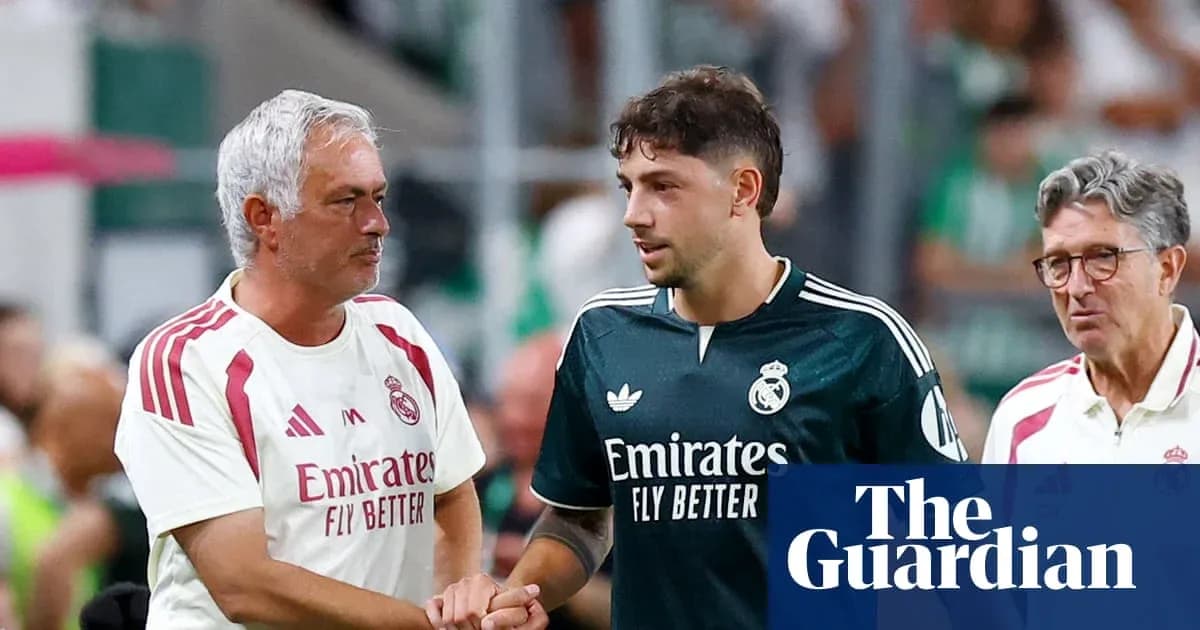
José Mourinho Returns to Real Madrid: A New Era Begins
José Mourinho walks back into Real Madrid with the same mission and a very different world around him.
The last time he took this job, in 2010, Spain had just been crowned world champions, Andrés Iniesta had settled a brutal World Cup final, and Barcelona were the all-conquering reference point. They still are the benchmark in La Liga, chasing a third straight title. Once again, Mourinho is the man hired to knock them off their perch. Once again, he inherits a squad stuffed with star power.
Some pillars from that first era are still standing. Chief among them: Florentino Pérez. If José Ángel Sánchez was widely credited with driving the Xabi Alonso appointment last summer, this time the 79-year-old president has taken full ownership. He effectively ran on a Mourinho ticket, promising the Portuguese coach’s return if he won June’s snap elections. Victory at the polls was followed by a classic Pérez flourish: the announcement dropped on the opening day of the World Cup.
Not everyone at the club sees this as a simple rewind. Jorge Valdano, who worked upstairs during Mourinho’s first spell, framed it bluntly to A Bola: almost 15 years have passed, football has shifted, society has changed, Florentino is different, and so, inevitably, is Mourinho.
Yet when Madrid’s season collapsed into anarchy last year, there was only one profile that truly appealed: the disciplinarian, the man of order. After Alonso’s sacking in January, Álvaro Arbeloa could not halt the slide. The dressing room spilled into public view. In May, Federico Valverde ended up in hospital needing stitches after a clash with Aurélien Tchouaméni. Days later, Madrid surrendered the league in the clásico and stumbled to a trophyless finish. Online, an extraordinary petition demanding Kylian Mbappé’s departure surged to 30 million signatures. Vinícius Júnior, with a year left on his deal, lived in a fog of speculation.
The chaos forced Pérez’s hand. Stability had to be bought.
The summer has not been flawless. A £129m bid for Julián Álvarez was rejected by Atlético Madrid. Barcelona are pushing harder to prise Rodri from Manchester City. Yet around Valdebebas there is a new stillness. Mourinho started work a month before his contract officially kicked in. There has been no grand unveiling, no theatrical press conference. Just a short, stern in-house interview: “It’s not about working at Real Madrid, it is working for Real Madrid.” The slogans and soundbites are largely parked in his Netflix documentary. Pre-season has been stripped back to low-key friendlies across Europe, not a circus tour.
One decision above all has reshaped the mood. Vinícius has signed a new six-year contract. Madrid called him “one of the most important players in one of the most successful periods in our history”. That is the cornerstone. Around it, Mourinho must construct a system that balances Vinícius, Mbappé and Jude Bellingham, and finds room for the newest galáctico: Yan Diomandé, a £115m winger who, astonishingly, was turning out for Leganés B in Spain’s fifth tier only last year.
Diomandé’s story already has Bernabéu threads running through it. He made his Leganés first-team debut there in March 2025. “Who makes their debut at 18 against Real Madrid? It was a dream. And then it was a nightmare,” he wrote in the Players’ Tribune this summer, while lighting up the World Cup for Côte d’Ivoire. The piece, raw and painful, was dedicated to his sister Roxane, who died aged 15 after her drink was spiked at a party, weeks after his La Liga debut. That grief now travels with him into the white shirt.
Down the left, Diomandé and Vinícius will have Marc Cucurella charging up behind them. The former Chelsea defender is one of several signings seemingly built for Mourinho’s touch: Bernardo Silva, Ibrahima Konaté, Denzel Dumfries and the 6ft 4in striker Carlos Espí all look like players who can quickly slot into his structure.
Yet the biggest personality on the pitch will still be the one in the technical area.
Mourinho’s return to the Bernabéu is one of the most unlikely comebacks of recent years. His late Premier League stints frayed, his European tour produced mixed returns, and his aura dimmed. Then came Benfica’s astonishing Champions League escape against Madrid last season, crowned by goalkeeper Anatoliy Trubin’s late goal. It yanked him back into the spotlight.
The glow did not last unblemished. After Vinícius accused Benfica’s Gianluca Prestianni of racist abuse, Mourinho’s subsequent comments drew heavy criticism. Kick It Out branded them “a form of gaslighting”. Uefa eventually banned Prestianni for “homophobic conduct”. Arbeloa’s verdict on his old boss was curt and familiar: “Mourinho is Mourinho.”
Any tension between coach and star forward has, for now, been buried. Back at Valdebebas for pre-season, Vinícius spoke of a smooth start. “It has gone very well, getting to know the new coach … Mourinho wants me to be as I have always been: happy, cheerful and playing my football.” No one around Madrid has suggested lingering bad blood.
La Liga Reunions
La Liga, too, has its own reunions to savour.
Racing Santander are back in the top flight for the first time since 2012 and have brought home a prodigal son. Sergio Canales, now 35, left Racing as a 19-year-old to join Mourinho’s Madrid in that summer of 2010. “I’m still struggling to believe this is real,” he admitted last month as he returned to El Sardinero. Deportivo and Málaga also resurface after years in the wilderness, both having sunk as low as the third tier since their last La Liga appearance in 2018. Deportivo’s marquee bet on experience is a 37-year-old Pierre-Emerick Aubameyang.
On the other side of the capital, Diego Simeone begins his 15th full season with Atlético Madrid and renews his old touchline rivalry with Mourinho in the derby. Atlético are adjusting to life after Antoine Griezmann. Their answer has been investment and symbolism: Lee Kang-in has arrived from Paris Saint-Germain and inherited Griezmann’s No 7 shirt.
Elsewhere, the league is dotted with familiar names in new chapters. Manuel Pellegrini, the man Mourinho once replaced at the Bernabéu, still steers Real Betis. Villarreal, the fifth Spanish club in this season’s Champions League, have turned to Iñigo Pérez after his eye-catching work at Rayo Vallecano.
In the Basque Country, Real Sociedad’s American coach Pellegrino Matarazzo is tasked with building on April’s Copa del Rey triumph. Across the divide at Athletic Club, the dugout has a German accent for the first time since Jupp Heynckes in 2003. Heynckes offered a simple piece of wisdom to Edin Terzic before he took the job: “Athletic is the only club where a handshake is more important than a signature.”
And yet, for all the noise around Madrid’s reset, the reigning force still wears blaugrana.
Barcelona start as favourites to retain the title. Robert Lewandowski has followed Griezmann’s path to Major League Soccer in the US, leaving a hole at centre-forward while Atlético dig in over Álvarez. On the flanks, the cast has shifted. Anthony Gordon replaces Marcus Rashford on the left, fighting for minutes with the fragile Raphinha. On the right, with respect to Karim Adeyemi, there is no genuine contest. That belongs to Lamine Yamal.
The teenager did not dominate the World Cup in the way many predicted, yet he returned from America as a world champion and, crucially, still only 19. He is expected to be the ringleader again if Hansi Flick is to emulate Pep Guardiola and deliver three straight league titles.
The calendar has already circled one date in red. The first clásico arrives at the Camp Nou at the end of October. Mourinho back on the touchline. Barcelona chasing history. Madrid chasing control.
La Liga, once again, feels like it is orbiting around that collision.
Related News
Transfer Rumors: Haaland’s Two Options; Real Madrid Targets $100 Million Premier League Star
Manchester United Targets Premier League Forward to Strengthen Attack
Liverpool Eyes 17-Year-Old Mexican Midfielder Gilberto Mora for Summer Transfer
Summer 2026 Transfer Window: Manchester United and Tottenham Struggle with New Signings
Liverpool Maintain Interest in Real Madrid Midfielder Amid Transfer Challenges
Transfer Insider Warns Tottenham About Costly Sale of Will Lankshear