
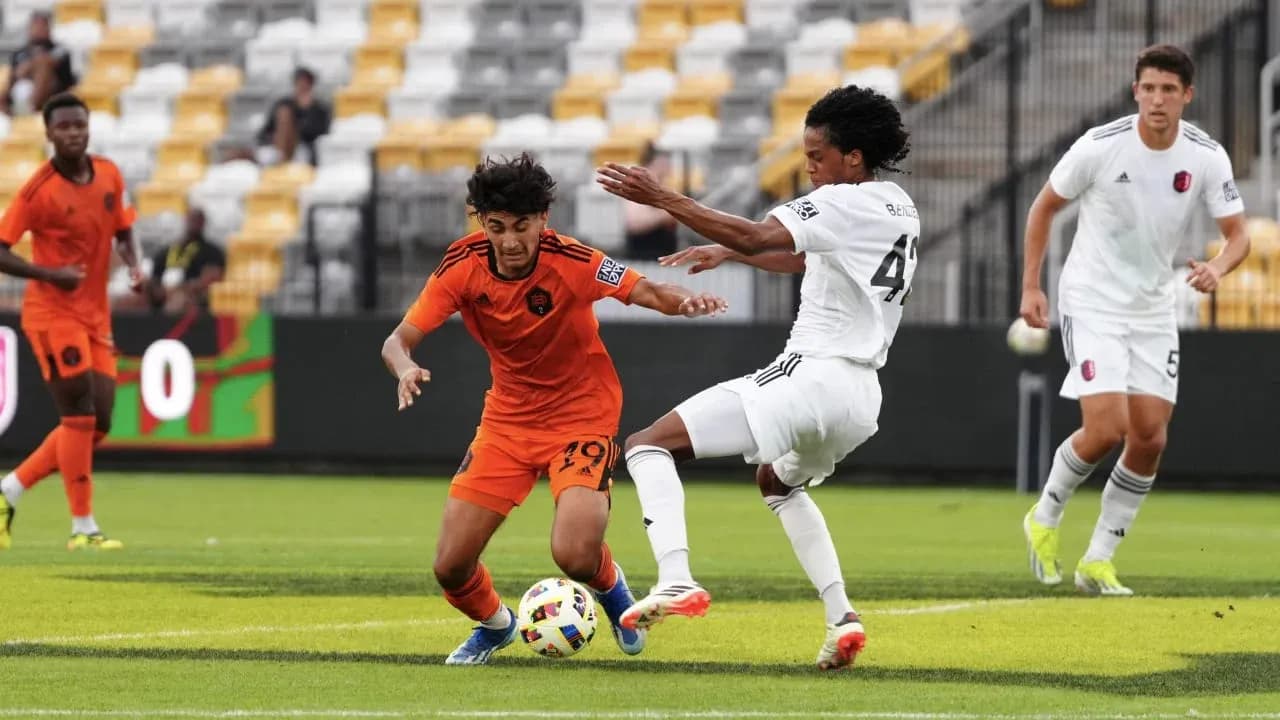
Houston Dynamo FC II Dominates St. Louis City II in MLS Next Pro Clash
On a cool night at CITYPARK, a meeting that looked like a measuring stick for two of MLS Next Pro’s sharpest projects became something more brutal: a statement. St. Louis City II, the league’s high-press darlings, were picked apart 4–1 by a Houston Dynamo FC II side that arrived as the only perfect team in the competition and left with their aura not just intact, but amplified.
Following this result, the table tells a story of separation at the summit. St. Louis City II sit on 23 points from 10 matches, ranked 2nd in both the Frontier Division and the Eastern Conference snapshot, with a total goal difference of +9 (21 goals for, 12 against in the standings; +10 if you track the broader statistics block at 23 for and 13 against). Houston, meanwhile, remain flawless: 9 wins from 9, 26 points, and a total goal difference of +20 (24 for, 4 against). If this was a group-stage clash with the feel of a future 1/8-final, Houston played it like a knockout: ruthless, controlled, and utterly convinced of their method.
I. The big picture: clash of attacking identities
Heading into this game, both sides were defined by attacking abundance. St. Louis City II had scored a total of 23 goals in 10 fixtures, with a home average of 2.7 goals for and 1.5 against. Their home record – 5 wins from 6 – had been built on front-foot football, with CITYPARK a venue where they usually overwhelm visitors early and ride momentum.
Houston Dynamo FC II arrived with an even sharper edge. Overall they had produced 25 goals in 9 matches, averaging 3.3 at home and 2.4 on their travels, while conceding just a total of 4 (0.0 at home, 0.8 away). Their total defensive record – four goals against across the entire campaign – framed them as the league’s most balanced unit: devastating in transition but underpinned by a disciplined block.
On the night, the first half at CITYPARK was open and relatively even on the scoreboard, locked at 1–1 at the interval. But the second half belonged entirely to the visitors, who added three unanswered goals to turn a contest between equals into a demonstration of tiers.
II. Tactical voids and discipline: where St. Louis cracked
Without explicit injury or suspension data, the tactical voids are revealed by how the XI functioned under pressure. St. Louis City II’s starting group – with L. McPartlin, S. Marion, Z. Lillington, K. Hiebert and R. Lynch forming the spine behind the ball – struggled once Houston raised the tempo after the break. The home season profile already hinted at a vulnerability: a home average of 1.5 goals conceded and biggest home defeat of 1–4. Houston simply reproduced that worst-case scenario.
Disciplinary trends deepened the problem. Heading into this game, St. Louis had shown a clear yellow-card spike between 46–60 minutes, with 31.58% of their total yellows in that window, and red cards split evenly between 46–60 and 61–75 minutes (50.00% each). That mid-game turbulence has tactical consequences: it often forces the coach to dial back the press or reshuffle lines under duress. Against an opponent as relentless as Houston, any hesitation is fatal.
Houston’s own card profile told a different story. Their yellows were more evenly distributed, but with pronounced late-game aggression: 22.73% of yellows in 61–75 and another 22.73% in 76–90. This is a side that stays in duels and maintains intensity deep into matches without crossing into red-card territory. That discipline underpins their ability to keep clean sheets – 5 in total, including 4 at home and 1 away – and to defend leads without unraveling.
III. Key matchups: hunter vs shield, engine vs enforcer
This fixture was less about individual stars – the data gives us no top scorers list – and more about unit matchups.
For St. Louis, the attacking trident of P. Ault, P. McDonald and A. Jundt embodied their vertical intent. Ault and McDonald, supported by the connective work of C. Pearson and T. Pearce, usually thrive on quick combinations and second-ball chaos. Their season numbers supported that identity: a total average of 2.3 goals for per game, and a biggest home win of 4–0. The “hunter” here was the system itself: collective pressing and layered runs rather than a single talisman.
Houston’s “shield” was formidable. With Pedro Cruz anchoring from goal and a back line featuring N. Betancourt, I. Mwakutuya, E. Hata and R. Miller, they came in with a total average of just 0.4 goals conceded per match. On their travels, they had allowed only 4 goals in 5 games while scoring 11. The way they absorbed St. Louis’s early thrusts, then suffocated space between the lines, matched that statistical steel.
In the engine room, Gustavo Dohmann and M. Arana were pivotal. Their task was to disrupt the rhythm of Pearson and Pearce, deny McDonald clean touches between lines, and feed the front trio of S. Mohammad, J. Bell and Arthur Sousa. The result – four away goals at a ground where the hosts had previously dominated – echoed Houston’s biggest away wins profile, which already included a 1–4 scoreline.
IV. Statistical prognosis and xG lens
We do not have explicit xG numbers, but the season metrics allow a reasoned reading. St. Louis, with a total average of 2.3 goals scored and 1.3 conceded, usually operate in high-xG environments at both ends: they create plenty, but open the door for opponents. Houston, with 2.8 goals for and 0.4 against on average, tend to generate strong attacking xG while suppressing opponent quality.
A 4–1 away win aligns neatly with those underlying patterns. Houston’s attack performing at or slightly above its away average (2.4) and St. Louis falling below their usual home output while matching their worst defensive scenarios fits a model where:
- Houston’s xG was likely substantial, driven by repeated transitions and high-quality chances.
- St. Louis’s xG probably clustered in the first half before being choked off as Houston’s structure tightened.
Following this result, the narrative hardens. St. Louis City II remain a dangerous, attack-minded contender with promotion ambitions – their total record of 8 wins from 10 still screams quality – but their ceiling may be defined by defensive volatility and mid-game discipline. Houston Dynamo FC II, by contrast, look every inch a 1/8-final favourite: a side whose numbers, structure and mentality all point in the same direction, and who have now gone to one of the league’s toughest venues and turned a top-of-the-table clash into a rout.
Related News

MLS Winners and Losers: Rising USMNT Star Cavan Sullivan, St. Louis City's Smart Moves, and Chicago Fire's Struggles Without Hugo Cuypers

MLS Highlights: Portland Timbers End Drought, Josh Sargent Shines, Cavan Sullivan Impresses
Tacoma Defiance vs Colorado Rapids II Stats: Head-to-Head Record

St. Louis City II vs Vancouver Whitecaps II: Head-to-Head Stats and Match Preview
Atlanta United II vs New York City II Stats: Head-to-Head Record
Houston Dynamo FC II vs Austin II Stats: Head-to-head Record